
Author: imToken
In the dynamic realm of Web3, the discourse around “cross-chain” and “interoperability” (often shortened to “Interop”) has consistently remained a central theme. While these terms are sometimes used interchangeably, their nuances are critical for understanding the future of decentralized networks.
To clarify, cross-chain initiatives primarily focus on asset movement, addressing the fundamental challenge of “transporting” digital value across different blockchains. Interoperability, however, extends far beyond mere asset transfer, encompassing the seamless “collaboration” of assets, states, services, and logic across diverse ecosystems.
As the modular blockchain narrative propels the proliferation and heterogeneity of Layer 1 (L1) and Layer 2 (L2) solutions, user bases and liquidity have become increasingly fragmented. In this evolving landscape, interoperability has emerged as the universally recognized ideal end-state. Imagine a future where users are oblivious to the underlying chain; they simply express an intent, and the system autonomously executes the operation within the most suitable environment.
The Ethereum Foundation (EF) recently unveiled its updated UX roadmap, signaling a renewed commitment to this vision. Coupled with ongoing engineering advancements in areas like withdrawal latency, message passing, and instant proofs, the intricate puzzle of true interoperability is steadily coming together.
What Exactly is “Interop”? Beyond the Bridge
At its core, “interoperability” transcends the simple function of an “asset bridge.” It represents a comprehensive suite of system-level capabilities designed to foster a truly unified blockchain experience.
This holistic vision entails several key components:
- Shared State & Proofs: Different chains can reliably share their states and cryptographic proofs.
- Cross-Chain Logic Execution: Smart contracts on one chain can seamlessly invoke logic or functions residing on another.
- Unified User Experience: Users interact with a single, cohesive interface, eliminating the need to constantly switch networks or perform repetitive authorizations.
- Equivalent Security Boundaries: All execution environments maintain comparable levels of trustworthiness and security.
Only when these capabilities are harmonized can users truly dedicate their attention to value-generating activities, unburdened by network complexities or liquidity fragmentation. This aligns perfectly with the ultimate goal of cross-chain engineering: empowering users to focus on the flow of value itself, rather than the technical barriers between chains.
The year 2024 has witnessed the modular blockchain narrative explode, giving rise to an ever-increasing number of specialized L1s and L2s. This fragmentation has pushed interoperability from an abstract protocol-level discussion into a tangible necessity for mass user experience and foundational application logic.
Whether through intent-centric execution architectures, cross-chain aggregators, or omnichain decentralized exchanges (DEXs), a singular objective drives innovation: liberating users and liquidity from the confines of the Ethereum mainnet. The aim is to enable one-stop asset swaps, liquidity provision, and strategic operations through a unified interface, eliminating the friction of frequent network switching.
Ultimately, the grand vision for interoperability is to abstract the blockchain entirely from the user’s perception. This paradigm shift allows DApps and project teams to revert to a user-centric product design, crafting intuitive, low-barrier environments that mirror the ease of Web2. In doing so, interoperability becomes the final hurdle cleared for mainstream users to seamlessly enter the Web3 world.
From a product standpoint, widespread adoption hinges not on making everyone understand blockchain technology, but on enabling them to use it effortlessly without needing to grasp its intricacies. Indeed, for Web3 to reach billions, interoperability is the foundational infrastructure for that “last mile.”
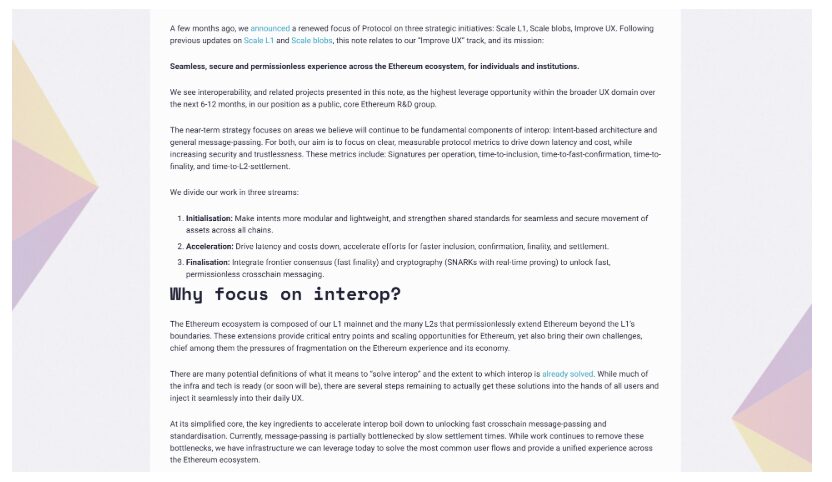
The Ethereum Foundation’s “Protocol Update 003 — Improve UX,” released on August 29th, underscored this direction. It reiterated the EF’s three strategic pillars post-reorganization: Scale L1 (mainnet scaling), Scale Blobs (data scaling), and Improve UX (enhancing user experience). Within the “Improve UX” mandate, interoperability stands as the undisputed core.
From “Cross-Chain” to “Interop”: The Ethereum Foundation’s Vision
The EF’s update firmly positions interoperability as central to achieving a seamless, secure, and permissionless Ethereum ecosystem. The core message is clear: while cross-chain asset transfers are a crucial first step, true interoperability lies in the collaborative exchange of data, state, and services across chains. Ethereum’s long-term ambition is for all Rollups and L2s to “appear as a single chain” to the end-user.
The EF acknowledges that while much of the foundational infrastructure and technology are either mature or nearing completion, significant engineering efforts are still required to integrate these solutions into everyday wallet and DApp experiences.
To this end, the EF has structured its “Improve UX / Interop” research and development into three parallel workstreams: Initialization, Acceleration, and Finalization.
1. Initialization: Standardizing Cross-Chain Interactions
This phase aims to establish interoperability’s starting point, making Ethereum’s cross-chain operations lighter and more standardized. Key objectives include making “Intents” more modular and lightweight, developing universal standards for cross-chain assets and operations, and providing interchangeable, composable interfaces for various execution layers.
Notable projects and standards under Initialization include:
- Open Intents Framework (OIF): A modular intent stack co-developed by EF in collaboration with industry leaders like Across, Arbitrum, Hyperlane, LI.FI, and OpenZeppelin. It supports flexible combinations of different trust models and security assumptions.
- Ethereum Interoperability Layer (EIL): Led by the ERC-4337 team, EIL is building a permissionless, censorship-resistant cross-L2 transaction transmission layer, designed to make multi-chain transactions feel as native as single-chain operations.
- New ERC Standards: A suite of new Ethereum Request for Comments (ERCs) is being developed, covering areas such as interoperable addresses (ERC-7828/7930), asset integration (ERC-7811), multi-calls (ERC-5792), and generic message interfaces for intents (ERC-7683/7786).
The direct goal here is to decouple “what the user wants to achieve” (declarative) from “how the system executes it” (procedural), enabling seamless collaboration among wallets, bridges, and verification backends under a unified semantic framework.
2. Acceleration: Real-Time Multi-Chain Interactions
The Acceleration phase focuses on reducing latency and costs, making multi-chain interactions feel instantaneous. This involves measurable improvements in metrics such as transaction signature counts, inclusion times, fast confirmations, and L2 settlement finality. Initiatives include:
- Faster L1 Confirmation Rules: Aiming to bring strong confirmations down to the 15-30 second range.
- Shortening L1 Slot Time: Research and engineering efforts to potentially reduce the L1 slot time from 12 seconds to 6 seconds.
- Optimized Withdrawal Mechanisms: Enhancements like faster withdrawal processing (e.g., from 12 days down to shorter periods) and the introduction of 2-of-3 fast settlement mechanisms for proofs.
These measures are foundational for enabling rapid cross-domain message passing and delivering a truly unified user experience.
3. Finalization: Exploring Second-Level Finality
The Finalization step integrates real-time SNARK proofs with faster L1 finality to explore interoperability models that achieve near-instantaneous, “second-level” finality. This ambitious long-term vision promises to redefine cross-domain issuance, bridging primitives, and the scope of cross-chain programmability.
From an objective standpoint, within the Ethereum ecosystem, Interop has evolved far beyond the basic concept of an “asset bridge.” It now serves as an umbrella term for a comprehensive set of system-level capabilities:
- Cross-Chain Data Communication: Enabling different L2s to share states or verification results.
- Cross-Chain Logic Execution: Allowing a smart contract on one L2 to invoke logic on another.
- Cross-Chain User Experience: Presenting users with a single wallet and a single transaction, abstracting away the complexity of multiple underlying chains.
- Cross-Chain Security and Consensus: Maintaining equivalent security boundaries across different L2s through robust proof systems.
Viewed through this lens, Interop is essentially the future common language for protocols within the Ethereum ecosystem. Its significance lies not merely in transmitting value, but in facilitating the shared execution of logic.
Ethereum’s Path to Ubiquitous Interoperability
A recent discussion initiated by Vitalik Buterin on the Ethereum Magicians forum highlights the urgency and strategic importance of these efforts. Vitalik advocated for shortening the Stage-1 optimistic rollup withdrawal time from the traditional 7 days to a more agile 1-2 days, while exploring the gradual introduction of faster settlement and confirmation mechanisms under controlled security parameters.
While seemingly focused on rollup withdrawal user experience, this discussion is a direct echo of the “Acceleration” pillar within the broader interoperability roadmap.
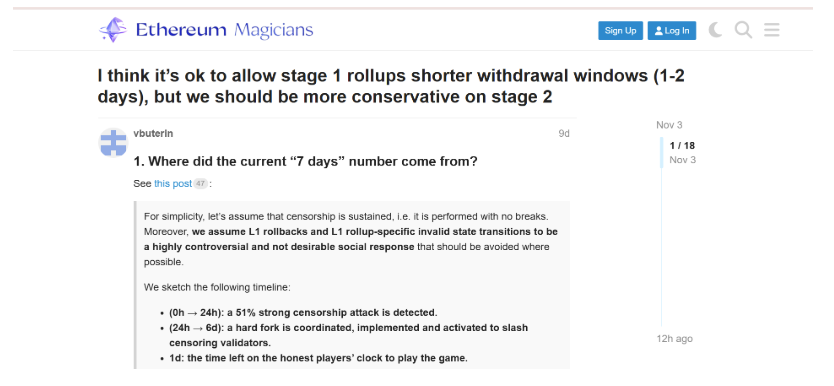
Withdrawal latency is more than just a user inconvenience; it represents a critical liquidity bottleneck for the entire multi-chain collaboration system:
- For Users: It directly impacts the speed at which funds can move between different Rollups.
- For Intent Protocols & Bridge Networks: It dictates the capital efficiency of their solutions.
- For the Ethereum Mainnet: It influences the ecosystem’s ability to maintain consistency and security amidst increasingly frequent interactions.
Vitalik’s proposal essentially opens the floodgates for faster cross-domain communication. Shortening withdrawal times is not just an enhancement for Rollup user experience; it’s a fundamental infrastructure upgrade that unlocks the rapid flow of cross-domain messages, liquidity, and state. This aligns perfectly with the EF’s “Acceleration” goals: reducing confirmation times, increasing fund settlement speed, and enabling seamless cross-chain fund transfers.
These concerted efforts will culminate at the Devconnect event in Argentina on November 17th, where Interop is slated to be a key theme. The EF team is expected to unveil further details regarding the Ethereum Interoperability Layer (EIL) at the conference.
Collectively, these initiatives point towards a singular, profound transformation: Ethereum is evolving from a focus on “scaling” to a new era of “integration.”
This article, the first in our Interop series, serves to introduce the foundational premise that interoperability is the ultimate destination of the cross-chain narrative. We’ve offered a preliminary glimpse into the structural upgrade unfolding within the Ethereum ecosystem, from the EF’s technical roadmap and Vitalik’s real-time discussions to standardized engineering blueprints and progressively shorter settlement cycles.
In upcoming installments, we will delve deeper into various facets, explaining why interoperability is not merely a bridge, but the underlying protocol that will connect Ethereum’s future.
Stay tuned.
(The above content is an excerpt and reproduction authorized by our partner PANews. Original Link | Source: imToken)
Disclaimer: This article provides market information only. All content and views are for reference purposes and do not constitute investment advice. They do not represent the views or positions of BlockBeats. Investors should make their own decisions and conduct their own transactions. The author and BlockBeats will not be held responsible for any direct or indirect losses incurred by investor transactions.