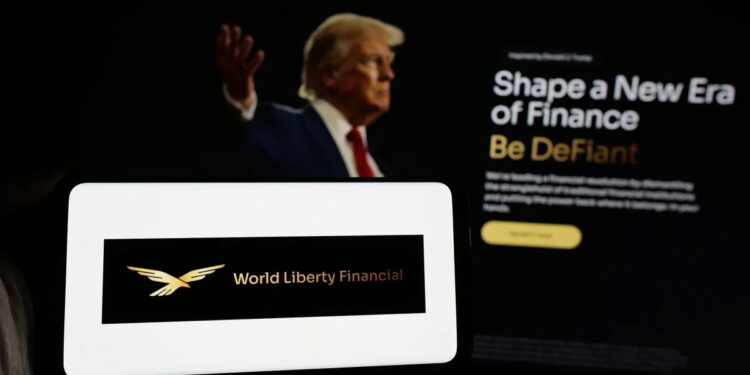
Trump-Linked DeFi Project World Liberty Financial Grapples with Security Breach and Sanctions Allegations
The decentralized finance (DeFi) project World Liberty Financial (WLFI), prominently linked to the Trump family, finds itself at the epicenter of a swirling storm, grappling with both a significant security breach and intense congressional scrutiny over alleged sanctions violations.
Security Breach Prompts Urgent User Fund Relocation and KYC
In a recent announcement on social media platform X, World Liberty Financial disclosed that a “relatively small number” of user wallets had been compromised. The breach is suspected to be a result of sophisticated phishing attacks or seed phrase leaks. Crucially, the project explicitly stated these were “third-party security vulnerabilities,” not issues originating from WLFI’s core platform or its smart contracts.
To mitigate risks and protect assets, WLFI initiated proactive measures back in September, freezing affected wallets and undertaking a rigorous ownership verification process. The team is currently developing and testing new contract logic, promising that once validated, assets belonging to verified users will be securely transferred to new, fortified wallets. As part of this security overhaul, all users are now required to re-undergo KYC (Know Your Customer) verification.
Emphasizing its unwavering commitment to user safety and regulatory adherence, World Liberty Financial affirmed, “Even though the issue originated from external vulnerabilities, the team prioritizes user security while ensuring compliance with regulatory requirements.”
The full scope of the breach, including the precise number of affected users and the total value of compromised funds, remains undisclosed.
Congressional Pressure Mounts Over Alleged Sanctions Violations
Yet, these technical challenges may merely be the prelude to a far more significant legal and political battle. Earlier this week, Democratic Senators Elizabeth Warren and Jack Reed escalated their concerns, dispatching a formal letter to the U.S. Department of Justice and the Treasury Department. Their demand: a thorough investigation into whether World Liberty Financial has breached international sanctions.
The senators’ concerns are rooted in a detailed report from the oversight organization Accountable.US. This report controversially alleges that WLFI’s token sales included transactions with suspicious wallets purportedly linked to nefarious entities such as North Korea’s infamous “Lazarus Group,” tools designed for evading Russian ruble sanctions, and various Iranian cryptocurrency exchanges.
With prominent Trump family members — Eric Trump, Donald Trump Jr., and Barron Trump — listed as co-founders, the specter of potential conflicts of interest has long kept congressional members on edge. It is presently unclear whether WLFI’s Wednesday security announcement was a strategic move to address or deflect the mounting senatorial pressure.
Crypto Experts Challenge Accusations, Citing Flawed Report
However, the grave accusations of “allegedly funding terrorists” have not gone unchallenged within the broader cryptocurrency community. A chorus of blockchain security specialists, including Taylor Moynahan, Head of Security at MetaMask (Ethereum’s largest self-custodial wallet), and Nick Bax, founder of Ump.eth, have vociferously disputed the veracity and methodology of the Accountable.US report.
Nick Bax, in particular, lambasted the report’s foundational logic as “quite far-fetched.” He pointed out that a sprawling 14-page document was ostensibly built upon a solitary, suspicious “shitcoin” transaction record, which was then tenuously stretched to implicate North Korean hackers.
“The worst part is, not only are senators spreading misinformation, but it has also led to an innocent user named Shryder being wrongly identified as a North Korean hacker, resulting in approximately $95,000 worth of his WLFI tokens being frozen.”
Disclaimer: This article is for market information purposes only. All content and views are for reference only and do not constitute investment advice. They do not represent the views and positions of the author or Blockcast. Investors should make their own decisions and trades. The author and Blockcast will not bear any responsibility for direct or indirect losses incurred by investors’ transactions.