Cryptocurrency Market Plunge: What’s Driving December’s Volatility?
By Shaw, Jinse Finance
The dawn of December brought an unwelcome shock to cryptocurrency investors, as a brief respite from market fear quickly dissipated. What factors are behind this renewed instability? As the year draws to a close, what trajectory awaits the crypto market? Will the current downturn persist, or are we witnessing a deeper entrenchment of the bear market?
Crypto Market Suffers Flash Crash, Long Positions Decimated
The cryptocurrency market experienced a sharp “flash crash” on the morning of December 1st, sending Bitcoin, Ethereum, and other major assets tumbling. Bitcoin saw a rapid decline of over $4,000 within two hours, briefly breaching the $87,000 mark and hitting a low of $86,161, marking a nearly 5% drop over 24 hours. Ethereum followed suit, plunging over $200 in two hours, momentarily falling below $2,900 to touch $2,813.20, with a 24-hour decline exceeding 5.5%. Solana and BNB also recorded significant short-term losses.
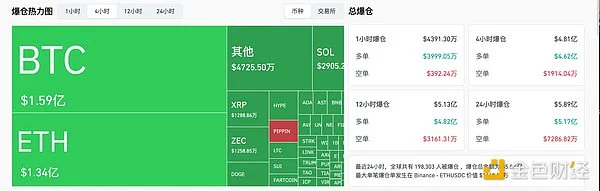
According to Coinglass data, the past four hours alone witnessed a staggering $481 million in liquidations across the network. A vast majority, $462 million, came from long positions, while short positions accounted for $19.14 million, clearly indicating a predominantly bullish wipeout. Bitcoin liquidations totaled $159 million, and Ethereum liquidations reached $134 million. Over 198,000 traders were liquidated within a 24-hour period, with the largest single liquidation order, valued at $14.48 million, occurring on Binance for ETH/USDC.
This market downturn occurred despite recent optimism surrounding potential Federal Reserve interest rate cuts. Several converging factors reignited investor panic: persistent weak inflows into Bitcoin Spot ETFs, significant selling pressure from “whale” investors, a fresh wave of leveraged long position liquidations, and the ongoing tightening of regulatory policies in China.
China’s Regulatory Clampdown Intensifies Market Jitters
Adding to the market’s woes, the People’s Bank of China (PBOC) recently convened a high-level meeting of its coordination mechanism for combating virtual currency trading and speculation. Representatives from thirteen key departments, including the Ministry of Public Security and the Cyberspace Administration of China, attended. The meeting unequivocally reiterated China’s prohibitory stance on virtual currencies and vowed to continue cracking down on related illegal financial activities.
During the session, officials emphasized that virtual currencies lack the legal status of fiat currency, are not legal tender, and therefore should not be circulated or used as currency. All virtual currency-related business activities were once again classified as illegal financial activities. Special attention was paid to stablecoins, which were highlighted as a form of virtual currency currently unable to meet crucial requirements like customer identification and anti-money laundering (AML). This deficiency, the PBOC warned, exposes stablecoins to risks of misuse in illicit activities such as money laundering, fundraising fraud, and illegal cross-border fund transfers. The meeting concluded by urging all participating units to prioritize risk prevention and control, maintain the ban on virtual currencies, and relentlessly suppress illegal crypto-related financial operations.
While no new regulatory policies were introduced, the meeting’s firm reaffirmation of China’s strict prohibition on virtual currency transactions and stringent stablecoin oversight significantly amplified existing market concerns.
Macroeconomic Headwinds: BOJ’s Hawkish Shift Adds to Global Uncertainty
The broader macroeconomic landscape is also contributing to market instability. Bank of Japan (BOJ) Governor Kazuo Ueda recently signaled that the BOJ’s policy board might consider raising benchmark interest rates this month. While emphasizing that any hike would merely adjust the degree of monetary easing, Ueda indicated that authorities would make appropriate decisions on policy shifts. Speaking to business leaders in Nagoya, Ueda noted Japan’s moderate economic recovery and projected inflation to briefly dip below 2% in early fiscal year 2026 before re-accelerating to align with the 2% target later in the outlook period. He highlighted strengthening trends in wage and price increases, alongside a growing impact of exchange rates on prices, suggesting timely adjustments to easing policies to achieve price stability. Further rate hikes could be considered if economic conditions and prices continue to improve.
Overnight index swap data reflects growing market expectations, with traders pricing in approximately a 64% chance of a BOJ rate hike by the close of its next policy meeting on December 19th. The probability of action by January next year has climbed to 90%. Following Ueda’s remarks, the Japanese Yen modestly strengthened against the US Dollar. Prior to his speech, two-year Japanese government bond yields had already reached their highest levels since 2008, driven by escalating BOJ tightening expectations.
This rising hawkish sentiment from the Bank of Japan, juxtaposed with the Federal Reserve’s still-unconfirmed rate cuts, creates a complex and uncertain macroeconomic environment. Such global uncertainties inevitably cast a shadow over risk assets, including the volatile cryptocurrency market.
ETF Net Inflows Remain Anemic, Institutional Support Lags
Despite some recent positive signs, institutional capital inflows into cryptocurrency ETFs remain insufficient to drive a sustained market recovery. Farside Investors data indicated that US spot Bitcoin ETFs recorded a cumulative net inflow of $73.2 million last week, while US spot Ethereum ETFs saw a more substantial cumulative net inflow of $312 million last week. However, these figures are dwarfed by earlier outflows.
Notably, BlackRock’s spot Bitcoin ETF, IBIT, experienced a staggering net outflow of $2.34 billion throughout November. This included record single-day outflows of approximately $463 million on November 14th and $523 million on November 18th. While the return to net inflows is a welcome development, the scale of current institutional engagement is still modest compared to the previous exodus, proving inadequate to underpin a broader, lasting market rebound.
“Whale” Investors Liquidate Holdings, Fueling Downward Pressure
Adding further downward pressure, significant profit-taking by large “whale” investors has been observed. On-chain analyst @ai_9684xtpa reported that an “ancient whale” wallet, holding Ethereum since 2016 with an average cost basis of just $203.22 per ETH, appears to have offloaded 7,000 ETH via Wintermute over the past month. With an average transfer price of $3,024, this potential sale would net an estimated profit of $19.745 million.
Another prominent example, monitored by on-chain analyst Ai Yi, involves an address that built a position of 1,074 WBTC four years ago at an average price of $10,708. After liquidating its WBTC holdings, this address seems to have turned its attention to Ethereum. Earlier this year, the same address realized a substantial profit of $107 million by selling 1,000 BTC at an average price of $118,011. Recently, it deposited 5,000 ETH, valued at $15.36 million, to Binance. Over the past two weeks, this wallet has cumulatively transferred 13,403.28 ETH, totaling $41.06 million, to exchanges. It still retains a holding of 15,000 ETH.
The sustained large-scale selling by these “OG” whale addresses introduces considerable downward pressure on the market, acting as a significant catalyst for recent price declines.
Potential Catalysts: December Holds Hope for Market Recovery
Despite the current bearish sentiment, December could introduce several positive factors that might stimulate a market rebound. One significant development is the anticipated conclusion of the Federal Reserve’s Quantitative Tightening (QT) program. The Fed initiated monetary policy tightening in March 2022 and began reducing its bond holdings (QT) in June 2022. Since then, the Fed has withdrawn over $2 trillion from the market, shrinking its balance sheet to approximately $6.55 trillion. However, expectations suggest that this trend is set to reverse, with the Fed potentially ceasing its market liquidity withdrawal efforts in the near future.
Furthermore, the Federal Reserve is scheduled to announce its latest interest rate decision on December 10th. Recent statements from key Fed officials, coupled with “dovish” remarks from a potential candidate for the next Fed Chair under a Trump administration, have significantly heightened market expectations for a 25-basis-point rate cut in December. CME’s “FedWatch” tool currently indicates an 87.4% probability of a 25-basis-point Fed rate cut in December, with only a 12.6% chance of rates remaining unchanged. Looking ahead to January next year, the probability of a cumulative 25-basis-point rate cut stands at 67.5%, versus a 9.2% chance of no change.
While the cryptocurrency market is currently grappling with persistent sluggishness, these anticipated positive macroeconomic shifts in December could provide the necessary impetus for a modest recovery.
Market Analysts Weigh In: Divergent Views on Crypto’s Path Forward
As December unfolds, the cryptocurrency market faces an uncertain path. Will the anticipated positive catalysts materialize and reignite growth, or is a prolonged downturn into the new year more likely? We delve into various expert interpretations to understand the potential trajectories.
Key Market Interpretations:
- CryptoQuant Research: Stablecoin Supply Signals Underlying Strength
A recent report from CryptoQuant highlights that the total supply of ERC20 stablecoins has surpassed $160 billion in 2025, reaching an all-time high. This metric is considered a crucial predictor for Bitcoin’s price movements, exhibiting a more significant correlation than global M2 money supply. Stablecoins, as the primary source of liquidity in the crypto market, quickly and directly reflect investor capital flows, with their supply growth often preceding Bitcoin price rallies. This pattern was evident during the 2021 bull market and the 2024-2025 market recovery periods. CryptoQuant’s team suggests that the current record-high stablecoin supply indicates sustained underlying purchasing power, potentially serving as a significant driver for Bitcoin’s next price surge. - Matrixport Chart Analysis: A Collision of Forces
Matrixport’s analysis describes Bitcoin as entering a rare phase where positioning, market sentiment, and macro policy are simultaneously in collision. Implied volatility has sharply declined, and demand for crash protection has receded, yet the price remains below a historically challenging resistance level. Concurrently, a critical on-chain cost basis indicator is being tested—a level that previously differentiated between “panic” and “deep value.” Adding to the tension, while Fed rate cut expectations are soaring amid a shift in tone, historical data suggests this is often a period where many traders misjudge subsequent trends. Seasonal patterns and trend structures offer conflicting signals, both backed by data. - MisterCrypto: Bitcoin Primed for $100K-$110K Rebound
Market analyst MisterCrypto believes that conditions are ripe for Bitcoin to initiate a rebound towards the $100,000-$110,000 range. He observes signs of stability in Bitcoin’s short-term structure following what he terms a “capitulation-like sell-off.” Indicators related to trader behavior suggest that as market sentiment plunged into extreme fear, large players began opening new long positions—a combination historically indicative of a rebound during downturns. - Bitwise’s André Dragosch: Macro Environment Echoes COVID-19 Era
Bitwise crypto researcher André Dragosch draws parallels between Bitcoin’s current macro environment and the COVID-19 pandemic period. Based on the scale of previous monetary stimulus, he anticipates an acceleration in global growth, potentially extending through 2026. Dragosch suggests that Bitcoin’s current price appears disconnected from future macroeconomic prospects, implying substantial upside potential. - Arthur Hayes (BitMEX Co-founder): $250K BTC by Year-End
BitMEX co-founder Arthur Hayes maintains his bold prediction that Bitcoin (BTC) will surge to $250,000 by year-end, representing an approximately 170% increase. Hayes firmly believes Bitcoin has bottomed, citing last week’s dip to $80,600 as the low point, followed by a subsequent 12% rebound. He points to the impending end of the US liquidity crunch, the Fed’s October 25-basis-point rate cut, and market expectations of QT concluding by early December, with an 87% chance of further rate cuts on December 10th. Coupled with the reset effect from the October 11th crypto market leverage liquidations, these factors are expected to provide significant upward momentum for Bitcoin. Despite acknowledging potential deviations, Hayes remains long-term bullish and optimistic. - Crypto Analyst Ali: Recovery Post-Trader Losses
Crypto analyst Ali posted that “Bitcoin (BTC) typically recovers after on-chain traders’ losses exceed 37%. Currently, this indicator stands at 20%,” suggesting there might still be room for further capitulation before a strong recovery. - Santiment: Ethereum Poised for 7% Short-Term Gain
Cryptocurrency sentiment analysis platform Santiment forecasts a potential short-term rise of nearly 7% for Ethereum (ETH). This prediction is based on current low stablecoin yields (around 4%), which indicate that the cryptocurrency market has not yet entered an overheated state. Santiment’s report suggests that this phenomenon implies the market has not reached a major top and still has further upside potential, predicting that Ethereum might soon test the $3,200 resistance level.
(The above content is excerpted and reproduced with authorization from partner PANews. Original Link | Source: Jinse Finance)
Disclaimer: This article is provided for market information purposes only. All content and views are for reference only and do not constitute investment advice. They do not represent the views or positions of BlockTempo. Investors should make their own decisions and trades. The author and BlockTempo will not assume any responsibility for direct or indirect losses incurred by investors’ trading activities.