
The Ethereum network is poised for a monumental leap forward with the “Fusaka” upgrade, scheduled for mainnet launch on December 3, 2025. This marks the second major hard fork of the year, following May’s “Pectra” upgrade. The name “Fusaka” itself is a portmanteau, merging the internal upgrade codenames Osaka (for the execution layer) and Fulu (for the consensus layer), symbolizing its comprehensive impact across the protocol.
Unveiling the Fusaka Upgrade: A New Era for Ethereum Scalability
Currently, Ethereum’s Rollup ecosystem handles the vast majority of transactions and fee revenue. However, these vital Layer 2 solutions remain constrained by the volume and cost associated with publishing data back to Layer 1.
The Fusaka upgrade is meticulously designed to alleviate these pressures. Its cornerstone feature, PeerDAS (Peer Data Availability Sampling), revolutionizes how validators interact with Rollup data blocks. Instead of requiring validators to download the entirety of each block, PeerDAS enables them to verify data availability by sampling random fragments. This significantly reduces bandwidth and storage demands while dramatically boosting data throughput across the network.
Complementing PeerDAS, Fusaka introduces the “Blob-Only Parameter” (BPO), refined gas and block size limits, and adjustments to historical data expiry. These combined enhancements empower the blockchain to gracefully adapt to multiple subsequent capacity increases, paving the way for unprecedented scalability.
This article will delve into the transformative changes brought by the Fusaka upgrade, position it within Ethereum’s overarching Surge, Verge, and Purge roadmap, and explore its potential ramifications for users, Rollups, and the entire Ethereum ecosystem in the years to come.
From Merge to Fusaka: Charting Ethereum’s Evolution
To fully appreciate Fusaka’s strategic importance, it’s essential to contextualize it within Ethereum’s progressive development journey:
- The Merge (2022): A landmark transition from a Proof-of-Work to a Proof-of-Stake consensus mechanism, slashing energy consumption by approximately 99.9%.
- Shapella (2023): Enabled the withdrawal of staked Ether, transforming a unidirectional staking system into a more liquid one and attracting a broader base of validators.
- Dencun (March 2024): Introduced Ethereum Improvement Proposal (EIP) 4844, colloquially known as “blobs.” These provide a cheaper, temporary data channel specifically for Rollups, marking the advent of “protodanksharding.”
- Pectra (May 2025): Integrated EIP-7702 for account abstraction and recalibrated staking parameters, including the validator cap of 2048 Ether.
These upgrades meticulously align with Vitalik Buterin’s high-level roadmap: Merge, Surge, Verge, Purge, and Splurge. The “Surge” phase is dedicated to scaling Ethereum through Rollups and enhanced data availability, while “Verge” and “Purge” focus on enabling lighter clients and systematically removing outdated historical data.
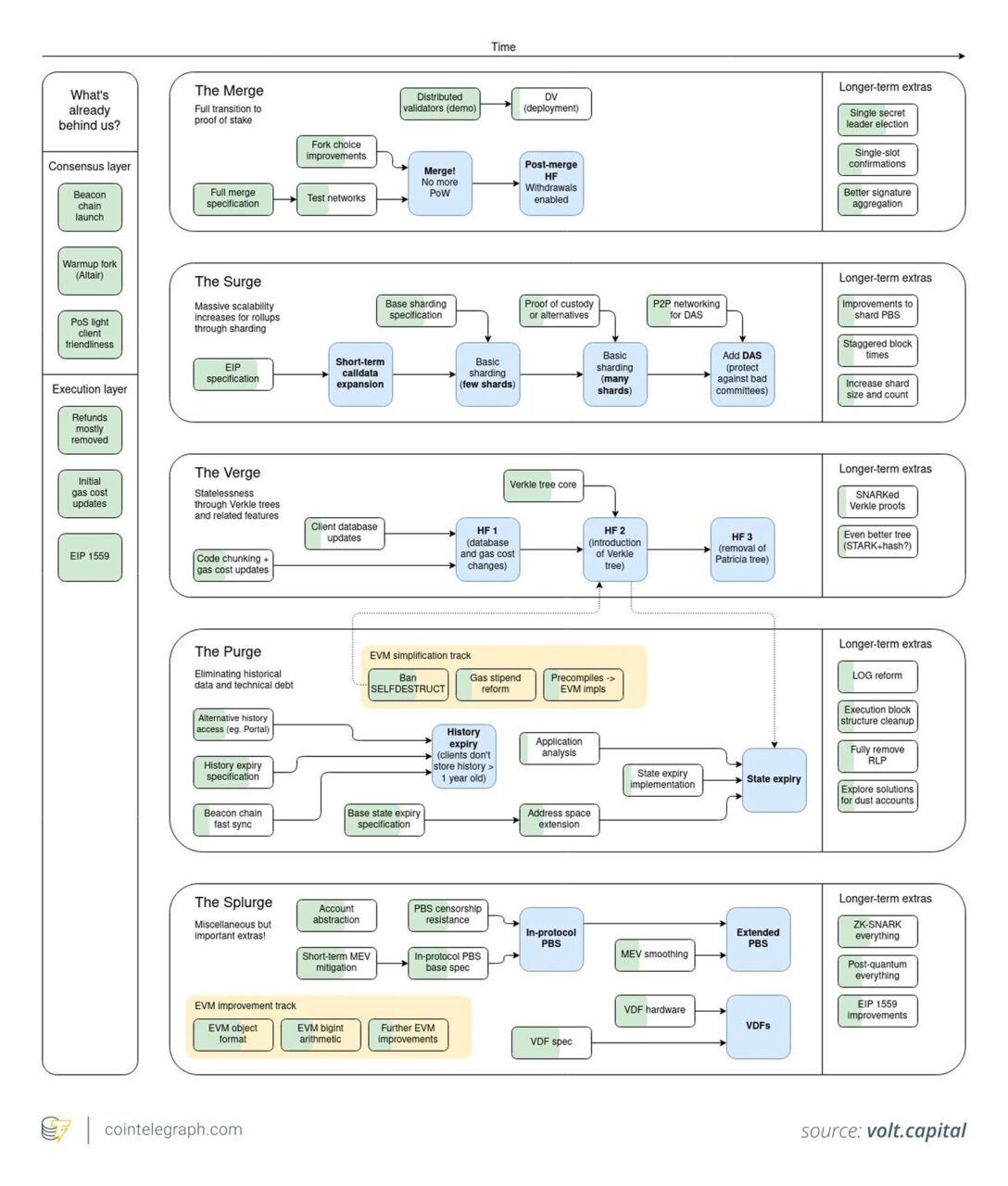
Fusaka stands out as the first upgrade to simultaneously propel all these functionalities forward. It scales Rollup data as part of the Surge, optimizes historical data and lightweight synchronization mechanisms as components of the Verge and Purge, and explicitly sets the stage for a modular Ethereum stack. This ambitious vision aims to achieve over 100,000 transactions per second (TPS) by augmenting L2 throughput atop a robust L1 settlement layer.
PeerDAS, Blobs, and Expanded Block Capacities
At the heart of Fusaka’s scaling solution lies EIP-7594, which introduces PeerDAS.
Rather than obliging every full node to download entire Rollup data blocks, PeerDAS intelligently segments these blocks into smaller units. Utilizing sophisticated sampling and erasure coding techniques, it allows validating nodes to retrieve only random fragments. If a sufficient number of these fragments are available, the network can confidently ascertain the existence of the complete data. This innovative approach drastically reduces bandwidth and storage requirements for individual nodes, laying the groundwork for an eventual eightfold increase in blob capacity without mandating hardware upgrades for stakers.
To facilitate this expansion with greater agility, EIP-7892 introduces the BPO (Blob-Only Parameter) fork. This minor hard fork selectively modifies just three blob-related parameters: the target value, the maximum value, and the base fee adjustment factor. Post-Fusaka, Ethereum gains the flexibility to incrementally boost blob capacity in smaller, more frequent steps, responding dynamically to growing L2 demand, rather than waiting years for a monolithic hard fork.
On the execution front, Fusaka also brings crucial updates to gas and block size:
- The effective block gas target is significantly increased from the current 45 million. EIP-7825 imposes limits on the gas that can be consumed by a single transaction, while EIP-7934 raises the 10 MB Recursive Length Prefix (RLP) block size limit to mitigate the risk of Denial-of-Service (DoS) attacks.
- EIP-7823 and EIP-7883 reprice and impose limits on the MODEXP precompile, preventing a single, computationally intensive cryptographic call from stalling an entire block.
In essence, Fusaka provides Ethereum with expanded capacity to store Rollup data and process complex transactions, all while integrating robust security mechanisms to ensure blocks remain verifiable by ordinary nodes.
Enhancing User Experience, Security, and Developer Tooling
Fusaka’s improvements extend beyond mere capacity, with several EIPs specifically targeting user experience, security, and developer convenience:
- EIP-7917: Ensures the proposer schedule for the next epoch is fully deterministic and accessible on-chain via the beacon root. This is critical for Rollup-based solutions and pre-confirmation schemes that require advance knowledge of which validator will propose a given block to offer rapid and reliable “soft finality” guarantees.
- EIP-7951: Adds a secp256r1 precompile, providing native Ethereum support for P-256 signatures. This curve is widely adopted by Apple’s Secure Enclave, Android Keystore, Fast Identity Online 2 (FIDO2), and WebAuthn keys. This integration allows wallets to leverage device-level biometrics and keys, moving beyond traditional seed phrases and bringing L1 closer to mainstream platform login experiences.
- EIP-7939: Introduces an opcode for counting leading zeros, which efficiently calculates the number of leading zero bits in a 256-bit word. This makes bit-level mathematical operations, large integer arithmetic, and certain zero-knowledge proof circuits more cost-effective and simpler to implement for developers.
- EIP-7642: Expands Ethereum’s historical data expiry mechanism, enabling clients to discard a greater volume of pre-Merge and older data while publicly announcing the range of data they retain. This can save hundreds of gigabytes of storage space per node and significantly accelerate the synchronization process for new validators.
Beneficiaries of the Fusaka Upgrade: L2 Nodes, Validators, and ETH Holders
The Fusaka upgrade carries far-reaching implications for various stakeholders within the Ethereum ecosystem:
- For the L2 Ecosystem: The synergy of PeerDAS and the BPO fork translates into cheaper and more abundant data availability. Analysts project that Fusaka, combined with the initial BPO fork, could reduce L2 data fees by 40% to 60% for a sustained period, particularly benefiting high-throughput applications like DeFi, gaming, and social platforms. Lower data costs foster greater experimentation and are likely to ignite a new wave of Rollup competition centered on pricing and user experience.
- For Node Operators and Validators: Fusaka offers a mixed bag of reduced and increased burdens. Data sampling and historical expiry streamline operations by decreasing the volume of data nodes need to download and store, thereby accelerating the synchronization of new nodes. However, as BPO forks push blob counts higher, well-equipped validators and infrastructure providers will shoulder increased upload bandwidth requirements. This dynamic necessitates careful client implementation and guidance to prevent undue centralization of network operations towards larger operators.
- For Institutions and Staking Service Providers: Fusaka is largely perceived as a strategic enabler rather than a singular speed boost. More predictable data throughput, enhanced gas and block size limits, and clearer historical data management collectively simplify the planning and execution of large-scale validator operations.
- For ETH Holders: The impact is clear: the underlying Ethereum network is being meticulously re-tuned into a high-capacity L2 settlement and data engine. Adjustments to minimum fees and blob pricing are designed to attract more transaction activity to settle on Ethereum, which could influence the fee market and validator rewards. However, this evolution comes with inherent trade-offs, including increased protocol complexity. If ordinary users do not perceive tangible improvements in cost and experience, it could invite criticism.
Beyond Fusaka: Glamsterdam and the Road to 100,000 TPS
The next anticipated upgrade, codenamed Glamsterdam, is slated for release in 2026. It promises two pivotal advancements:
- Enshrined Proposer-Builder Separation (ePBS): Aims to fortify the Maximal Extractable Value (MEV) supply chain by separating block building and proposing at the protocol layer, moving beyond reliance on external relays.
- Block-level Access Lists (BALs): Designed to facilitate more efficient execution and improved handling of state access, crucial for accommodating future increases in blob capacity.
Fusaka’s contributions, such as PeerDAS and the BPO fork, significantly advance the Surge. The extended historical data expiry and peer-to-peer (P2P) adjustments embody the themes of Verge and Purge. Furthermore, user experience enhancements like Proposer Lookahead and P-256 support enable the widespread adoption of pre-confirmations and passkey-enabled wallets.
If Ethereum maintains this pace of innovation, Fusaka will undoubtedly be remembered as a critical inflection point. It signifies a profound shift in the roadmap, transforming a collection of disparate plans into a cohesive, value-driven scaling solution. The ultimate goal remains steadfast: to support a modular stack capable of 100,000 transactions per second, all while rigorously preserving the decentralized characteristics that define the network’s intrinsic value.
Disclaimer: This article provides market information only. All content and opinions are for reference only and do not constitute investment advice. They do not represent the views and positions of BlockTempo. Investors should make their own decisions and trades. The author and BlockTempo will not be liable for any direct or indirect losses incurred by investors’ transactions.