
Tether Freezes Over $182 Million USDT on Tron: A Landmark Enforcement Action
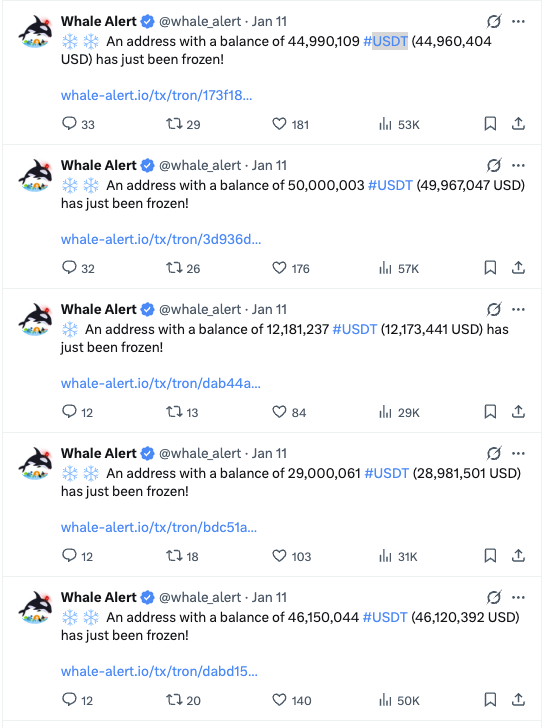
In a significant display of its commitment to combating illicit financial activities, Tether, the issuer of the world’s largest stablecoin, USDT, recently froze over $182 million across five distinct wallet addresses on the Tron blockchain. This substantial operation, meticulously tracked by the on-chain data monitoring tool Whale Alert, stands as one of the largest single freezing actions observed on the Tron network in recent months.
On-chain analysis indicates that the five affected addresses held varying amounts of USDT, ranging from approximately $12 million to $50 million each. While the specific rationale behind this particular freeze has not yet been publicly disclosed by Tether, the action unequivocally signals the company’s proactive stance on compliance and security within the digital asset space.
Aligning with Global Sanctions and Robust Compliance Policies
This freezing operation, executed on January 11th, directly aligns with Tether’s enhanced wallet freezing policy, which officially commenced in December 2023. This policy is primarily designed to facilitate comprehensive cooperation with the U.S. Department of the Treasury’s Office of Foreign Assets Control (OFAC) and its “Specially Designated Nationals (SDN)” sanctions list, thereby preventing sanctioned entities from exploiting USDT for illicit purposes.
Tether’s terms of service explicitly empower the company to proactively freeze addresses or furnish user information to relevant authorities. This authority is exercised either upon the receipt of a valid court order or when Tether, at its discretion, deems such action “reasonable and necessary” to uphold stringent legal and regulatory standards.
Tether’s Extensive Track Record in Combating Illicit Finance
The recent freeze is not an isolated incident but rather a component of Tether’s broader, ongoing efforts to collaborate with global law enforcement agencies. Data unveiled on Tether’s official website, TetherFacts.com, underscores the company’s substantial contributions: to date, Tether has provided assistance to over 310 law enforcement agencies across 62 jurisdictions worldwide, culminating in the cumulative freezing of more than $3 billion worth of USDT.
Specifically, in close cooperation with prominent U.S. law enforcement bodies such as the FBI and the U.S. Secret Service, Tether had frozen over 2,380 wallets, accounting for approximately $1.14 billion in assets, as of July 2025. This demonstrates a robust and unwavering commitment to fostering financial integrity and security within the rapidly evolving cryptocurrency ecosystem.
A Striking Disparity in Enforcement: Tether vs. Competitors
An intriguing aspect of Tether’s enforcement activities is the pronounced disparity when compared to its primary competitor, Circle, the issuer of USDC. According to a comprehensive report published by the analytics firm AMLBot in December 2025, the total value of assets frozen by Tether since 2023 is a staggering 30 times greater than that frozen by Circle, which stands at $109 million.
Currently, USDT commands an impressive 64% of the stablecoin market share, boasting an unparalleled circulating supply exceeding $187 billion. In stark contrast, USDC, which prides itself on a compliance-first approach and is strategically based in the United States, maintains a total supply of approximately $75 billion.
Stablecoins and the Critical Fight Against Illicit Cryptocurrency Transactions
The heightened scrutiny and aggressive enforcement actions surrounding stablecoins are particularly pertinent given their escalating role in the broader cryptocurrency landscape. A recent report from Chainalysis indicates that stablecoins have regrettably become the preferred medium for illicit cryptocurrency transactions. The data suggests that in 2025, the global illicit cryptocurrency flow is conservatively projected to reach $154 billion, with stablecoins contributing a substantial 84% of this total.
Against this backdrop, Tether’s decisive enforcement actions, such as the recent $182 million freeze on Tron, are indispensable steps in addressing these formidable challenges and significantly bolstering the legitimacy and overall security of the stablecoin market.
Disclaimer: This article is provided for market information purposes only. All content and views are for reference only, do not constitute investment advice, and do not represent the views and positions of the author or the platform. Investors should make their own decisions and trades, and the author and platform will not bear any responsibility for direct or indirect losses incurred by investors’ transactions.