
Unlocking Unprecedented Privacy: A Deep Dive into Bitcoin Silent Payments
Author: Area Bitcoin
Translated & Compiled by: Felix, PANews
In the evolving landscape of digital finance, the privacy of Bitcoin transactions has become a paramount concern. As users increasingly seek more secure and discreet methods for on-chain interactions, a groundbreaking innovation is emerging: Silent Payments. This revolutionary approach promises to redefine how individuals and organizations manage their Bitcoin, offering a significant leap forward in privacy without compromising usability.
This comprehensive guide will delve into the essence of Silent Payments, exploring their critical importance to the Bitcoin network, their underlying cryptographic structure, and the transformative impact they are poised to have on the ecosystem.
What Exactly Are Silent Payments?
At its core, a Silent Payment is an ingenious method for receiving Bitcoin that safeguards your financial privacy. Unlike conventional Bitcoin transactions, Silent Payments prevent the disclosure of your balance or transaction history to anyone observing your public address. This innovative concept is rooted in BIP 352, a proposal advocating for truly reusable addresses within the Bitcoin protocol.
Consider the common dilemma: if you regularly accept Bitcoin donations or receive multiple payments throughout the year, current practices force a difficult choice. You either generate a new, unique address for every single transaction (a cumbersome process) or repeatedly use the same address, thereby sacrificing your privacy and enabling anyone with a blockchain explorer to trace all your associated inflows and outflows.
Silent Payments elegantly resolve this. They allow you to share a single, reusable public key address, eliminating the need to constantly generate new ones while ensuring your privacy remains uncompromised. The proposal for Silent Payments first surfaced in March 2022, and its recent integration into the official Bitcoin codebase marks a pivotal moment, signifying robust review and readiness for broader adoption by wallet developers, albeit with potential minor refinements still to come.
Why This Innovation Matters for Bitcoin Privacy
Traditional Bitcoin addresses, in their current form, function much like conventional bank account numbers. However, the inherent transparency of the blockchain means that every transaction linked to a specific address is openly viewable via a block explorer. This transparency, while foundational to Bitcoin’s trustless nature, presents a significant privacy challenge: reusing an address publicly exposes all associated payments.
Silent Payments fundamentally alter this dynamic. By sharing just one public address, the intricate details of each transaction become visible exclusively to the sender and receiver. This remarkable feat is achieved through advanced cryptographic techniques, which enable the recipient to receive funds into a unique, distinct address for every transaction. Crucially, only the recipient possesses the means to identify and access these privately delivered funds.
While the term “Silent Payments” might sound novel, its lineage traces back to the “Stealth Addresses” concept, first introduced in 2012. Despite its early promise, a truly effective and scalable implementation of this privacy-enhancing idea within Bitcoin remained elusive until now.
The Evolution of Privacy: Stealth Addresses and BIP 47
The pursuit of enhanced transaction privacy has been a cornerstone of Bitcoin’s development since its inception. Over the years, several proposals aimed at bolstering anonymity emerged, with “Stealth Addresses” and BIP 47 – both initially championed by Peter Todd – standing out as significant early attempts. Let’s examine the limitations and challenges these pioneering methods encountered in their quest for greater anonymity and transactional efficiency.
Stealth Addresses: Early Promise, Practical Hurdles
Stealth Addresses represented one of the earliest efforts to improve Bitcoin transaction privacy. The core idea was elegant: empower the recipient to generate a unique, private address that only they could cryptographically access. However, a major technical hurdle quickly emerged: the system required adding an extra key to the blockchain, typically utilizing the OP_RETURN field.
This design choice introduced two critical drawbacks:
- Compromised Anonymity: The very act of adding supplementary data to the blockchain served as a tell-tale sign that a stealth address was in use. Any astute observer could readily identify this technique, thereby undermining the intended anonymity.
- Inefficiency and Increased Costs: Augmenting the blockchain with additional data made transactions bulkier, less efficient, and more expensive. This directly conflicted with Bitcoin’s foundational principle of maintaining a lightweight and accessible network.
An alternative, which involved leveraging an existing key within the transaction to avoid adding extra data, was considered but ultimately shelved due to its technical complexity and the absence of efficient tools (such as modern libraries like Lipsack P, which now simplify these calculations).
BIP 47: A Step Towards Notification Payments
As the community continued to seek improved privacy solutions, BIP 47 emerged as a subsequent proposal designed to address some of the earlier challenges. BIP 47 introduced a “notification system,” a departure from adding data to the blockchain with every single payment. Under this method, a sender would upload data to the blockchain only once. The recipient could then identify this data and use this “key” to streamline all future payments from that sender.
While an improvement, BIP 47 came with its own set of advantages and disadvantages:
Advantages of BIP 47:
- Clear Recipient Identification: Recipients could easily discern which on-chain data was intended for them, simplifying the verification process.
- Reduced Redundant Data: Notification data was added only once per sender-recipient pair, making it more space and resource-efficient than the repeated data additions required by Stealth Addresses.
Disadvantages of BIP 47:
- Increased Sender Complexity: Each payment still necessitated an initial on-chain notification from the sender, effectively adding an extra transaction. This proved cumbersome for large-scale or frequent use.
- Inefficient Blockchain Usage: The data appended for notifications was often unrelated to the actual payment itself, leading to perceived inefficiencies in blockchain resource allocation.
- Payment Linkability: If multiple payments were made from the same sender to the same recipient, the recipient could potentially link these funds back to a common origin, thereby compromising anonymity. In contrast, Silent Payments aim for complete sender anonymity.
- Identity Exposure: The sender’s payment code was revealed to the recipient within the notification transaction, posing a concern in scenarios demanding the highest levels of anonymity, such as sensitive donations.
Despite its merits, BIP 47’s limitations—particularly the requirement for extra transactions and the lack of absolute anonymity—hindered its widespread adoption. Silent Payments are designed to overcome these very issues, offering a more intuitive and profoundly private user experience. While Silent Payments do require the recipient’s wallet to scan the blockchain, this is generally considered a worthwhile trade-off for the substantial privacy gains achieved compared to BIP 47.
In essence, both Stealth Addresses and BIP 47 made valuable contributions to the dialogue around Bitcoin privacy, but their inherent constraints prevented broad implementation. Silent Payments now emerge as a highly promising solution, seeking to integrate the best attributes of their predecessors:
- Robust Privacy Guarantees
- Enhanced Efficiency
- Streamlined User Experience
How Silent Payments Revolutionize Your Bitcoin Experience
For the average user, interacting with Silent Payments is remarkably straightforward. Imagine you possess a Bitcoin wallet seamlessly connected to your full node. You simply generate a unique Silent Payment (SP) code, which can then be effortlessly shared, perhaps as a QR code. Any individual or entity supporting Silent Payments can then scan this QR code or input the code to initiate a payment. It’s that simple and intuitive.
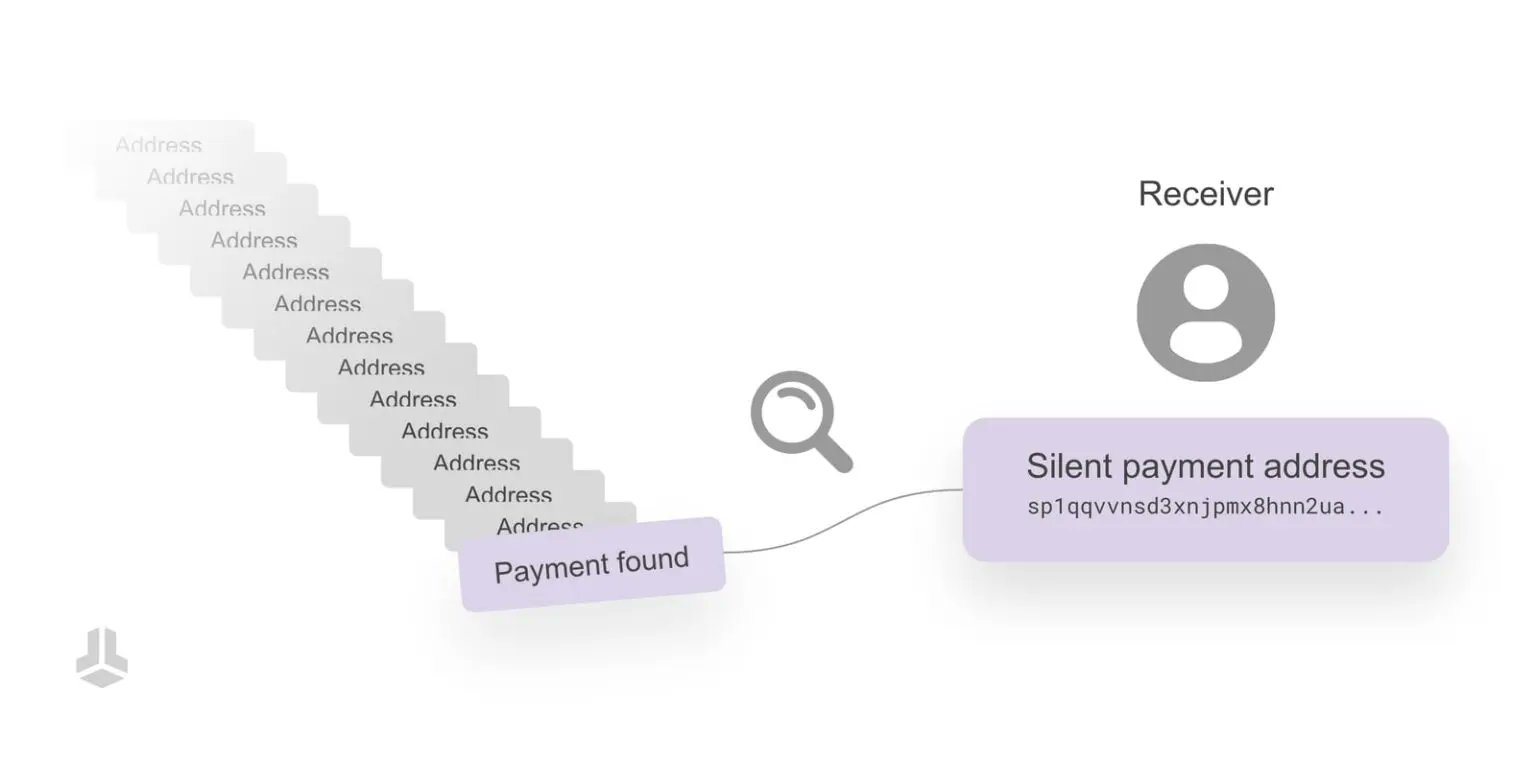
For recipients operating a full node, the process is incredibly efficient, with near-zero overhead costs, thanks to sophisticated optimizations. However, a crucial distinction lies in the recipient’s wallet functionality: to identify incoming Silent Payments, the recipient’s wallet software must actively scan every new Taproot transaction on the network to determine if it contains funds directed to their Silent Payment address. This requires a slightly more robust processing capability from the wallet.
The Anatomy of a Silent Payment Address
A Silent Payment address shares its foundational structure with a standard Taproot address. Taproot addresses are identifiable by the “bc” prefix, signifying a Bitcoin address, followed by “1” and a version number, with the remainder encoded using bech32m. Silent Payments similarly leverage bech32m encoding but distinguish themselves with an “sp1” prefix, explicitly denoting it as a Silent Payment address.
Crucially, this address contains two public keys. These keys do not directly reveal the destination of the Bitcoin. Instead, they provide the necessary instructions for deterministically generating the unique Taproot public key script for each payment. This innovative design allows users to generate, share, and securely reuse a single Silent Payment address, just like a regular Bitcoin address, but without any compromise to their privacy—a core advantage that sets it apart.
Leading the Charge: Wallets Embracing Silent Payments
While Silent Payments are still in their developmental phase and awaiting widespread adoption, a few pioneering wallets have already integrated this cutting-edge technology. Currently, Cake Wallet and BitBox stand out as early supporters.
Cake Wallet: A Pioneer in Mobile Privacy
Cake Wallet has distinguished itself as one of the first mobile wallets to implement Bitcoin Silent Payments, offering public beta versions on both Android and iOS. This integration allows users to experience enhanced privacy directly from their mobile devices.
Here’s how to activate and utilize Silent Payments within Cake Wallet:
- On the wallet’s home screen, locate and tap the “Silent Payments” button within the card or grid view. This action initiates the scanning of blocks for relevant transactions.
- It’s vital to remember that due to the anonymous nature of Silent Payment transactions, your wallet must actively scan the blockchain to detect incoming funds.
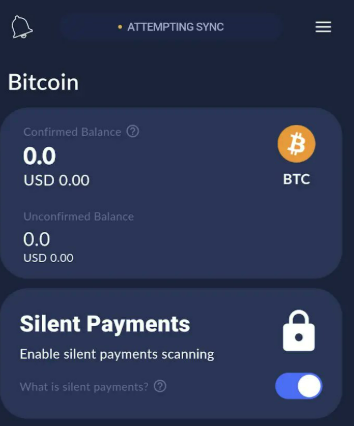
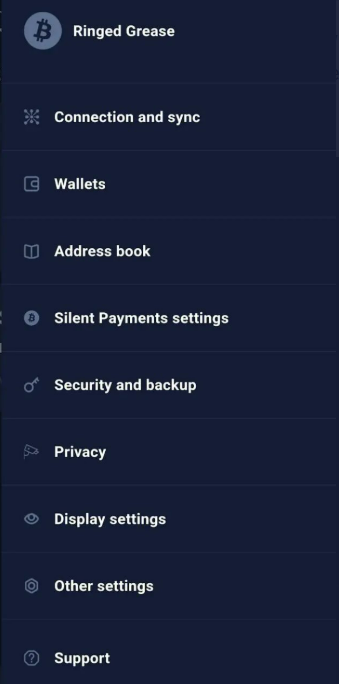
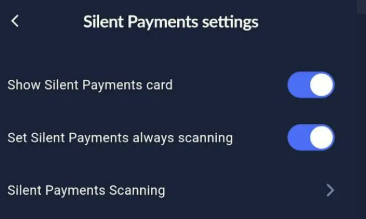
Once the initial scan completes, Silent Payment verification will automatically pause upon reaching the latest block. To ensure your wallet continuously checks for new Silent Payment blocks, navigate to “Menu” -> “Silent Payment Settings” and enable the “Always scan for Silent Payments” option.
BitBox: Hardware Security Meets Advanced Privacy
Complementing mobile solutions, BitBox has emerged as one of the first hardware wallets to support Silent Payments. This integration significantly elevates privacy protection for users, combining the robust security of a hardware device with the advanced anonymity of Silent Payments.
With Silent Payments, senders can generate unique, one-time addresses derived from a recipient’s static public key. This functionality is particularly beneficial for entities like activists, NGOs, and charitable organizations. They can share a single, reusable address to solicit donations without inadvertently disclosing their identity, the identities of their donors, or the precise amounts received. This powerful feature empowers BitBox users to support various causes and conduct transactions with a heightened degree of privacy, shielding their financial activities from unnecessary third-party scrutiny.
The Power of Labeling: Managing Payments with Discreet Identification
One of the initial challenges for Silent Payments was the ability to discern the sender of a payment without compromising privacy. The elegant solution introduced to address this is Labeling.
So, what exactly is Labeling?
Labeling enables you to differentiate between various senders when using a single Silent Payment address, all while preserving your privacy and incurring minimal additional scanning costs. This ingenious technique allows for the inclusion of supplementary information within Silent Payment addresses without undermining user anonymity. It achieves this by deterministically “fine-tuning” the spending key associated with the transaction.
In simpler terms, a spending key acts as a digital signature, authorizing the use of funds within an address. By subtly adjusting this key in a deterministic manner, different payment sources can be uniquely identified by the recipient.
For example, imagine you maintain two distinct Silent Payment profiles:
- One designated for your activities on platform X.
- Another for your engagements on Nostr.
With labeling, the initial segment of both Silent Payment addresses would remain identical (signifying they both belong to you), while the latter portion would exhibit a subtle difference. This distinction allows your wallet to automatically identify whether a payment originated from a user on X or from Nostr when you review your incoming funds.
This inherent flexibility strikes a perfect balance between robust privacy protection and the practical need for useful transaction information. Of course, for those desiring absolute anonymity, the option to use a standard Silent Payment address without any labeling remains available, ensuring no identifiable sender information is transmitted. However, when tracking payment sources is beneficial, labeling provides an efficient and privacy-conscious mechanism.
The applications for this technology are vast, spanning exchanges, social media platforms, and individual use cases. It empowers users to manage multiple online identities without creating obvious links between them, or to gain more granular payment information only when specifically desired.
Silent Payments in Action: An Exchange Scenario
The adoption of Silent Payments by cryptocurrency exchanges could unlock particularly compelling use cases.
Consider depositing funds into an exchange. Instead of receiving a static, reusable deposit address that links all your transactions, the exchange could generate a Silent Payment address for you. Each subsequent payment you send to this address would be automatically identified as originating from you (via the labeling mechanism), eliminating the need for you to manage multiple distinct addresses. Furthermore, this technology holds immense potential for streamlining automated withdrawal processes.
Imagine reusing the same Silent Payment address across various platforms without the hassle of managing a different extended public key (xPub) for each. This would dramatically simplify the user experience and enhance overall privacy.
Conclusion: A New Era for Bitcoin Privacy
Silent Payments represent a significant paradigm shift, poised to revolutionize the way we interact with Bitcoin. By offering a simpler, more intuitive, and profoundly private experience, this innovation addresses some of the most pressing concerns in the cryptocurrency space.
Should Silent Payments gain widespread adoption, the rate of on-chain address reuse is expected to decline dramatically, fostering a more secure and private environment for all participants in the Bitcoin network. This technology presents an unparalleled opportunity to align user incentives with optimal privacy practices, paving the way for future Bitcoin payments that are more discreet and secure than ever before.
(The above content is excerpted and reproduced with authorization from partner PANews, original link)
Disclaimer: This article is provided for market information purposes only. All content and views are for reference and do not constitute investment advice. They do not represent the opinions or positions of BlockTempo. Investors should exercise their own judgment and make independent trading decisions. The author and BlockTempo shall not be held responsible for any direct or indirect losses incurred by investors as a result of their transactions.