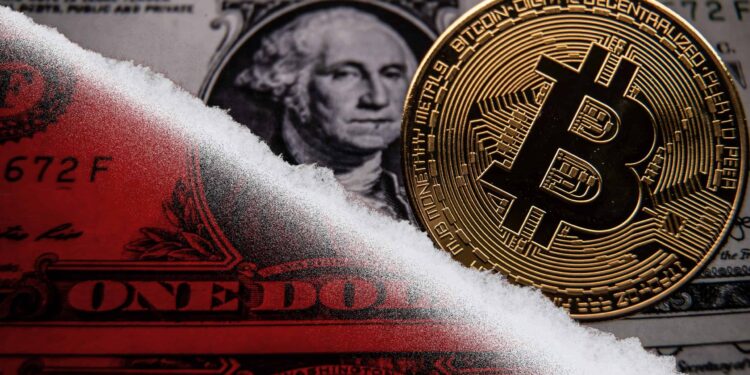
The Bitcoin Paradox: Why a Weak Dollar Isn’t Fueling a Crypto Rally, According to J.P. Morgan
In a perplexing turn for market watchers, the recent weakening of the U.S. dollar has failed to ignite the typical Bitcoin rally. This “contrarian trend” has sparked considerable debate, with J.P. Morgan Private Bank offering a compelling explanation: the key lies not with Bitcoin itself, but in the unique nature of this particular dollar decline.
Unpacking the Divergence: USD vs. Bitcoin Performance
Over the past year, the U.S. Dollar Index (DXY), a benchmark measuring the dollar’s strength against a basket of major currencies, has seen an approximate 10% decline. Historically, a weaker dollar often translates to a stronger Bitcoin, as investors seek alternative stores of value. Yet, defying this conventional wisdom, Bitcoin has paradoxically fallen by 13% over the same period.

J.P. Morgan’s Insight: A Different Kind of Dollar Weakness
Yuxuan Tang, Head of Asia Macro Strategy at J.P. Morgan Private Bank, highlights a crucial distinction. He notes that the current dollar depreciation is predominantly driven by short-term capital flows and shifts in market sentiment, rather than fundamental changes in the U.S. economic outlook or anticipated monetary policy adjustments.
“In fact, since the beginning of the year, interest rate differentials have consistently favored the dollar,” Tang explains. “The current dollar sell-off mirrors patterns observed around April last year, primarily propelled by transient capital movements and prevailing market mood.”
A Temporary Phenomenon? The Dollar’s Potential Rebound
Given this context, J.P. Morgan posits that the dollar’s current weakness might be a “cyclical phenomenon.” As U.S. economic momentum is projected to regain strength throughout the year, the dollar is expected to find its footing once more, potentially reversing its recent downtrend.
Bitcoin vs. Gold: Diverging Paths in a Weak Dollar Environment
This unique scenario explains why Bitcoin isn’t fulfilling its perceived role as a “dollar hedge asset.” In stark contrast, gold, a traditional safe haven, has continued its upward trajectory amidst dollar weakness. Bitcoin, however, has remained confined to a trading range, suggesting that the broader cryptocurrency market does not perceive the dollar’s decline as indicative of long-term macroeconomic shifts.
From an investment perspective, Bitcoin currently behaves more like a risk asset highly sensitive to liquidity, rather than a reliable store of value. Without a definitive pivot in monetary policy expectations, a mere weakening of the dollar is deemed insufficient to attract substantial new capital into the volatile crypto market.
Strategic Diversification: Beyond Bitcoin
J.P. Morgan Private Bank’s analytical framework offers a clear reminder for investors: those seeking to diversify against dollar risk may find more direct and effective beneficiaries in traditional assets. Specifically, gold and emerging market assets are presented as more robust options for hedging against dollar fluctuations.
Disclaimer: This article is intended solely for market information purposes. All content and views are provided for general reference only and do not constitute investment advice. They do not necessarily reflect the opinions or positions of the author or BlockTempo. Investors are encouraged to make independent decisions and conduct their own due diligence. The author and BlockTempo will not assume any responsibility for direct or indirect losses incurred from investor transactions.