BlackRock Embraces DeFi: BUIDL Fund Lands on UniswapX, UNI Token Purchase Signals New Era
By Jae, PANews
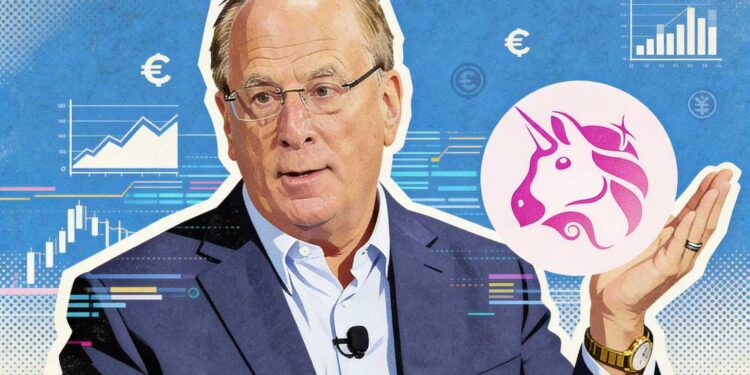
In a landmark move that sent ripples across both traditional finance (TradFi) and decentralized finance (DeFi), global asset management titan BlackRock announced on February 11th that its approximately $2.2 billion tokenized U.S. Treasury fund, BUIDL, would be integrated with the UniswapX protocol for on-chain trading.

This pivotal announcement was compounded by BlackRock’s confirmation of purchasing Uniswap’s native governance token, UNI. While the exact quantity remains undisclosed, this marks an unprecedented moment: the financial behemoth, overseeing a staggering $14 trillion in assets, has directly exposed its balance sheet to a DeFi governance token for the first time.
The news ignited an immediate surge, with the UNI token climbing over 25%. Hayden Adams, founder of Uniswap, hailed the occasion, stating, “It’s a big day for DeFi. This partnership will leverage Uniswap’s market structure to provide on-chain trading for BUIDL investors, with settlement on Ethereum. This is a significant step towards ‘almost all value being tradable on-chain’.”
This collaboration transcends a simple asset listing; it represents a profound validation and a new frontier for financial infrastructure. For the first time, Wall Street has not just observed, but actively engaged with the DeFi ecosystem, signaling a readiness to integrate. Tony Edward, founder of Thinking Crypto Podcast, succinctly captured the sentiment: “This is major crypto adoption. BlackRock is embracing DeFi.”
For Uniswap, this signifies a crucial evolution from a retail-centric platform to an indispensable backend for institutional-grade liquidity. For BlackRock, it underscores a newfound conviction that decentralized exchanges (DEXs) have achieved the maturity and robustness required to serve as foundational financial infrastructure.
BUIDL’s $2.2 Billion Integration: Transforming Treasuries into Instant Digital Liquidity via UniswapX
To fully grasp the magnitude of this partnership, it’s essential to understand the technical nuance: BUIDL isn’t merely pooled in a traditional Uniswap V2 or V3 liquidity pool. Instead, it’s strategically integrated into UniswapX.
Since its inception, BUIDL has rapidly become the largest on-chain institutional tokenized fund, primarily backed by stable U.S. Treasuries, cash, and repurchase agreements. Historically, the liquidity of such tokenized assets has been constrained by conventional over-the-counter (OTC) trading or cumbersome redemption cycles, limiting their dynamic utility in the burgeoning digital asset market.
UniswapX, an “Intents-based” trading aggregation protocol developed by Uniswap Labs, provides the key. Its core mechanism is a Request for Quote (RFQ) framework, meticulously designed to offer institutional investors a trading environment that is gas-free, resistant to Miner Extractable Value (MEV) attacks, and optimized for best pricing.
This innovative approach means users no longer need to navigate complex trading links, incur gas fees, or fret over MEV exploits. They simply express their “intent” – for example, “I want to exchange BUIDL for USDC” – and professional market makers seamlessly execute the transaction.
A critical differentiator between this architecture and traditional Automated Market Makers (AMMs) is its inherent programmable compliance.
In the BUIDL trading workflow, Securitize Markets assumes the vital role of a “regulatory gatekeeper.” They are responsible for rigorous pre-qualification and whitelisting of all participating investors. Access to this exclusive trading ecosystem is restricted to qualified investors holding assets exceeding $5 million. Furthermore, prominent market makers like Wintermute and Flowdesk undergo a stringent pre-screening process.
This sophisticated setup ensures that while BUIDL trades on a decentralized protocol, its participants remain firmly within the bounds of strict Know Your Customer (KYC) and Anti-Money Laundering (AML) regulations.
This “compliance sandwich” model ingeniously bridges the gap between the permissionless nature of decentralized protocols and the stringent requirements of traditional financial compliance. In essence, transactions are initiated on the Uniswap interface, settled on the Ethereum blockchain, but the regulatory burden is deftly handled upfront by Securitize.
This allows Uniswap to preserve the permissionless integrity of its underlying protocol while simultaneously attracting and accommodating institutional-grade capital. It’s a powerful demonstration of the “intent-based” trading model in action: users declare their intent, and specialized “Fillers” execute it under predefined compliant conditions.
Even more revolutionary is the dramatic leap in settlement efficiency.
Traditional money market funds typically face T+1 settlement times, or even longer. BUIDL’s integration on UniswapX, however, enables atomic, real-time settlement. This means holders can instantly convert their U.S. Treasury shares, which generate a 4% annualized yield, into USDC at any time – including weekends and holidays – thereby vastly enhancing capital efficiency.
For institutions, this unprecedented level of liquidity positions tokenized assets with unparalleled advantages over traditional assets, particularly in crucial areas like collateral management and risk hedging. Essentially, this innovation creates a highly liquid secondary market for “yield-bearing stablecoins,” with UniswapX serving as the low-friction conduit between yield entitlement and immediate purchasing power.
UNI Transformed: From “Governance-Only” to Productive Asset, Backed by BlackRock’s Capital
While BUIDL’s integration marks a significant business collaboration, BlackRock’s acquisition of UNI tokens represents a deeper capital alignment, akin to a strategic partnership.
For an extended period, UNI was often colloquially referred to as a “worthless governance token.” Holders could participate in protocol voting but received no direct economic share from the protocol’s hundreds of billions of dollars in annual trading volume. This narrative, however, fundamentally shifted with the passage of the “UNIfication” proposal.
The “UNIfication” framework revolutionized UNI’s value proposition. It formally activated Uniswap’s protocol fee switch and introduced an innovative “TokenJar + Firepit” smart contract system. Under this new structure, all protocol fees generated from Uniswap V2, V3, and L2 Unichain flow into TokenJar. Crucially, the only mechanism to extract value from TokenJar is by burning an equivalent amount of UNI tokens via Firepit.
This programmatic buyback and burning mechanism directly translates the protocol’s robust trading volume into a powerful deflationary force for UNI tokens for the first time.
As of February 12th, estimates based on DeFiLlama data project Uniswap protocol’s annualized revenue to exceed $26 million.
BlackRock’s strategic purchase of UNI tokens at this critical juncture underscores its keen capital acumen. UNI is no longer merely a symbolic voting right; it has evolved into a blue-chip asset possessing “productive asset” characteristics. As the trading volume of Real World Assets (RWA) like BUIDL continues to expand on Uniswap, the fees captured by the protocol will inevitably rise, accelerating the burning of UNI and significantly enhancing the token’s intrinsic value.
However, the strategic intent behind this transaction extends far beyond mere financial returns. It also encompasses a desire for “discourse power” and influence over the global decentralized liquidity infrastructure. As a capital giant managing over $14 trillion, BlackRock has a vested interest in ensuring the stability and institutional-friendliness of the trading protocols that underpin its tokenized assets. Holding a sufficient proportion of UNI tokens provides several strategic advantages:
- Preventing Discriminatory Fee Policies: This stake helps safeguard against the imposition of excessive fees on the UniswapX path where BUIDL resides, ensuring fair operational costs.
- Promoting Standardization of Compliant Hooks: Within the Uniswap V4 Hooks architecture, BlackRock can leverage its voting power to advocate for and support liquidation Hooks that adhere to stringent regulatory requirements, thereby fostering a more institution-friendly trading environment.
- Asset Value Endorsement: Through its direct holdings, BlackRock sends a powerful signal to other traditional financial institutions: certain DeFi tokens have matured to a level where they are suitable for inclusion in diversified asset allocations.
The strategic alliance between BlackRock and Uniswap is far from a serendipitous encounter; it signifies DeFi’s definitive transition from an “experimental finance” phase to a robust “infrastructure finance” stage. By welcoming a participant of BlackRock’s caliber, Uniswap is not only validating its position but also carving out a formidable new competitive moat in the increasingly dynamic DEX market.
(This content has been abridged and republished with permission from our partner, PANews. Original article link)
Disclaimer: This article provides market information only. All content and views are for reference only and do not constitute investment advice. They do not represent the views and positions of BlockTempo. Investors should make their own decisions and transactions. The author and BlockTempo will not bear any responsibility for direct or indirect losses incurred by investors’ transactions.