
The year of the Dragon has just begun, and the “prediction market ETF” arena is already witnessing fierce competition. In an era where traditional investment converges with speculative forecasting, and the financial landscape evolves rapidly, major ETF issuers are pushing boundaries with innovative products linked to prediction markets. On the 17th, ETF issuers Bitwise Asset Management and GraniteShares independently submitted prospectuses to the U.S. Securities and Exchange Commission (SEC) for a series of “prediction market exchange-traded funds (ETFs)” focused on U.S. election outcomes.
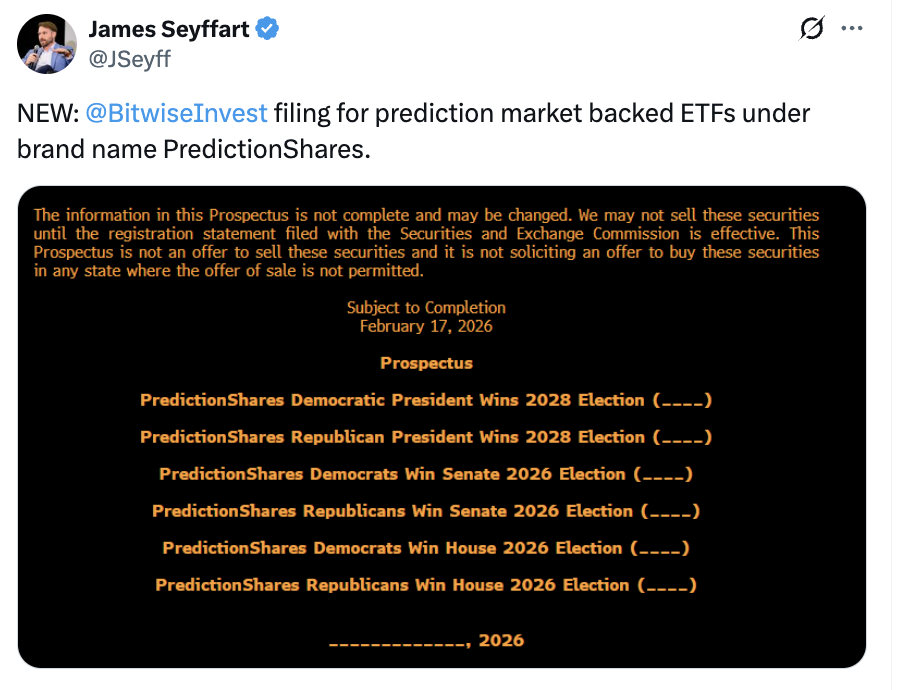
Bitwise filed a prospectus on Tuesday, introducing its new ETF series named “PredictionShares,” comprising six prediction market ETFs to be listed on NYSE Arca. GraniteShares also submitted a prospectus on Tuesday, launching six similarly structured funds, all based on the results of U.S. general elections.
This development closely follows Roundhill Investments’ application on the 14th, which Bloomberg ETF analyst Eric Balchunas has dubbed a “prediction market ETF race.”
These innovative ETFs are designed to offer investors exposure to “binary event contracts”—essentially wagers on future outcomes—traded on regulated exchanges, thereby merging the worlds of finance, politics, and speculation.
The Evolution of Prediction Markets and Their ETFs
Prediction markets are decentralized platforms where participants buy and sell contracts based on the likelihood of specific future events, such as election results or economic indicators. By aggregating collective intelligence through trading, these markets often yield more accurate forecasts than traditional polls. In the cryptocurrency space, platforms like Polymarket have popularized this concept by leveraging blockchain technology to facilitate transparent, tamper-proof betting on real-world outcomes, from presidential elections to sports events.
The allure of prediction markets lies in their efficiency: the contract price reflects the market’s implied probability of an event occurring. For instance, a contract trading at $0.60 suggests a 60% chance of the predicted outcome materializing. Historically, these markets originated from academic research and early platforms like the Iowa Electronic Markets. However, their popularity has exploded with the integration of cryptocurrencies, enabling anonymous participation and global access.
Now, ETF issuers are financializing these concepts, transforming them into accessible and regulated investment products. Unlike direct cryptocurrency bets on platforms such as Polymarket, these new ETFs will invest in binary event contracts listed on exchanges regulated by the Commodity Futures Trading Commission (CFTC). Each fund pledges to allocate at least 80% of its assets to these contracts (e.g., a contract for the Democratic Party winning the 2028 presidential election), which pay $1 if the event occurs and $0 otherwise. The remaining assets may be held in cash or short-term U.S. Treasury bills. This structure converts probability forecasting into a tradable asset class, potentially attracting institutional investors seeking diversified exposure without navigating the complexities of direct crypto trading.
Roundhill pioneered this trend with its applications for ETFs linked to presidential, Senate, and House election outcomes, utilizing swap agreements or direct holdings of “event contracts” to gain exposure. Bitwise’s “PredictionShares” series and GraniteShares’ similar offerings quickly followed suit, both proposing six funds for listing on NYSE Arca: specifically targeting a Democratic or Republican victory in the 2028 presidential election, and control of the Senate or House in 2026.
Bloomberg’s Seyffart highlighted this as part of a broader trend toward the “ETF-ization of everything,” underscoring how such products securitize prediction market assets and open new avenues for investment.
This isn’t the first foray into event-based ETFs for these issuers. Roundhill previously applied for all-or-nothing ETFs using Flexible Exchange Options (FLEX Options), for example, betting on the S&P 500 reaching 10,000 points by 2030. Bitwise, a leader in crypto index funds with over 40 products, recently expanded into strategic ETFs for tokens like Bittensor (TAO) and Sui, combining direct holdings with indirect exposure. GraniteShares, known for its leveraged single-stock ETFs, also pursues high-volatility strategies, including 2x long and short funds for crypto-related stocks like MicroStrategy (MSTR) and Riot Platforms (RIOT).
These applications build upon a growing trend of packaging the volatility and innovation of cryptocurrencies into familiar ETF structures, potentially bridging the gap between traditional finance (TradFi) and decentralized finance (DeFi).
Community Reaction and Broader Implications for the Crypto Ecosystem
The crypto community on X (formerly Twitter) has reacted with a mix of excitement and cautious optimism, viewing these applications as a bullish signal for the mainstream adoption of prediction markets. Prominent ETF analyst Eric Balchunas tweeted, “The race is on… Roundhill’s filing on Friday sparked a prediction market ETF race. GraniteShares and Bitwise have now joined the fray.” This post garnered significant interaction, with replies discussing the potential for “new alpha products.”
Overall, discussions on X portray these ETF applications as a step towards the “financialization” of crypto concepts. Users have praised Roundhill’s swap-based structure for potentially avoiding the net asset value (NAV) erosion often seen in options ETFs. Sentiment leans positive, with many seeing this as a validation of prediction markets’ role in forecasting and hedging, although regulatory approval under SEC scrutiny remains a significant hurdle.
These ETF applications underscore the accelerating convergence of cryptocurrency and traditional finance, potentially injecting significant liquidity into prediction markets and enhancing their predictive capabilities. For the crypto community, this translates to easier access to event-based speculation without the complexities of operating decentralized exchanges. If approved, these products could attract billions in assets, much like how spot Bitcoin ETFs revolutionized crypto investment.
However, challenges persist: binary contracts are subject to stringent regulation, and the SEC’s stance on crypto-related products continues to evolve. As Balchunas noted, this is “not the first such application, and I think it’s highly unlikely to be the last.” With the 2026 midterm elections and the 2028 general election on the horizon, these ETFs could become valuable tools for hedging political risk, further blurring the lines between market dynamics and geopolitical events.
The entry of Bitwise, GraniteShares, and Roundhill into prediction market ETFs signals the maturing of the crypto space, where innovation meets regulatory frameworks. As indicated by community reactions, this could herald a new era of “Alpha” in the investment landscape, but ultimate success hinges on navigating the SEC’s rigorous approval process.
Related Content: Is a Regulatory Storm Brewing? U.S. SEC and CFTC Closely Monitoring Prediction Markets
Disclaimer: This article provides market information only. All content and views are for reference purposes only and do not constitute investment advice, nor do they represent the views and positions of BlockBeats. Investors should make their own decisions and transactions. The author and BlockBeats will not bear any responsibility for direct or indirect losses incurred by investors’ transactions.