The Nakamoto Heist: How David Bailey Used a 99% Stock Collapse to Buy His Own Empire
This exposé delves into the audacious financial maneuvers orchestrated by David Bailey and his controlled entity, Nakamoto Holdings ($NAKA). It chronicles a dizzying saga: from the meteoric rise of a shell company’s stock post-reverse merger, through a devastating 99% collapse that decimated retail investor holdings, to the eventual high-premium acquisition of Bailey’s private companies using the very public entity he had left in ruins. This is a meticulously engineered wealth transfer, exploiting information asymmetry and regulatory loopholes.
It’s a stark investigation into greed, compliance games, and the brutal realities of influencer capitalism. It serves as a potent warning: when faith is packaged as a financial product, and decentralized rhetoric meets centralized avarice, retail investors often become the ultimate source of exit liquidity. Understanding this narrative may provide a crucial dose of sobriety the next time a prominent figure champions a new investment.
In a stunning display of financial maneuvering, David Bailey, CEO of Nakamoto Holdings ($NAKA), has orchestrated the acquisition of two of his private companies using a publicly traded entity that has seen its market value plummet by 99%. What makes this transaction particularly audacious is that the groundwork for this intricate wealth transfer was laid long before the average retail investor ever bought a single share, and it was executed without requiring further shareholder approval.
To fully grasp the mechanics of this alleged ‘heist,’ we must retrace the steps from its inception.
The saga began in May 2025, when KindlyMD, a dormant shell company, announced a reverse merger with Nakamoto Holdings, a Bitcoin treasury vehicle founded by David Bailey. This announcement triggered a meteoric rise in KindlyMD’s stock price, soaring from $2 to over $30 within days. Retail investors, fueled by excitement and the endorsements of prominent Bitcoin influencers, flocked to buy shares. Bailey himself basked in the spotlight, boldly comparing Nakamoto Holdings to legendary financial dynasties like the Morgans, Medicis, and Rothschilds.
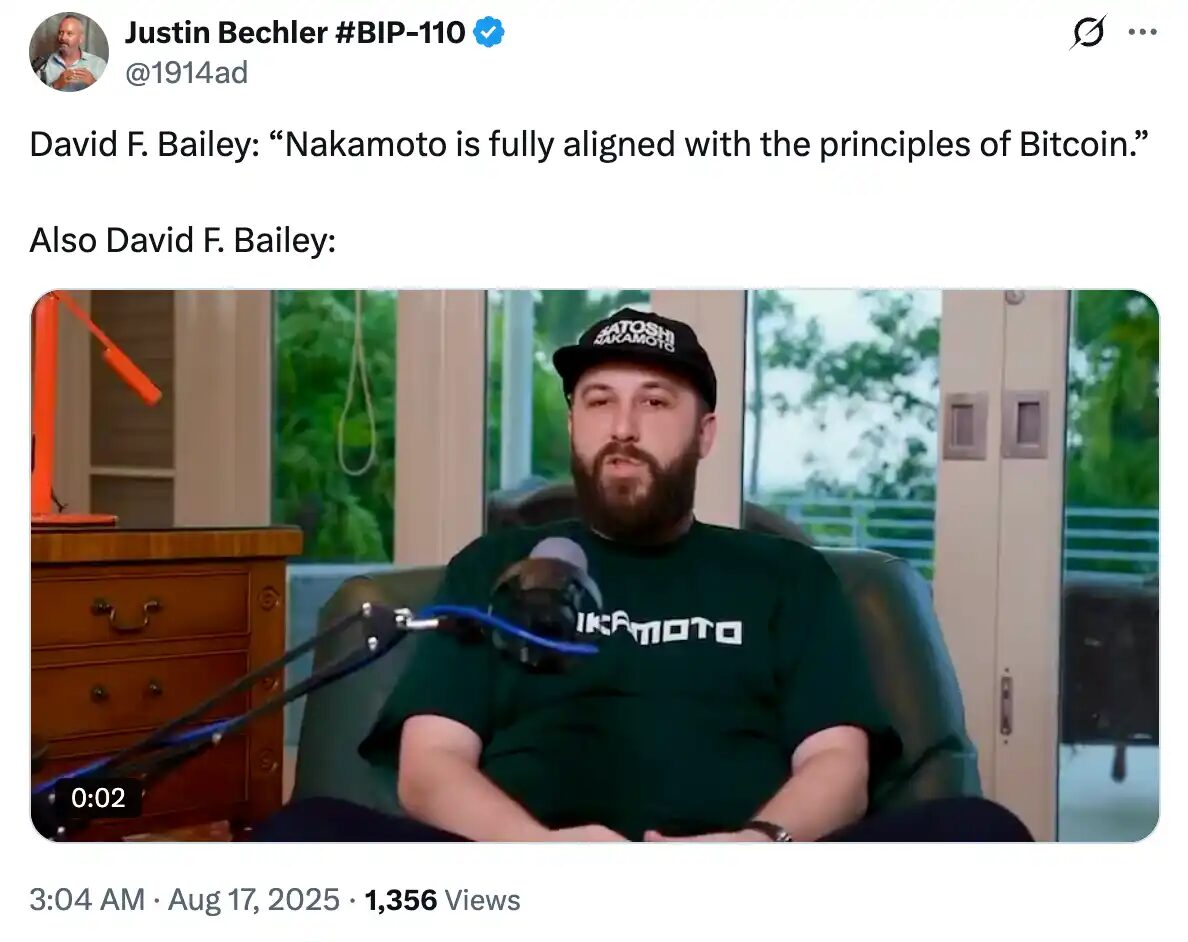
Just nine months later, the stock price has crashed to a mere 29 cents, and Bailey has now leveraged this decimated asset to acquire his private ventures.
The Pump: An Engineered Ascent
The design of this financial mechanism was remarkably intricate.
KindlyMD, originally an obscure micro-cap stock on Nasdaq, served as the vehicle for Nakamoto Holdings’ public debut via a reverse merger. This move was bolstered by a substantial $510 million Private Investment in Public Equity (PIPE) and $200 million in convertible debt. On paper, it appeared to be the birth of a Bitcoin treasury titan. A new generation of Bitcoin influencers eagerly championed $NAKA, urging investors to buy in with the promise of indirect Bitcoin ownership.
Within days, NAKA’s price-to-NAV (Net Asset Value) multiple reached an astonishing 23x, meaning speculators were paying $23 for every $1 worth of Bitcoin the company held. Even Michael Saylor’s MicroStrategy, a well-established company with years of operational history and revenue-generating software, never commanded such a premium. The critical distinction? MicroStrategy’s CEO wasn’t accused of structuring deals to personally benefit from the backend.

Insiders, however, held a crucial advantage. PIPE investors, including notable Bitcoin figures like Udi Wertheimer, Jameson Lopp, and Adam Back (known for opposing BIP-110), secured their shares at a mere $1.12 each. Retail investors, meanwhile, were buying in at $28, $30, $31, and even higher. This stark information asymmetry was baked into the structure from day one.
In June, Bailey executed another $51.5 million PIPE financing round at $5.00 per share. While still significantly below retail entry points, these second-wave investors, too, ultimately faced substantial losses. Bailey celebrated this fundraising, touting strong investor demand and claiming it took less than 72 hours to complete. Let’s examine the unfolding strategy.
The Precipitous Dump
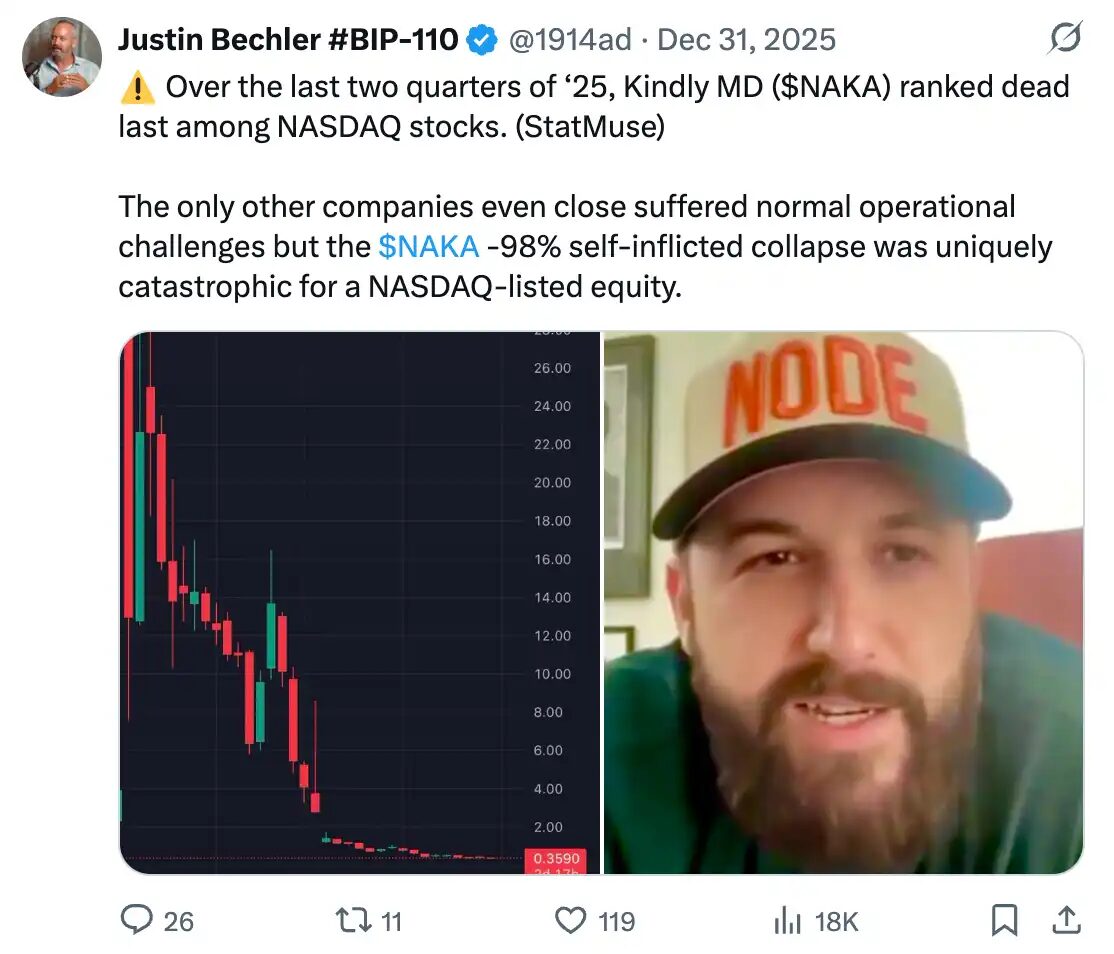
By September, NAKA’s stock had plummeted by a staggering 96%. Early PIPE investors, who acquired shares at $1.12, were finally able to cash out after the merger completed in August – and they did. Bailey’s response was unconventional for a public company CEO: he openly told shareholders who were merely ‘trading’ to exit their positions. And exit they did.
The stock continued its freefall, dipping below $1, then 50 cents, then 30 cents. A company holding approximately 5,765 Bitcoin, valued at over $500 million, now had a market capitalization of less than $300 million.

The market’s valuation of Nakamoto, falling below the intrinsic value of its Bitcoin holdings, spoke volumes about investor perception of the management team and corporate structure surrounding these assets.
The Debt Spiral
As the stock price collapsed, Bailey rapidly cycled through lenders, akin to a gambler borrowing on the casino floor.
The initial capital structure included a $200 million convertible note from Yorkville Advisors, convertible at $2.80 per share. As NAKA’s price plummeted below this threshold, the convertible note transformed into a debt that threatened to dilute equity. Consequently, on October 3rd, Nakamoto secured a $203 million term loan from Two Prime Lending to redeem the Yorkville notes and accrued interest.
Just four days later, on October 7th, they borrowed $206 million in USDT from Antalpha at 7% interest to repay Two Prime. The Antalpha loan had a mere 30-day term, with an option for a 30-day extension. Within a single week, they had replaced a convertible note with a term loan, and then the term loan with a 30-day bridge loan. The original intention was to convert this bridge loan into a $250 million, 5-year secured convertible note from Antalpha – a new convertible to repay the bridge, which repaid the term loan, which repaid the old convertible. However, that $250 million convertible note never materialized under Antalpha’s terms.
On December 16th, Nakamoto borrowed $210 million in USDT from Kraken at 8% interest, collateralized by 150% of its Bitcoin reserves.

Consider the implications: lenders held $315 million worth of Bitcoin as collateral for a $210 million loan. If NAKA’s stock went to zero, Kraken would seize the collateral. If Bitcoin itself dropped by 33%, Kraken would remain unscathed. At every turn of this convoluted saga, lenders were meticulously protected, while common shareholders bore the full brunt of the reflexive collapse. Each new loan tightened the noose around the company’s equity.
Delisting Countdown
On December 10th, Nasdaq issued a delisting warning to Nakamoto, citing its stock price falling below $1 for 30 consecutive business days. The company was given until June 8, 2026, to regain compliance by achieving a closing price of over $1 for ten consecutive trading days. Currently, the stock trades at 29 cents.
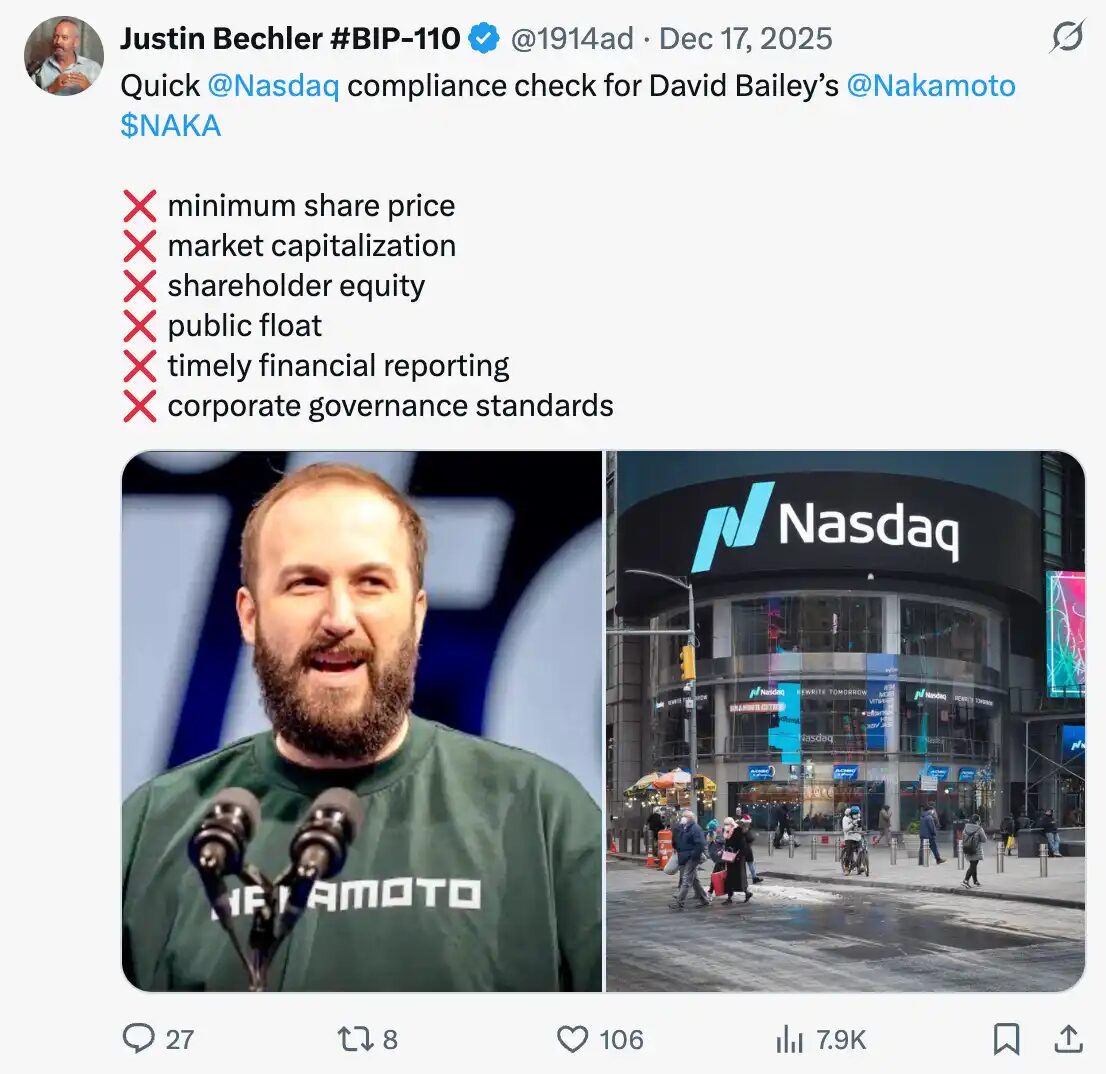
A delisting would cripple Nakamoto’s ability to conduct At-The-Market (ATM) offerings, issue convertible notes, or use its stock as acquisition currency. Everything Bailey had assembled within this shell company hinged on a Nasdaq listing that now appears unsustainable.
Accounting Catastrophe
In November, Nakamoto filed Form 12b-25 with the SEC, admitting its inability to file quarterly financial reports on time due to accounting complexities stemming from the merger. Preliminary figures painted a grim picture:
- A $59.75 million loss from the Nakamoto acquisition (paying above Net Asset Value).
- An unrealized loss of $22.07 million on digital assets.
- A realized loss of $1.41 million from Bitcoin sales.
- A $14.45 million loss from debt extinguishment due to refinancing maneuvers.
This amounted to a single-quarter loss of approximately $97 million, only partially offset by a $21.8 million accounting gain from contingent liabilities. The company, touted as a pristine Bitcoin treasury vehicle, couldn’t even file its books on time.
The Heist Unveiled
This brings us back to the events of this morning.
Nakamoto announced the signing of a definitive merger agreement to acquire BTC Inc and UTXO Management. BTC Inc owns Bitcoin Magazine and operates the Bitcoin Conference, while UTXO manages a Bitcoin-focused hedge fund. Bailey is the Chairman and CEO of Nakamoto, the acquiring entity. He is also the founder of BTC Inc and UTXO, the selling entities. He is the buyer, the seller, and the CEO approving the terms.
Weeks before the acquisition, however, he quietly transferred his CEO title to Brandon Greene, creating a paper-thin veil between himself and the entities he was about to purchase with shareholder capital.
This morning’s transaction was entirely financed through Nakamoto’s stock, priced at $1.12 per share based on a call option embedded in the original marketing services agreement. This is while $NAKA is desperately struggling to climb back from its current 29-cent valuation. Bailey’s companies received a stock valuation nearly four times the current market price. Security holders of BTC Inc and UTXO will receive 363.6 million shares, valuing the transaction at $107.3 million based on the current market price.
Crucially, these shares were issued at $1.12, indicating the deal was structured when NAKA’s stock was significantly higher, and the terms were never adjusted despite the subsequent collapse. Beyond the notional pricing on paper, the critical reality is that 363.6 million new shares just entered circulation. Regardless of whether the documents state $1.12 or $0.29, existing shareholders face substantial dilution. The $1.12 tag serves as a courtesy to the sellers, but the dilution is very real for everyone else.
No additional shareholder approval was required because the call option was pre-embedded in the initial merger documents, which shareholders approved when NAKA’s stock was trading at $20-$30. Retail investors, in approving those initial terms, unwittingly authorized the future acquisition of Bailey’s private businesses at a locked-in, high premium, even as their own investments were evaporating.
The Architecture of Self-Serving Deals
Stepping back, the entire architecture of this scheme is breathtakingly ‘elegant’ in its self-interest.
Bailey founded Nakamoto Holdings, merged it into a public shell company (KindlyMD), and raised $710 million in the process. Fueled by retail enthusiasm, the stock was inflated to 23x NAV. PIPE investors entered at $1.12, while the public paid 20-30 times that amount. The stock then collapsed by 99%. During this period, the company cycled through three lenders in a single week, attempting to manage $200 million in debt that was originally structured to convert to equity at prices far above current levels.
Now, with the stock trading below 30 cents, Bailey is using this hollowed-out vehicle to absorb his private empire, under terms agreed upon when the stock was trading at hundreds of times its current value. The initial KindlyMD merger appears to have been a Trojan horse; the acquisition of BTC Inc was the true payload.
Bailey, in a sense, disclosed this from the outset. Early press releases mentioned Nakamoto’s intent to acquire BTC Inc, contingent on audits and the exercise of a call option. The Marketing Services Agreement (MSA) was publicly filed, and the option terms were disclosed. Legally, everything was compliant and ‘transparent’ – as is often the case with complex financial engineering, where the devil is buried in the details of documents few will ever read.
The individual who runs Bitcoin Magazine, organizes the world’s largest Bitcoin conferences, and positions himself as a leader of the Bitcoin movement, built a public company, destroyed 99% of its shareholder value, and is now using it to acquire his own ventures at a premium. He once compared himself to the Medicis. At least the Medicis created value for Florence before taking their cut.
Nakamoto Holdings stands as a stark testament to what happens when influencer culture collides with the public stock market.
The Exit Liquidity Play
David Bailey raised $710 million from over 200 investors across six continents. He promised them a future akin to the Morgans, Medicis, and Rothschilds – a financial dynasty built on Bitcoin. He declared Nakamoto would bring Bitcoin to the heart of global capital markets, ensuring their names would echo through history.
What he delivered, however, was a devastating 99% loss.
He priced PIPE shares at $1.12 while retail investors paid $28. He embedded a call option to acquire his own companies into documents that shareholders approved without full comprehension. He cycled through three lenders in a week to prevent $200 million in debt from crushing equity, incurring $14 million in debt extinguishment losses. He sold Bitcoin from a treasury purportedly built to ‘hodl,’ incurring losses. He couldn’t even file quarterly reports on time. And when the stock ultimately crashed to 29 cents…
As the dust settled and the retail investors who trusted him were left with virtually nothing, he exercised that call option, using the wreckage of their investments to buy his private empire at four times the market price.
Bailey holds 11 million shares, acquired at a cost of $1.12 each. Adam Back holds nearly 9 million shares. Balaji, Lopp, Yusko, Salinas, Jihan Wu – all gained entry at prices unattainable for the teachers, truck drivers, or first-time investors. These are the individuals who shape the Bitcoin narrative: they run conferences, publish magazines, manage funds, and tweet. They are the supply chain of faith, converting skeptics into believers, and believers into exit liquidity.
Now, Bailey controls Bitcoin Magazine, the Bitcoin Conference, and a hedge fund, all bundled into a public company whose market cap is a fraction of its Bitcoin holdings, with all acquisitions funded by stock valued at four times the market price – and all approved before a single retail dollar entered the fray.
And he’s not finished.
Nakamoto has already filed for a $5 billion At-The-Market (ATM) stock offering with the SEC. Bailey now controls the media arm, the conference arm, the hedge fund, and a shelf registration that allows him to continue issuing stock, collateralized by Bitcoin reserves, until the very last drop of value is extracted.
When exactly did the Bitcoin community hand the keys over to conference promoters and influencer capitalists? And why are so many surprised when they drive the car away?