Original Author: Four Pillars
Translated & Compiled by: Ken, ChainCatcher
The Future of L2s: Unpacking the Open Source Monetization Debate Between Optimism and Arbitrum
Key Insights:
- Base’s strategic shift from Optimism’s OP Stack to a proprietary unified architecture sent ripples through the market, significantly impacting the value of the $OP token.
- Optimism champions a fully open-source model under the MIT license, with revenue sharing activated only for chains integrating into its “Superchain.” In contrast, Arbitrum’s “community source-code” model mandates a 10% protocol revenue contribution from chains built on Orbit that settle outside the Arbitrum ecosystem.
- This ongoing debate about open-source monetization within blockchain infrastructure mirrors historical challenges faced by traditional software giants like Linux, MySQL, and WordPress. However, the introduction of crypto tokens adds a unique layer of immediate financial and stakeholder dynamics.
- There is no single “correct” answer in this evolving landscape. A clear understanding of each model’s inherent trade-offs is crucial for fostering long-term sustainability within the Layer 2 ecosystem.
1. Base’s Pivotal Move and the Superchain’s Shifting Sands
On February 18th, Coinbase-backed Ethereum Layer 2 network, Base, made headlines by announcing its intention to decouple from Optimism’s OP Stack. This strategic pivot involves transitioning to a proprietary, unified codebase, aiming to consolidate critical components, including the sequencer, into a single repository while reducing reliance on external entities like Optimism, Flashbots, and Paradigm. Base’s engineering team highlighted in an official blog post that this shift is projected to double their hard fork frequency from three to six times annually, significantly accelerating upgrade cycles.
The market’s response was immediate and sharp: the $OP token experienced a decline of over 20% within 24 hours. This reaction underscores the gravity of the decision, as one of the largest chains within the Optimism Superchain ecosystem declared its independence.
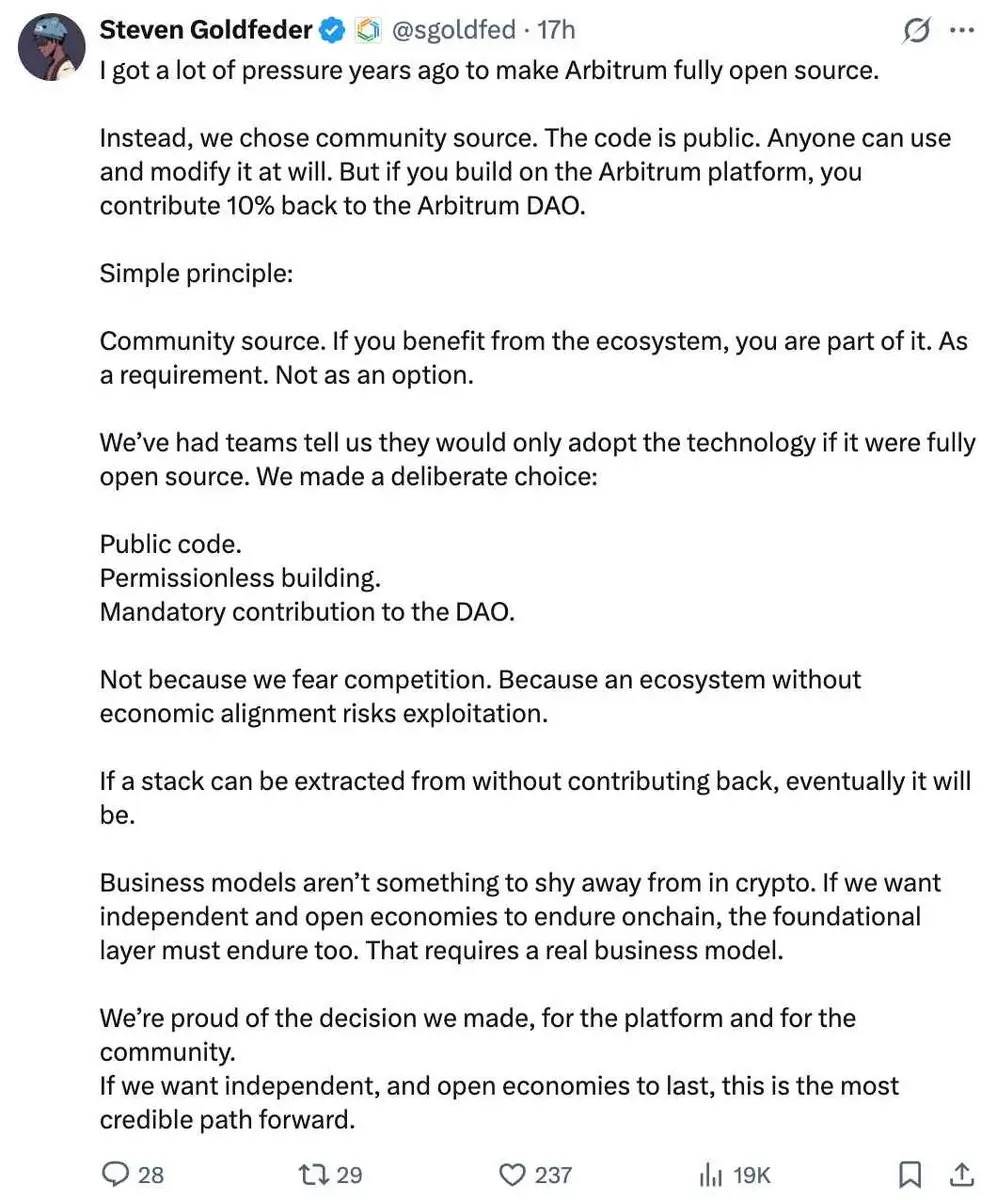
Coinciding with this development, Steven Goldfeder, co-founder of Arbitrum and CEO of Offchain Labs, took to X (formerly Twitter) to remind the community of Arbitrum’s distinct path. He emphasized that, despite pressure to fully open-source Arbitrum’s code, his team consciously adopted a “community source-code” model. Under this framework, while the code is publicly accessible, chains built on the Arbitrum Orbit stack are required to contribute a percentage of their protocol revenue to the Arbitrum Decentralized Autonomous Organization (DAO). Goldfeder’s pointed warning resonated: “If a stack allows claiming revenue without contributing, this is ultimately what happens.”
Base’s departure transcends a mere technical migration; it thrusts a fundamental question into the spotlight: what economic foundation should underpin blockchain infrastructure? This article delves into the divergent economic frameworks employed by Optimism and Arbitrum, dissecting their differences and exploring the potential trajectories for the industry.
2. Two Distinct Models for L2 Sustainability
Optimism and Arbitrum, both pioneers in Ethereum Layer 2 scaling, have adopted fundamentally different philosophies regarding software distribution and ecosystem economic sustainability.
2.1 Optimism: The Power of Unrestricted Openness and Network Effects
Optimism’s OP Stack operates under a fully open-source MIT license, granting anyone the freedom to access, modify, and deploy their own L2 chain without royalties or upfront revenue-sharing obligations. The economic alignment mechanism is primarily triggered when a chain opts to join Optimism’s official “Superchain” ecosystem.
Superchain members commit to contributing 2.5% of their chain’s gross revenue or 15% of their on-chain net revenue (fee revenue less Layer 1 gas costs), whichever is greater, to the Optimism Collective. In return, they gain access to shared governance, enhanced security, seamless interoperability, and the collective branding power of the Superchain.
The rationale is elegantly simple: fostering an explosion of L2s built on the OP Stack creates a vast, interconnected network. This network effect is designed to intrinsically boost the value of the OP token and the entire Optimism ecosystem. This strategy has already yielded significant adoption, attracting major players like Coinbase’s Base, Sony’s Soneium, Worldcoin’s World Chain, and Uniswap’s Unichain.
Beyond the permissive MIT license, the OP Stack’s modular architecture is a key differentiator. Its ability to independently swap out execution, consensus, and data availability layers empowers projects like Mantle and Celo to integrate advanced zero-knowledge proof modules, such as OP Succinct, and customize their stack extensively. This level of sovereignty—the freedom to obtain code and modify internal components without external permission—is highly appealing to large enterprises.
However, this very openness presents a structural vulnerability: low barriers to entry often translate to low barriers to exit. Chains leveraging the OP Stack have limited economic ties to the Optimism ecosystem. As a chain’s profitability grows, the economic incentive to operate independently becomes increasingly compelling. Base’s recent move serves as a stark illustration of this dynamic.
2.2 Arbitrum: Enforced Synergy and Long-Term Commitment
Arbitrum employs a more nuanced approach. For Layer 3 (L3) chains built on Arbitrum Orbit and settling on either Arbitrum One or Nova, no revenue-sharing obligation is imposed. However, under the Arbitrum Expansion Program, any chain (L2 or L3) that settles on a network *other than* Arbitrum One or Nova is required to contribute 10% of its net protocol revenue. This contribution is split, with 8% directed to the Arbitrum DAO treasury and 2% to the Arbitrum Developer Association.
This creates a dual structure: freedom for chains within the Arbitrum ecosystem, but a mandatory contribution for those utilizing Arbitrum’s technology for external deployments.
Historically, deploying an Arbitrum Orbit L2 directly settling on Ethereum required a governance vote from the Arbitrum DAO. While this process transitioned to a self-service model with the launch of the Arbitrum Expansion Program in January 2024, the earlier “permissioned” nature and emphasis on L3s may have deterred large enterprises seeking sovereign L2s. For companies aiming for direct Ethereum connectivity, an L3 structure built on Arbitrum One introduced additional business risks related to governance and technical dependencies.
Steven Goldfeder’s intentional branding of this model as “community source-code” positions it as a middle ground between traditional open source and proprietary licensing. It maintains code transparency while ensuring that commercial utilization outside the immediate Arbitrum ecosystem directly contributes to its upkeep and development.
The primary advantage of this model lies in its ability to align the economic interests of ecosystem participants. Chains settling externally face tangible exit costs, theoretically securing a sustainable revenue stream. The Arbitrum DAO has reportedly amassed approximately 20,000 ETH in revenue, and Robinhood’s recent announcement to build its own L2 chain on Orbit further validates the model’s appeal for institutional adoption. The Robinhood chain testnet’s impressive 4 million transactions in its inaugural week highlight Arbitrum’s technological maturity and its capacity for regulatory-friendly customization, offering significant value to specific institutional clients.
2.3 A Spectrum of Trade-offs
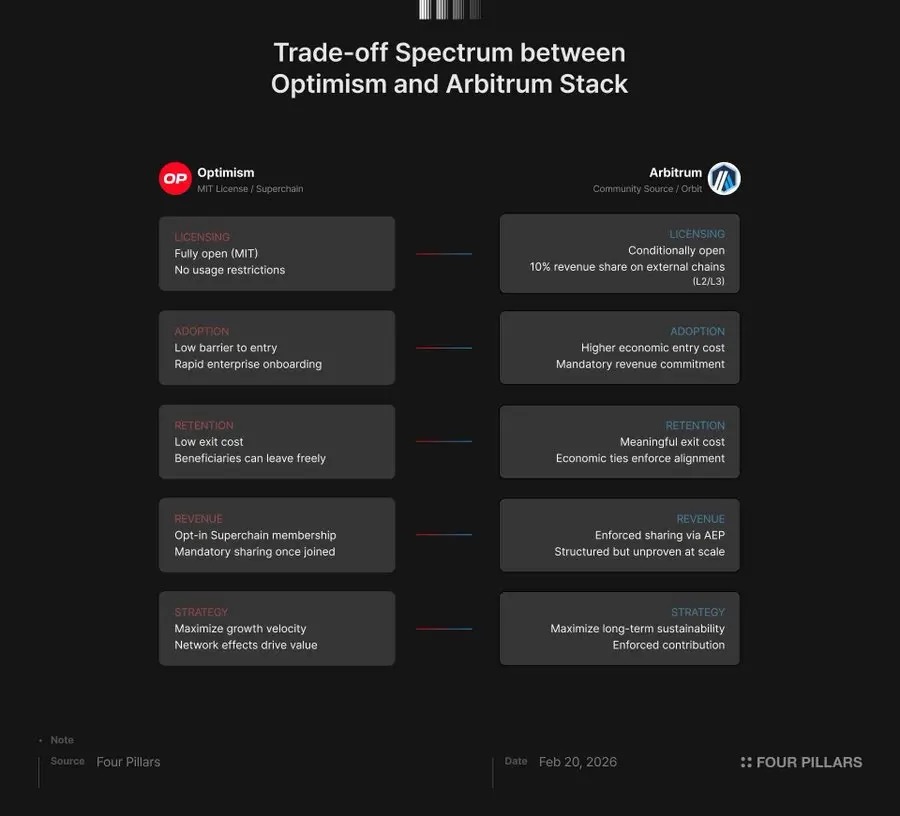
Both models are optimized for different strategic priorities. Optimism’s approach prioritizes rapid initial enterprise adoption through its unconditionally open MIT license, modular architecture, and the compelling proof-of-concept provided by Base. An environment offering permissionless code access, flexible component replacement, and established reference cases significantly lowers the entry barrier for commercial decision-makers.
Conversely, Arbitrum’s model emphasizes long-term ecosystem sustainability. Beyond its robust technology, its economic coordination mechanism—requiring contributions from external users—aims to secure a stable funding base for crucial infrastructure maintenance. While this might lead to a slightly slower initial adoption rate, the integration of Arbitrum’s unique features, such as Arbitrum Stylus, could result in substantial exit costs for projects, fostering greater commitment.
It’s important to note that the distinction between these models isn’t as stark as often perceived. Arbitrum also offers free, permissionless licensing within its ecosystem, and Optimism requires revenue sharing from its Superchain members. Both exist on a spectrum between “fully open” and “fully enforced,” differing in degree and scope rather than fundamental nature.
Ultimately, this divergence represents the blockchain world’s take on the classic business dilemma: balancing aggressive growth with long-term sustainability.
3. Echoes from Open Source History: Lessons for L2s
The tension between open access and monetization is not a novel challenge unique to blockchain. The history of open-source software is replete with similar debates over various monetization models.
3.1 Linux and Red Hat: Monetizing Services, Not Code
Linux stands as arguably the most successful open-source project ever, its GPL-licensed kernel pervasive across servers, cloud computing, embedded systems, and Android. Yet, Red Hat, the most successful commercial entity built upon the Linux ecosystem, did not profit from the code itself. Instead, it monetized services: technical support, security patches, and stability guarantees for enterprise clients, culminating in its $34 billion acquisition by IBM in 2019. The code was free, but professional operational support came at a premium. This strategy bears a striking resemblance to Optimism’s recently launched OP Enterprise.
3.2 MySQL and MongoDB: Dual Licensing and the “Freeloader” Problem
MySQL pioneered a dual-licensing model: a GPL-licensed open-source version alongside a commercial license for enterprises seeking commercial use. The code was transparent and free for non-commercial applications, but revenue generation required payment—a concept akin to Arbitrum’s community source-code model. While successful, this approach had its challenges. Oracle’s acquisition of Sun Microsystems in 2010, which included MySQL, sparked fears about its future, leading to its original creator, Monty Widenius, and community developers forking it into MariaDB. This highlights that while the catalyst was ownership, the potential for a fork remains an inherent risk in open source, a parallel to Optimism’s current situation.
MongoDB offers an even more direct parallel to the “freeloader” problem. In 2018, it adopted the Server Side Public License (SSPL) specifically to counter cloud service giants like Amazon Web Services and Google Cloud. These providers were utilizing MongoDB’s open code to offer managed services without contributing back to MongoDB, a recurring pattern throughout open-source history where value is extracted without reciprocation.
3.3 WordPress: Ecosystem Growth as Value Driver, but Challenges Persist
WordPress, fully open-source under the GPL license, powers an astonishing 40% of the world’s websites. Automattic, the company behind WordPress, generates revenue through its WordPress.com hosting services and various plugins, but the core WordPress software itself remains free to use. The platform’s open nature is based on the premise that the overall growth of its ecosystem will inherently enhance the platform’s value—a vision structurally aligned with Optimism’s Superchain.
While undoubtedly successful, the “freeloader” issue has never been fully resolved. A notable dispute arose between WordPress founder Matt Mullenweg and major hosting provider WP Engine, with Mullenweg publicly criticizing WP Engine for generating substantial revenue from the WordPress ecosystem while contributing disproportionately little in return. This paradox—where the largest beneficiaries of an open ecosystem are often the least contributors—mirrors the dynamic observed between Optimism and Base.
4. Why Blockchain Infrastructure Amplifies the Stakes
While these monetization debates are familiar territory in traditional software, they take on a heightened urgency and complexity within the realm of blockchain infrastructure.
4.1 Tokens as Economic Amplifiers
In traditional open-source projects, value is often diffused. The success of Linux, for instance, doesn’t directly cause the price of a specific asset to surge or plummet. However, in blockchain ecosystems, tokens serve as immediate financial barometers, reflecting the incentives, political dynamics, and health of the ecosystem in real-time. The departure of a major participant, as seen with Base, can trigger an instantaneous and highly visible consequence: a token price crash. The more than 20% drop in $OP vividly demonstrates how tokens not only gauge ecosystem health but also amplify crises.
4.2 The Burden of Financial Infrastructure
Layer 2 chains are not merely software applications; they are critical financial infrastructure. Billions of dollars in assets are secured and managed on these networks, demanding immense and continuous investment in stability, security, and maintenance. Unlike many successful traditional open-source projects where maintenance costs are often covered by corporate sponsorships or foundations, many L2 chains today struggle to sustain their own operations. Without external contributions, such as sequencer fee sharing, securing the necessary resources for ongoing infrastructure development and robust maintenance becomes a formidable challenge.
4.3 Ideological Crossroads: Openness vs. Sustainability
The crypto community is deeply rooted in an ideological tradition that champions “code should be free.” Decentralization and freedom are core tenets intricately woven into the industry’s identity. Within this context, Arbitrum’s fee-sharing model can face ideological resistance from certain community factions. Conversely, while Optimism’s open model is ideologically appealing, it grapples with the stark economic realities of long-term sustainability.
5. The Unavoidable Truth: Infrastructure is Never Free
While Base’s decision undeniably presented a challenge to Optimism, it is premature to declare the Superchain model a failure.
Firstly, Optimism has proactively adapted. On January 29, 2026 (Note: The original article states 2026, which is a future date. This may be a typo or refer to a future formal rollout), Optimism officially rolled out OP Enterprise. This enterprise-grade service is tailored for fintech companies and financial institutions, offering support for deploying production-ready chains within 8 to 12 weeks. While the core OP Stack remains MIT-licensed and allows for self-management, Optimism’s assessment is that for many teams lacking deep blockchain infrastructure expertise, partnering with OP Enterprise represents a more rational and efficient path.
Furthermore, Base’s separation from the OP Stack is not an immediate, clean break. Base itself has confirmed its intention to remain a core support service client of OP Enterprise during its transition and plans to maintain compatibility with OP Stack specifications throughout the process. This signifies a technical evolution rather than a complete relational severance, an official stance from both parties. On the other side, Arbitrum’s community source-code model, while theoretically robust, also faces a gap between its ideal design and current practical implementation.
In reality, the approximately 19,400 ETH in net fee revenue accumulated in the Arbitrum DAO treasury primarily stems from sequencer fees and Timeboost MEV auctions directly on Arbitrum One and Nova. Fee-sharing contributions from ecosystem chains via the Arbitrum Expansion Program have yet to be publicly confirmed at any significant scale. This is due to several structural factors: the Arbitrum Expansion Program itself only launched in January 2024, most existing Orbit chains are L3s built on Arbitrum One (thus exempt from revenue sharing), and even prominent independent L2s like the Robinhood chain remain in testnet phase.
For Arbitrum’s community source-code model to truly solidify as a “sustainable revenue structure,” the ecosystem awaits the mainnet launch of large L2s like Robinhood and the tangible inflow of fee-sharing revenue through the Arbitrum Expansion Program. The requirement for large enterprises to contribute 10% of protocol revenue to an external DAO is a significant ask. The fact that institutions like Robinhood still opt for Orbit underscores its value proposition in other dimensions, such as customization potential and technological maturity. However, the model’s core economic rationale remains to be fully proven. Bridging the gap between theoretical design and actual capital flows is a crucial challenge Arbitrum must address.
Ultimately, the two distinct models presented by Arbitrum and Optimism represent different answers to a singular, fundamental question: How do we ensure the long-term sustainability of vital public infrastructure?
The focus should not be on declaring one model inherently “correct,” but rather on understanding the nuanced trade-offs each entails. Optimism’s open approach facilitates rapid ecosystem expansion but carries the inherent risk of its most successful beneficiaries potentially seeking full independence. Arbitrum’s mandatory contribution model aims to establish a sustainable revenue stream but may present a higher initial barrier to adoption.
Regardless of the chosen path, entities like OP Labs, Sunnyside Labs, and Offchain Labs employ world-class research and development talent, all dedicated to scaling Ethereum while preserving its decentralized ethos. Without their continuous innovation, advancements in L2 scaling would be impossible. And the resources to fund this indispensable work must originate from somewhere.
There is no such thing as free infrastructure. As a community, our imperative is not blind allegiance or reflexive criticism, but to initiate an honest, transparent dialogue about who bears the costs of this foundational infrastructure. Base’s recent move can and should serve as a pivotal starting point for this crucial conversation.
(The above content is excerpted and reproduced with authorization from partner PANews, original link | Source: ChainCatcher)
Disclaimer: This article is for market information purposes only. All content and opinions are for reference only and do not constitute investment advice, nor do they represent the views and positions of BlockBeats. Investors should make their own decisions and trades. The author and BlockBeats will not be liable for any direct or indirect losses incurred by investors’ transactions.