Bitcoin Plunges Below $63K Amid Global Tariff Fears and AI Uncertainty: What’s Next for Crypto?
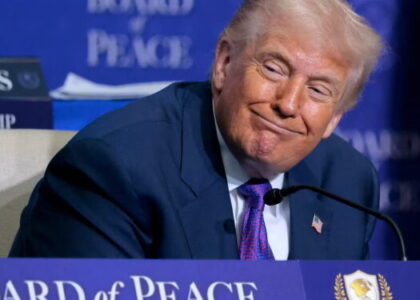
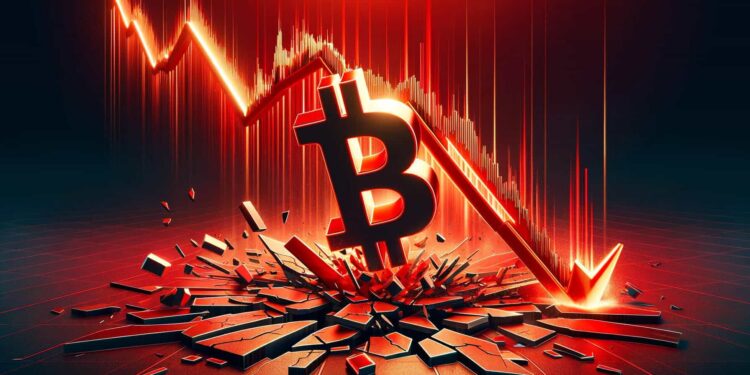
Global investor sentiment has taken a sharp turn towards risk aversion, triggered by a potent combination of former President Trump’s proposed 15% global tariffs and widespread anxieties surrounding the disruptive potential of artificial intelligence. This heightened caution has sent ripples through financial markets, with Bitcoin experiencing a significant downturn today, extending its weakness from the previous night.
The world’s leading cryptocurrency briefly breached the critical $63,000 mark, retreating to its lowest valuation since February 6th. This latest dip underscores the fragility of the crypto market in the face of macro-economic pressures and evolving technological landscapes.
Tariff Threats and Geopolitical Tensions Weigh Heavily
Matt Howells-Barby, VP of Growth at prominent crypto exchange Kraken, commented on the situation, stating, “Much like the broader US equity market, Bitcoin has seen a sharp correction today. The primary catalyst appears to be the resurgence of tariff uncertainty, reminiscent of market anxieties from April 2025. Furthermore, escalating geopolitical tensions are likely to exert additional downward pressure on Bitcoin in the short term.”

Howells-Barby emphasized the significance of the $60,000 threshold, noting, “The $60,000 level is a crucial support for bulls. Should this level fail to hold, Bitcoin could potentially retest the mid-to-low $50,000 range.”
Broader Market Contagion: Tariffs and the AI Revolution
The broader market’s reaction on Monday provided a clear backdrop to Bitcoin’s struggles. Following the Supreme Court’s decision to block an earlier tariff policy, Trump doubled down on his stance, announcing an increase in temporary tariffs on imported goods from 10% (declared last Friday) to a more aggressive 15%. This announcement sent US stocks plummeting. Concurrently, capital began a swift exodus from companies perceived as vulnerable or lagging in the ongoing “AI revolution,” intensifying pressure on risk assets across the board.
Technical Outlook: Is a “Death Cross” on the Horizon?
From a technical analysis perspective, Bitcoin may be poised for a more extended period of price discovery as it searches for a definitive bottom. Historical data frequently illustrates that Bitcoin’s true market bottom often coincides with a specific technical event: the 50-week moving average (MA) crossing below the 100-week moving average. This bearish crossover, commonly referred to as a “Death Cross,” accurately marked the ultimate bottoming points during the bear markets of both 2018 and 2022.
Currently, the 50-week MA remains elevated above the 100-week MA, indicating that a “Death Cross” is not imminent. This suggests that before such a crossover officially materializes—potentially triggering a phase of “capitulation selling”—Bitcoin could explore lower depths, possibly dipping towards $50,000 or even further.
Understanding the “Lagging Indicator” Phenomenon
While counter-intuitive at first glance—a “Death Cross” typically signals weakening momentum—this pattern perfectly aligns with the nature of moving averages as “lagging indicators.” These crossovers serve to “confirm” an existing trend rather than to “predict” future price movements. Historically, when a “Death Cross” has appeared on Bitcoin’s charts, the market has often already experienced its most severe declines, marking the final capitulation phase and, paradoxically, the eventual end of the bear market.
However, as with all technical indicators, historical performance offers valuable insights but does not guarantee future outcomes. Investors are strongly advised to exercise stringent risk management strategies in these volatile market conditions.
Disclaimer: This article is provided for market information purposes only. All content and opinions expressed herein are for reference only, do not constitute investment advice, and do not represent the views or positions of the publisher. Investors should conduct their own due diligence and make independent trading decisions. The author and publisher shall not be held liable for any direct or indirect losses incurred by investors as a result of their trading activities.