
Pi Network Celebrates One Year of Open Mainnet with Significant Growth in Users and Nodes
The mobile-first blockchain, Pi Network, recently marked the first anniversary of its Open Network launch. The Pi Core Team took to the X platform to unveil the latest advancements within its ecosystem, highlighting remarkable growth over the past year in critical areas such as Know Your Customer (KYC) verification, mainnet migration, and developer engagement.
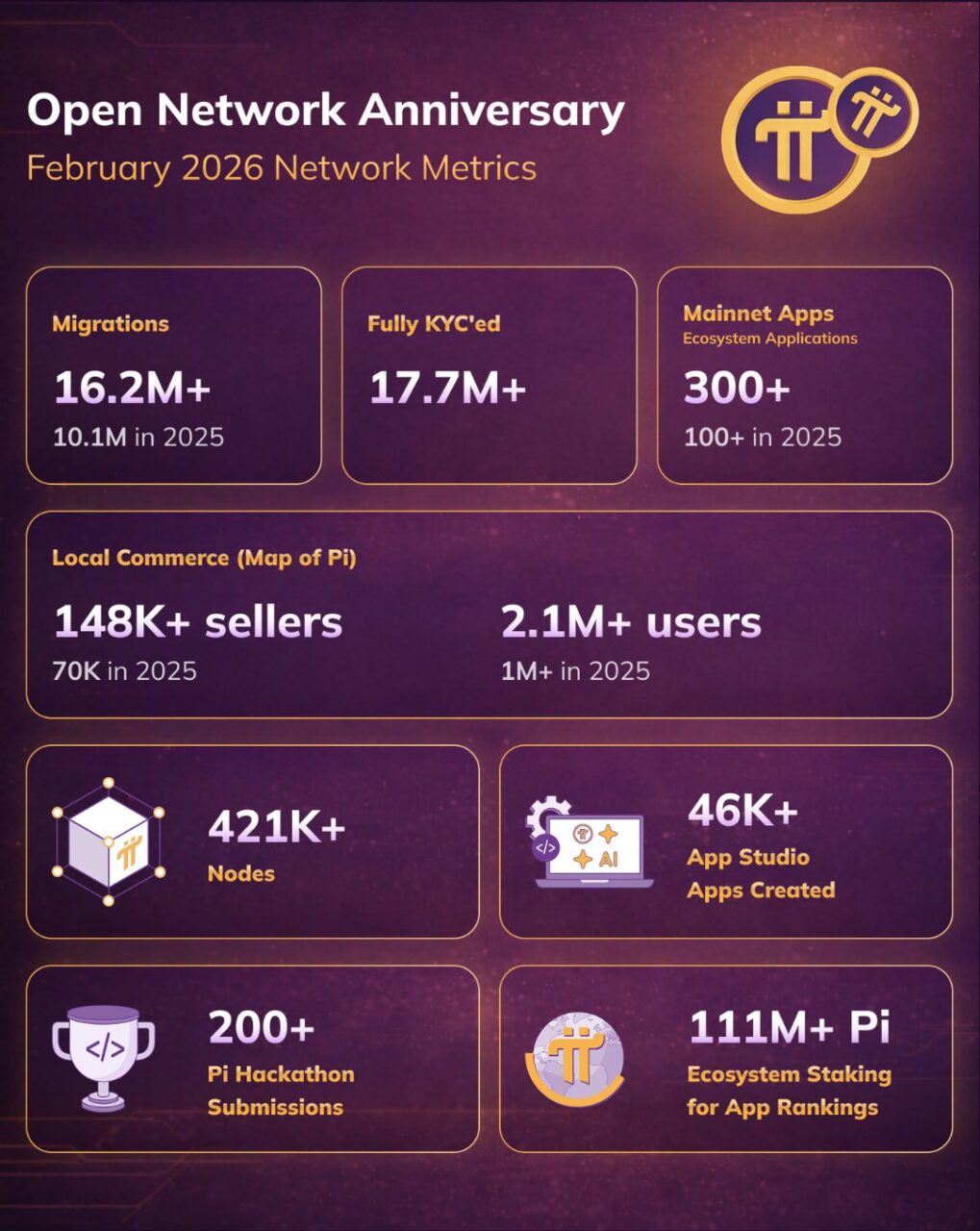
Official data reveals impressive statistics: approximately 16.2 million users have successfully migrated to the mainnet, a substantial increase from roughly 10.1 million recorded during the same period last year. Furthermore, about 17.7 million accounts have completed full KYC verification. The ecosystem also boasts over 300 mainnet applications, supported by around 148,000 local merchants and an active consumer base of approximately 2.1 million users. On the infrastructure front, the network is fortified by an impressive 421,000 active nodes.
Beyond these figures, the App Studio has fostered the creation of over 46,000 application projects, while hackathon events have garnered more than 200 submissions. The community has collectively staked approximately 111 million $PI tokens, primarily to support application ranking and overall ecosystem development. The team has also upgraded the protocol to version 19.6 and announced that version 19.9 will be the final significant update before the anticipated launch of version 20.
Community Sentiment Divided Amid Calls for Accelerated Migration and Reward Distribution
Despite the Pi Core Team’s continuous emphasis on ecosystem expansion, community sentiment appears notably divided. A segment of users and traders has openly questioned the project’s pace, urging for the swift distribution of validator rewards and the initiation of a second round of mainnet migration. Concerns have also been raised regarding accounts that have been locked for extended periods, causing some users to miss potential opportunities to sell at higher price points, thereby putting pressure on overall project trust.
In response, the Pi Core Team stated its intention to evaluate future optimization directions by referencing ecosystem token design documents on GitHub and feedback gathered via Google Forms. The official stance reiterates that token value should be anchored in practical application and long-term utility, rather than being swayed by short-term market fluctuations.
From a structural perspective, the $PI token is designed with a fixed maximum supply of 100 billion tokens. Of this, 65% is allocated for community mining, 20% for the core team, 10% for foundation reserves, and 5% for liquidity. With the resumption of mainnet migration, approximately 200 million $PI tokens have flowed into exchange wallets, leading to an anticipated increase in market selling pressure.
Pi Price Nears All-Time Low, Liquidity Emerges as a Critical Variable
The price performance of $PI stands in stark contrast to the narrative of ecosystem growth. According to CoinGecko data, $PI recently traded at approximately $0.16, experiencing a weekly decline of over 8.7%. This places it precariously close to its all-time low of approximately $0.13. The daily trading volume hovered around $15.35 million, while the broader cryptocurrency market capitalization retreated to roughly $2.26 trillion, marking an annual decline of about 27.5%.
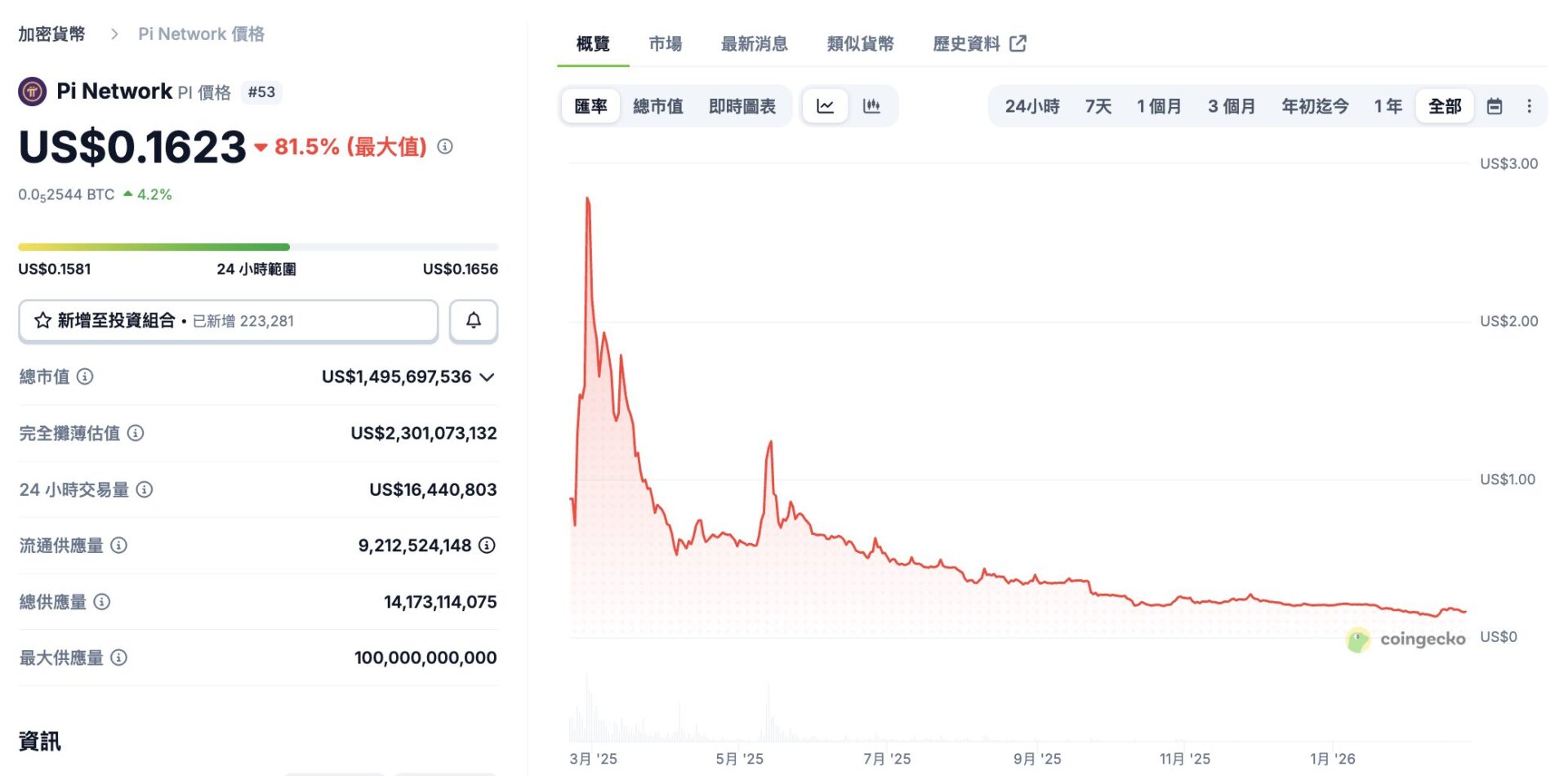
From a technical analysis standpoint, the price of $PI continues to trade below its 50-day Exponential Moving Average (EMA). The $0.1533 mark has emerged as a critical short-term support level. Should the daily candle close decisively below this point, the market could potentially test the $0.13 region.
Compounding the overall market weakness, records indicate tens of millions of $PI tokens flowing out from certain foundation-related wallets within a 24-hour period. This development has fueled concerns among traders regarding potential distribution pressure. While metrics such as total value locked (TVL) on the platform and monthly transaction fees still suggest active usage, the prevailing price trend clearly reflects a significant disparity between the supply being released and the growth in demand.
As Pi Network commemorates its first year of the Open Network, it simultaneously showcases impressive expansion in mainnet users and applications while confronting the stark reality of its token price nearing historical lows. Market attention is visibly shifting from a “growth narrative” to a focus on “liquidity and the pace of token distribution.” Consequently, the upcoming progress in migration and token release will serve as crucial indicators for observing the project’s future trajectory.
(The above content is an authorized excerpt and reproduction from our partner, CryptoCity. Original Link)
Disclaimer: This article is provided for market information purposes only. All content and opinions are for reference only and do not constitute investment advice. They do not represent the views or positions of BlockTempo. Investors should make their own decisions and trades. The author and BlockTempo shall not bear any responsibility for direct or indirect losses incurred by investors’ transactions.