Author: Zen, PANews
Iran’s Crypto Paradox: A Nation’s Survival, A People’s Escape Amidst Economic Turmoil
While the world’s gaze remains fixed on Iran and the Persian Gulf, often framed by narratives of military escalation, geopolitical risks, and their impact on energy markets and shipping lanes, a closer look reveals a more intimate story. Beneath the headlines of military actions, oil facility disruptions, Strait of Hormuz tensions, and volatile financial markets, ordinary Iranians in cities like Tehran, Mashhad, and Ahvaz are navigating a different reality: the urgent need to protect their lives and assets.
In the wake of recent attacks, Iran’s largest cryptocurrency exchange, Nobitex, witnessed a staggering surge in asset outflows, skyrocketing by approximately 700% within minutes. This rapid shift was further corroborated by Chainalysis reports, confirming a sharp increase in hourly domestic crypto trading volumes in the hours following the incidents. Over a mere four-day period leading up to March 2, more than $10 million in crypto assets accelerated their exodus from Iran, underscoring how digital currencies have become a vital conduit for Iranians seeking safer financial havens.
The Rial’s Relentless Decline and the Dollar’s Unyielding Grip
For Iran, any escalation of tensions in the Middle East sends immediate tremors through its fragile exchange rate and financial system, unexpectedly elevating cryptocurrency to a critical role. Over the past years, the Iranian economy has been caught in a deepening spiral of external sanctions, internal imbalances, and relentless currency depreciation. The persistent weakening of the national currency, the Rial, has transcended mere price fluctuations, evolving into a pervasive national panic.
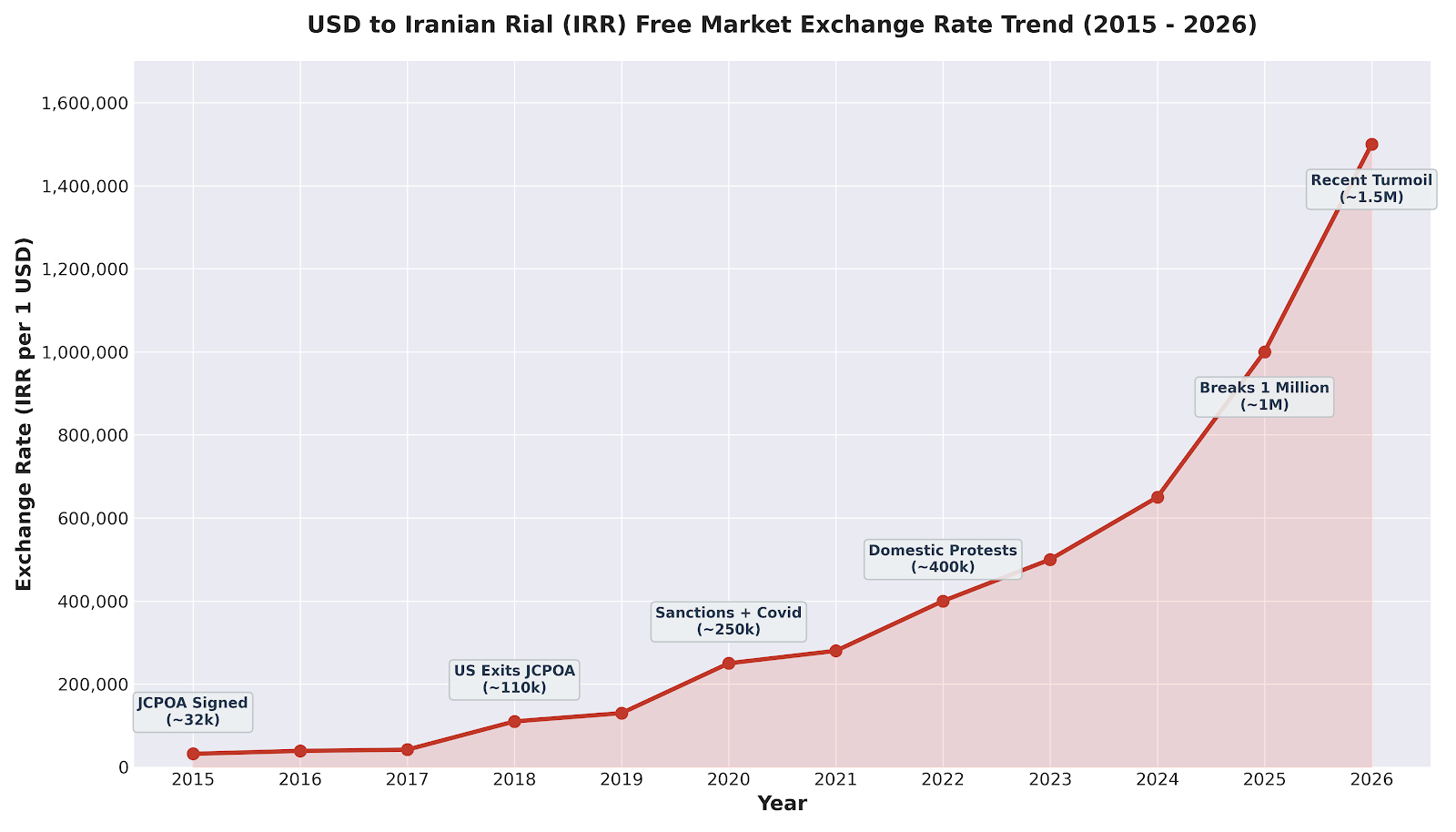
In 2015, following the Joint Comprehensive Plan of Action (JCPOA), there was a brief period of optimism, with the free market rate hovering around 32,000 Rials to the US dollar. However, after the US withdrew from the JCPOA and reimposed sanctions in 2018, the Rial rapidly plunged into the “hundreds of thousands” era against the dollar. Prolonged sanctions, coupled with rampant inflation, tight foreign exchange supply, and escalating geopolitical conflicts, saw the Rial breach the million-Rial mark last year. Amidst widespread protests earlier this year, it plummeted to a historic low of 1.5 million Rials per dollar.
Trapped within a global financial architecture dominated by the US dollar, sanctioned Iran finds itself in an unenviable position. The dollar, as the world’s primary “hub currency,” facilitates stable, low-friction cross-border transactions essential for imports, debt servicing, insurance, shipping, and critical component procurement. Even with Iran’s printing presses running at full throttle, churning out Rials, this crucial capability remains irreplaceable.
In countless commodity markets and supply chain pricing systems, the dollar remains the inherent benchmark. Under sanctions, Iran struggles to access dollar clearing services through conventional banking channels, making hard currency both scarce and expensive. Consequently, a widespread public sentiment has emerged: convert Rials into more reliable assets as quickly as possible. This includes US dollar cash, gold, and, increasingly, cryptocurrencies such as Bitcoin and stablecoins like USDT.
As an Islamic nation, financial activities must also adhere to Sharia law, which strictly prohibits usury (Riba) and gambling (Gharar). Cryptocurrency trading, with its inherent volatility and speculative nature, presents a complex challenge. However, Iran’s Supreme Leader, Ayatollah Ali Khamenei, has maintained a relatively open stance on crypto, advocating for Sharia law to evolve with the times. This pragmatic approach is, at its core, a realistic compromise born out of economic desperation.
Crypto: A Double-Edged Sword for Iran, from Government to Citizenry
Amidst prolonged sanctions and soaring inflation, both the Iranian government and its citizens are actively seeking alternatives to hard currency. This necessity has transformed crypto assets, particularly Bitcoin and dollar-pegged stablecoins, from mere speculative instruments into indispensable tools for value preservation. They serve as a financial safety valve for citizens and a “cyber bank” for the state machine to circumvent sanctions.
The Iranian government’s attitude towards cryptocurrency can be described as a complex mix of “love-hate,” simultaneously utilizing and suppressing it.
At the state level, when crypto activities facilitate import settlements, foreign exchange acquisition, or fund transfers, regulators have shown a degree of tolerance, even integration. An early example was the domestic legalization of Bitcoin mining. Crucially, cryptocurrencies have also become a significant tool within the “shadow financial network” of the Iranian government and military, enabling the transfer of funds and evasion of international oversight. According to TRM Labs, over 5,000 addresses linked to Iran’s Islamic Revolutionary Guard Corps (IRGC) have been identified, with an estimated $3 billion in crypto transferred by the organization since 2023. British blockchain research firm Elliptic reported that Iran’s central bank acquired at least $507 million worth of USDT stablecoins in 2025 (note: this date is in the future, likely implying a recent or ongoing accumulation period).
However, the government’s stance quickly shifts to tightening controls when cryptocurrency is perceived as accelerating Rial depreciation, intensifying capital flight, or fostering unregulated civilian financial networks. In early 2025 (again, likely meaning 2024 in context), the Central Bank of Iran (CBI) abruptly halted Rial payment channels for all crypto exchanges, effectively preventing over 10 million crypto users from purchasing assets like Bitcoin with their local currency. Reports indicated that a primary objective was to curb further Rial depreciation and prevent its rapid conversion into foreign currencies or stablecoins via exchanges.
This administrative measure, which cuts off fiat gateways, essentially severs the most convenient path for citizens to convert Rials into value. Yet, it doesn’t diminish society’s underlying need for crypto; instead, it pushes demand into more clandestine and decentralized channels, including over-the-counter (OTC) trading, alternative payment accounts, or more covert on-chain transfers. Each sudden restriction, implemented during periods of currency crisis, reinforces the public’s preference for “off-system assets,” serving as a stark reminder that financial rules can change arbitrarily and personal assets are not entirely under individual control.
At the citizen level, crypto demand is driven by three primary forces: value preservation, transferability, and speculation. TRM Labs estimates that 95% of Iran-related crypto flows originate from retail investors. Nobitex, Iran’s largest crypto exchange, boasts 11 million clients, with the majority of trading activity stemming from retail and small-scale investors. The exchange itself stated that “for many users, cryptocurrency primarily serves as a store of value in response to the continuous depreciation of the local currency.”
In a surreal turn of events in mid-2024, Telegram’s “Tap-to-Earn” crypto mini-games, such as Hamster Kombat and Notcoin, sparked a nationwide craze in Iran. On Tehran’s subways and bustling streets, countless Iranians frantically tapped their phone screens, hoping that “free crypto airdrops” could offer a meager defense against skyrocketing prices. Reports indicated that nearly a quarter of Iran’s population participated in these games. When a national currency loses credibility, even the faint hope of earning virtual coins by tapping a screen becomes a glimmer of light in the darkness.
Thus, a paradox emerges in Iran: authorities fear that crypto accelerates Rial depreciation and undermines capital controls, leading them to sever Rial payment channels at critical junctures. Simultaneously, within the long-term structural constraints of sanctions and foreign exchange scarcity, cryptocurrency repeatedly proves its utility. For the average Iranian, this utility is paramount, serving as an emergency exit in times of crisis.
The Hidden Battle for Power: Crypto Mining and Resource Scarcity
Unlike the overt military confrontations on the front lines, Iran has been engaged in a silent, internal struggle for years: a battle over electricity resources. In a nation characterized by “scarce social resources,” electricity is no longer merely a utility but has been redefined as a strategic asset ripe for arbitrage. However, the cost of this arbitrage is ultimately borne by ordinary residents, leading to severe power supply challenges.
Despite being an energy-rich nation, Iran has long been plagued by a cycle of electricity shortages and rolling blackouts. The primary culprits are insufficient infrastructure investment, aging generation and transmission systems, and price subsidies that have artificially fueled demand growth.
In its public statements for the summer of 2025 (likely referring to 2024 in context), Iran’s power company, Tavanir, reported that crypto mining consumes nearly 2,000 MW of electricity, roughly equivalent to the output of two Bushehr nuclear power plants. More critically, while mining accounts for approximately 5% of total electricity consumption, it contributes a disproportionate 15%-20% to the current power deficit.
Tavanir further claimed that during a network outage linked to a conflict with Israel, national electricity consumption dropped by about 2,400 MW. The company attributed part of this reduction to a large number of illegal mining operations going offline, stating that the disruption involved 900,000 illicit devices – a figure that indirectly confirms the vast scale of underground mining. The CEO of the Tehran Province Electricity Distribution Company even declared Iran the world’s fourth-largest cryptocurrency mining hub, with over 95% of active miners operating without licenses, making it a “paradise for illegal miners.” This narrative, however, often serves to shift blame from systemic issues to the general populace.
Despite ostensible crackdowns on illegal mining by Iranian authorities in recent years, the problem has only proliferated. This suggests that so-called illegal mining has evolved from a fringe phenomenon into a structural industry. Behind it lies not just electricity price arbitrage, but also a complex web of grey-market protection, rent-seeking by law enforcement, and entrenched local interests, all bearing the deep imprint of privilege.
Remarkably, religious sites like mosques and military-controlled industrial zones reportedly enjoy the benefit of free electricity for mining. “Ordinary citizens and even private businesses cannot obtain the electricity required to operate and cool such a large number of mining rigs,” noted professionals in the cryptocurrency mining sector, implying that only industrial-scale operations could account for such immense power consumption.
Investigations by various media outlets and research organizations have revealed that Iran’s privileged classes hold absolute dominance in this electricity bonanza. Mosques and other religious establishments in Iran legally receive extremely cheap or even free electricity, leading many to become roaring “underground mining farms.” Concurrently, super-large mining operations are frequently concealed within military-controlled heavy industrial parks and other confidential facilities that are exempt from blackout quotas. While the privileged exploit “state electricity” to accumulate Bitcoin, ordinary citizens, burdened by hyperinflation, find even the luxury of powering a fan on a summer night a distant dream.
Ultimately, Iran’s electricity crisis and the proliferation of illegal mining are not simply law enforcement issues. They represent a fierce battle over subsidized resources, exacerbated by currency depreciation and the sheer pressure of survival. The searing pain of blackouts, however, continues to be a recurring reality for ordinary families during the long summer nights.
As the nation grapples with unending geopolitical conflicts and political uncertainty, Iran’s economic future remains shrouded in doubt.
(The above content has been excerpted and reproduced with permission from our partner PANews, original link.)
Disclaimer: This article is for market information purposes only. All content and views are for reference only and do not constitute investment advice. They do not represent the views or positions of BlockBeats. Investors should make their own decisions and trades. The author and BlockBeats will not bear any responsibility for direct or indirect losses incurred by investors’ transactions.