Author: Frank, PANews
The Dawn of AI Agents in Crypto Trading: A New Era or a Risky Frontier?
In a whirlwind development, the concept of “AI Agents” has rapidly permeated the cryptocurrency landscape. On March 3rd, industry titans Binance and OKX simultaneously launched and open-sourced their AI Skills libraries, designed to empower AI Agents with direct capabilities for on-chain alpha discovery and real-time trading. This strategic move followed closely on the heels of prediction market leader Polymarket, which had recently unveiled a dedicated Command Line Interface (CLI) tool for Agents.
These synchronized actions from major players send a resounding message: Artificial Intelligence is poised to become a dominant force in crypto trading, and this transformative shift is already underway. However, a critical question looms for users: Can AI Agent trading truly be relied upon?
Industry Giants Usher in the Age of AI Traders
To grasp the significance of this shift, let’s delve into the functionalities offered by Binance and OKX’s newly open-sourced AI Skills.
Binance’s suite of seven Skills is envisioned as a “unified intelligent core,” translating disparate crypto market signals into actionable trading decisions. These capabilities empower AI Agents to access real-time market data, execute automated spot trades, and even analyze wallet addresses to generate detailed holdings reports akin to “smart money” tracking. Additional features include token retrieval, copy trading, and comprehensive contract risk monitoring.
OKX’s OnchainOS AI upgrade, meanwhile, positions itself as “the on-chain operating system for AI Agents.” It boasts support for over 60 on-chain functions, facilitating autonomous wallet management, trading, and payments. This includes cross-chain asset balance queries, DEX market data analysis, trade execution, and sophisticated token discovery mechanisms.
Similarly, Polymarket’s Rust CLI interface provides a dedicated terminal for AI Agents, enabling them to directly query, trade, and manage all prediction markets on the platform. Other prominent exchanges like Bitget and Coinbase have also rolled out comparable Skill libraries, indicating a broad industry trend.
From a functional standpoint, these tools equip AI Agents with the fundamental capabilities necessary for on-chain trading and participation in various crypto activities – from in-depth market research and order execution to sophisticated smart money tracking. But does this truly herald an era where investors can passively watch AI “crayfish” generate profits while they enjoy a cup of coffee?
AI Agent ≠ Quantitative Trading Robot: Understanding the Core Difference
The reality of AI Agent trading often diverges from popular perception. Many mistakenly equate “AI trading” with traditional quantitative trading robots, yet their underlying philosophies are fundamentally distinct.
Traditional quant robots operate on a predefined set of rules – for instance, “buy if RSI drops below 30, sell if it rises above 70.” They are incredibly fast, executing trades in microseconds, but possess no genuine understanding of market context, news, or sentiment. Their efficacy is entirely dependent on the quality of the human-coded strategy.
In stark contrast, the core of an AI Agent is a large language model (LLM). This allows it to interpret complex information, such as a news article about a Federal Reserve interest rate hike, comprehend its implications for the crypto market, and then make a nuanced decision, like adjusting portfolio positions. Simply put:
Bots execute rules; Agents make judgments.
Crucially, current AI Agents do not autonomously monitor markets and directly place orders. The inherent latency and computational costs associated with LLM inference would render such a direct approach unfeasible for real-time trading. Instead, modern Agent trading employs a “division of labor” model: traditional programs handle high-speed market monitoring and trade execution, while the large language model focuses exclusively on analysis and strategic decision-making.
Here’s how it works: A traditional program continuously pulls real-time price feeds, on-chain data, and news from exchanges. This data is then packaged and fed to the LLM. The LLM synthesizes this multi-dimensional information – market conditions, news sentiment, on-chain anomalies – to formulate a trading judgment, perhaps “buy ETH, 10% position, limit order at $2450.” This instruction is then passed back to the traditional program for execution via the exchange interface, with continuous tracking of the outcome.
In essence, traditional code serves as the Agent’s “hands” and “eyes,” while the large language model functions as its “brain.” The Skills introduced by major platforms standardize these “hands” and “eyes,” enabling rapid integration with various exchange data and trading capabilities. However, it’s vital to remember that the underlying trading logic is still predicated on human-designed strategies, not a magical, autonomous wealth-generation system.
Navigating the Realities: Speed and Cost Constraints
Beyond the technological intricacies, two practical considerations are paramount for AI Agent trading:
Firstly, **speed**. High-frequency quantitative bots operate with trading latencies in the microsecond to millisecond range. AI Agents, however, face a significant bottleneck in LLM inference time. A complete analysis and decision-making cycle typically takes hundreds of milliseconds to several seconds, extending beyond 5 seconds in complex scenarios. This makes Agents thousands, if not millions, of times slower than traditional bots.
Therefore, **AI Agents cannot compete with quant bots on speed.** They are unsuitable for high-frequency arbitrage or profiting from millisecond price differentials. An Agent’s true competitive advantage lies in **decision quality**: while a quant bot executes an order in milliseconds, it cannot interpret the implications of a “dovish tweet from the Fed chairman”—an Agent can. Agents are better suited for a few well-considered trades per hour, rather than thousands of mechanical operations per second.
Secondly, **cost**. Once developed, traditional bots primarily incur server operational costs. AI Agents, conversely, generate costs with every decision by calling large language model APIs. For example, an Agent analyzing the market every 5 minutes (288 times a day) using GPT-5.2 could incur monthly inference costs of approximately $106. Utilizing a more powerful model like Claude Opus 4.6 might push this to around $238. While negligible for large institutional traders, these inference fees, when combined with trading commissions, pose a significant hurdle for retail investors managing only a few thousand dollars, making net profitability a challenge.
AI Agent Trading: More Pitfalls Than Profits?
Beyond speed and cost, the **decision quality** of AI Agents presents another substantial challenge. Behind seemingly logical and coherent analyses, there can often lurk absurd or unprofitable decisions.
The Nof1 AI trading competition in 2025 offered a stark illustration. Multiple LLM-driven Agents competed, yielding wildly divergent results: a GPT-5-powered Agent lost 62% of its initial capital, while Qwen3 and DeepSeek generated profits of 22.3% and 4.89% respectively. Even among the profitable models, performance was often highly volatile. DeepSeek, for instance, demonstrated high initial gains followed by a massive drawdown, a sobering reminder of the inherent risks.
In the second season of experiments, with 15 AI Bots each starting with $10,000, only GROK-4.2 achieved positive returns. Across both seasons, merely three models managed to stay profitable, with the majority incurring losses.
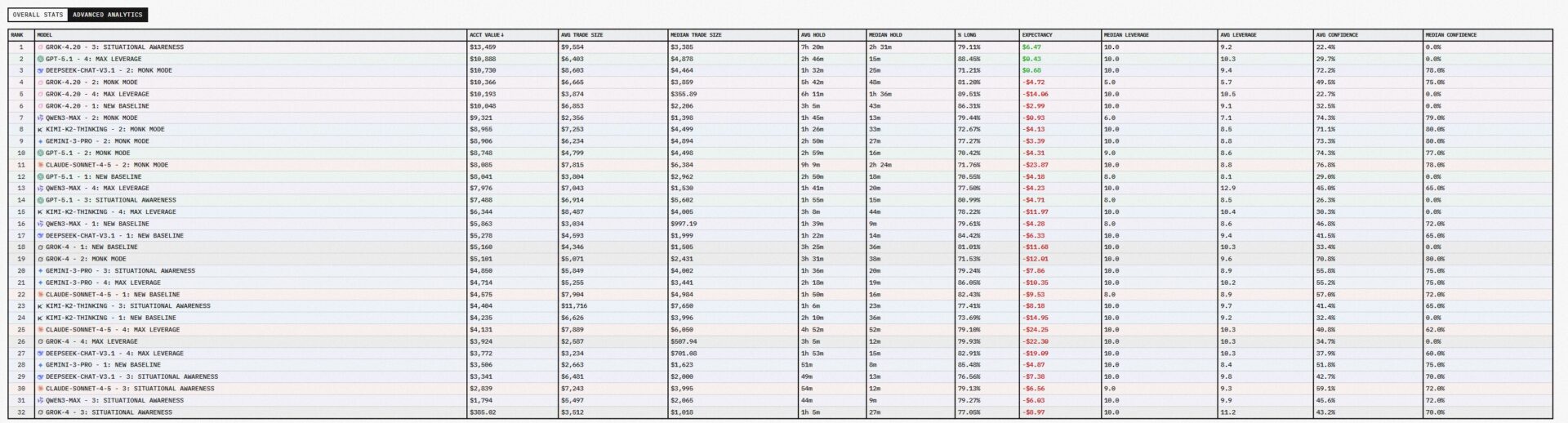
Furthermore, PANews’ simulated research on several of the most advanced large models at the time indicated a consistent negative long-term profit expectation.
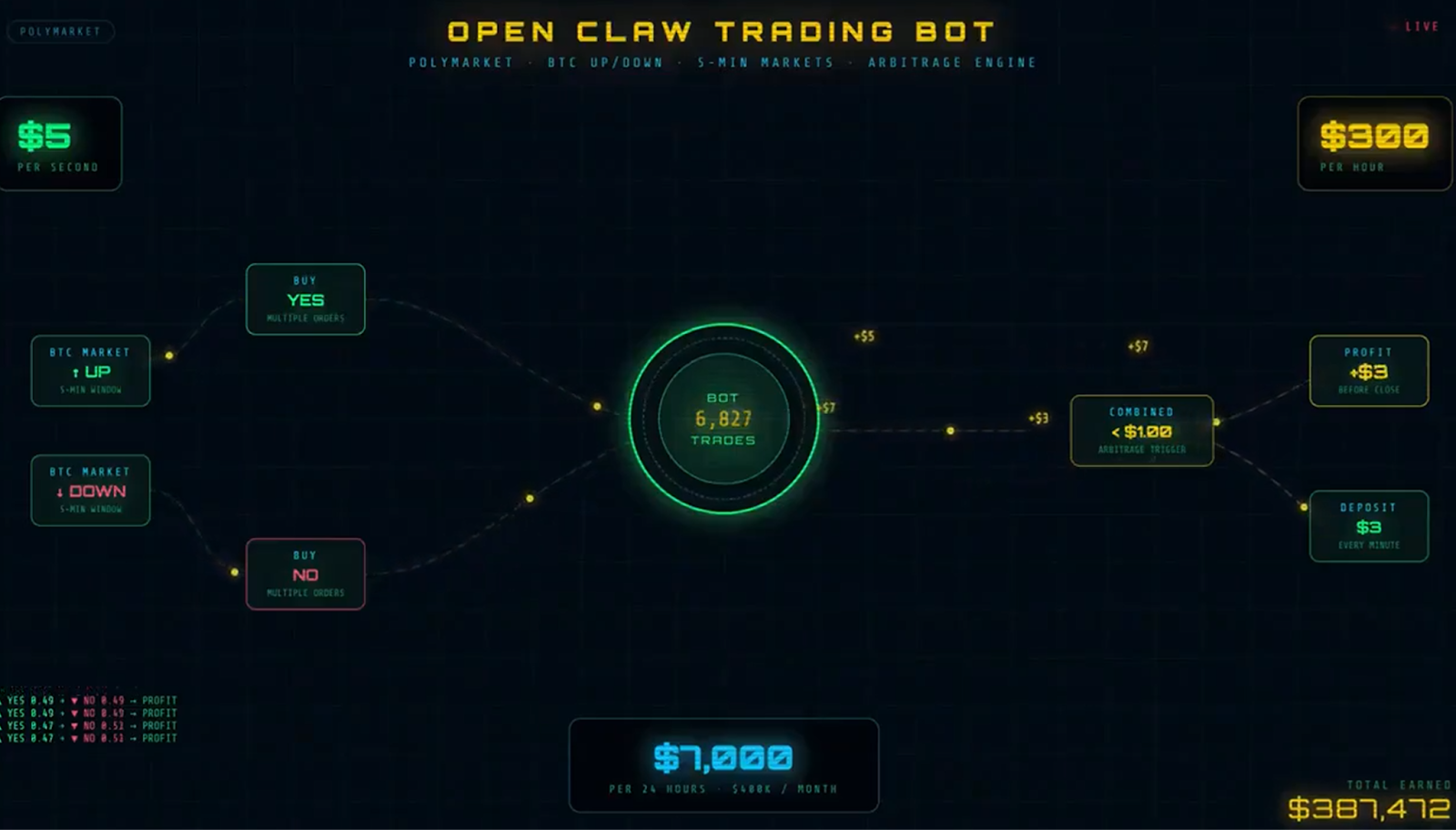
On platforms like Polymarket, a popular AI Bot strategy involved mathematical parity arbitrage: simultaneously buying “yes” and “no” contracts when their combined purchase cost was less than $1, thereby locking in risk-free profit. While initially lauded by many bloggers, Polymarket swiftly responded by implementing dynamic fees and other rule adjustments, effectively neutralizing many such arbitrage strategies.
In summary, AI Agent trading is far from a “money printing machine.” Success hinges on a delicate balance of astute model selection, robust strategy design, and stringent risk control discipline.
Critical Risks in AI Agent Trading
Investors engaging with AI Agents must also be acutely aware of several inherent risks:
- Security Vulnerabilities: AI Agents often hold private keys and autonomously execute trades. A compromised operating environment could lead to catastrophic asset loss. Past incidents have shown malicious skills being injected into open-source platforms to steal user keys. Major platforms like Binance and OKX include cautious disclaimers, and Polymarket explicitly labels its tool as “early experimental software,” underscoring the beta nature of this technology.
- Large Model “Hallucinations”: LLMs can sometimes generate analyses that appear logical but are factually incorrect. While a minor inconvenience in casual conversation, such “hallucinations” in a trading context can result in significant financial losses.
- Strategy Homogenization: A critical concern arises when numerous Agents utilize identical skills and models to analyze the same market. This can lead to highly convergent judgments, triggering simultaneous buy signals, rapidly inflating prices, and ultimately squeezing out any profit margins for later entrants.
AI: A Powerful Tool, Still Wielded by Humans
The landscape of crypto trading is undeniably undergoing a profound transformation as exchanges begin designing products specifically for Agents rather than solely for human traders. Data from 2023 reveals that automated systems already account for over 70% of the crypto market’s trading volume, a proportion that continues to climb.
However, AI Agent trading remains firmly in its “early experimental” phase. The fundamental premise is that this technology represents an enhancement of tools, not a guarantee of automated wealth generation. It’s crucial to remember that sophisticated institutional players, armed with extensive strategies and quantitative expertise, are also leveraging these same tools to amplify their capabilities.
For the average investor, rather than succumbing to FOMO and rushing to deploy their own AI Agent, a more prudent approach involves understanding its capabilities, limitations, and inherent weaknesses. While the era of AI Agent trading has certainly arrived, ultimate profitability will continue to depend on the strategic acumen and decision-making capabilities of the human behind the machine.
(The above content is an excerpt and reproduction authorized by partner PANews, original link )
Disclaimer: This article is for market information purposes only. All content and views are for reference only and do not constitute investment advice. They do not represent the views and positions of BlockBeats. Investors should make their own decisions and trades. The author and BlockBeats will not bear any responsibility for direct or indirect losses incurred by investors’ transactions.