Authored by: Ariel, CryptoCity
Taiwan’s Stance on Interest-Bearing Stablecoins: A Legislative Deep Dive
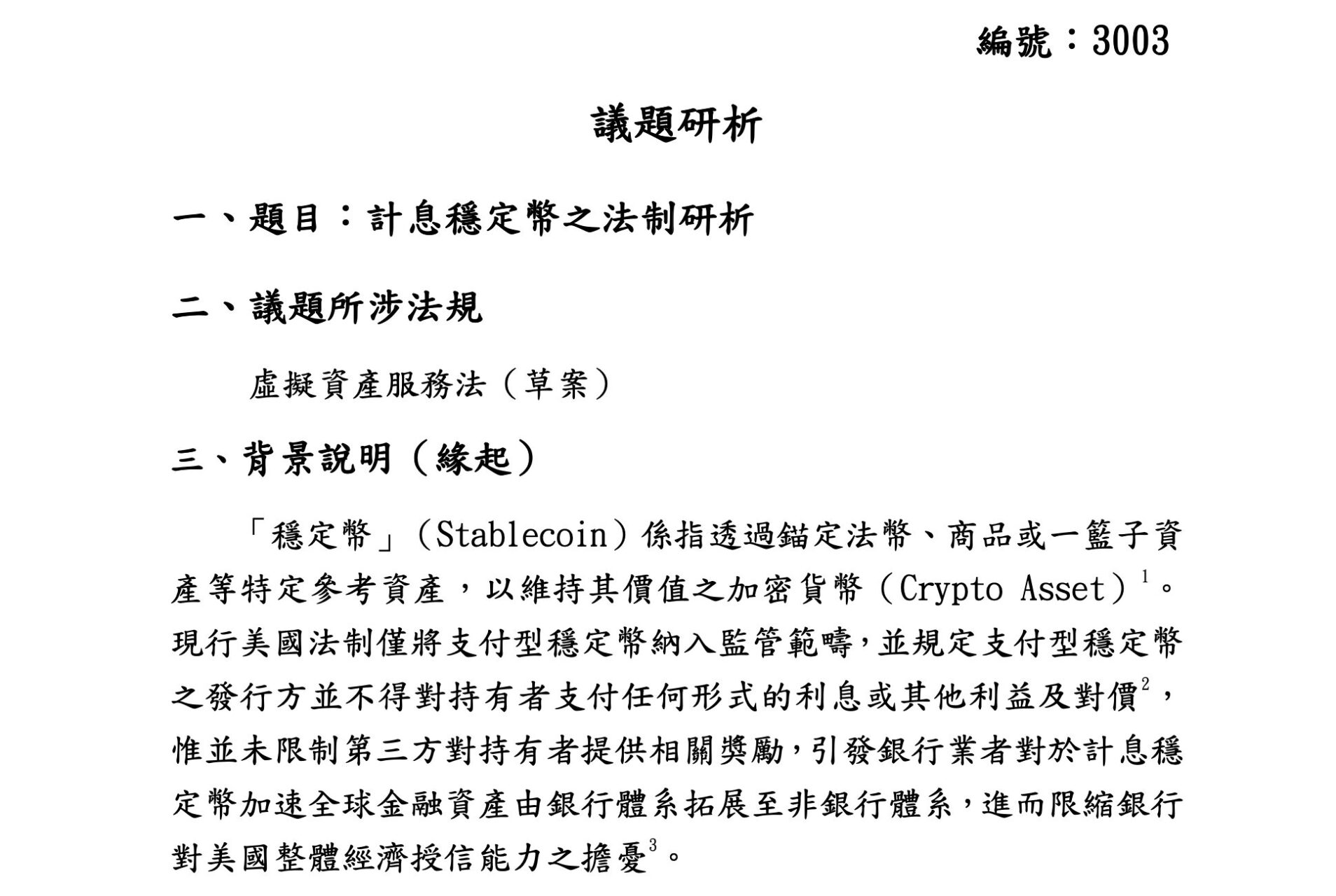
Taiwan’s Legislative Yuan’s Legal Affairs Bureau recently published a comprehensive report on the legal analysis of interest-bearing stablecoins on March 3rd. This pivotal document, informed by research from the Central Bank and submitted to the Financial Supervisory Commission (FSC) for review, signals a critical juncture for digital asset regulation in Taiwan.
The FSC has provided an initial response, indicating that the intricate details of relevant regulations are still under meticulous deliberation. Public clarification is anticipated once a definitive legal framework begins to materialize and internal discussions among supervisory authorities reach a mature consensus.
International Precedents and Taiwan’s Regulatory Ambiguity
The Legal Affairs Bureau’s report highlights a prevailing international consensus: stablecoins are generally prohibited from offering interest. This approach aims to firmly establish stablecoins as payment instruments, distinctly separating them from investment vehicles. However, the report also notes the nuanced landscape in the United States, where the GENIUS Act, while not explicitly endorsing interest, does not strictly forbid third parties such as exchanges or custodians from indirectly providing interest on stablecoin holdings. This distinction has ignited a fervent debate between the traditional banking sector and the burgeoning cryptocurrency industry.
The Virtual Asset Service Act: Unanswered Questions on Stablecoin Interest
In Taiwan, the draft “Virtual Asset Service Act” (VASA), proposed by the FSC, classifies stablecoins as virtual assets, similarly excluding them from investment purposes. Yet, the draft remains notably silent on the crucial question of whether stablecoins can bear interest. Furthermore, the feasibility of allowing Virtual Asset Service Providers (VASPs) to offer reward mechanisms to stablecoin holders through third-party arrangements is still under active consideration.
The Legal Affairs Bureau’s analysis underscores the inherent tension at the intersection of crypto platforms and traditional banks. Banks express significant apprehension that permitting interest on stablecoins could undermine their fundamental credit base. Conversely, cryptocurrency platforms argue that a blanket prohibition on platform-based stablecoin reward mechanisms would severely impede the industry’s competitive landscape and stifle innovation.
The report urges lawmakers and regulatory bodies to closely monitor evolving legislative discussions and trends in the United States. It also calls for a proactive approach to solicit and integrate the perspectives of relevant Taiwanese industry stakeholders, fostering a collaborative environment to build much-needed consensus.
FSC’s Vision for TWD Stablecoins: A Phased, Regulated Launch
Parallel to these discussions, the FSC is actively spearheading the development of Taiwan Dollar (TWD) stablecoins. FSC Chairman Peng Jin-lung previously indicated that the initial phase would predominantly feature currency-backed stablecoins, with a strategic priority to allow highly regulated financial institutions to pilot their issuance. This phased approach aims for a gradual rollout, with the potential inclusion of other institutions considered only after the regulatory framework and operational systems have matured.
Deputy Director-General Chang Chia-kuei of the FSC’s Banking Bureau further elaborated that the passage of the Virtual Asset Service Act will necessitate the creation of subsidiary legislation. These sub-laws will define critical operational details, including the scope of stablecoin usage, precise fund reserve requirements, and robust clearing processes. The FSC’s steadfast commitment is to ensure that all stablecoin conversion and usage activities are fully integrated into anti-money laundering (AML) and broader regulatory frameworks, thereby striking a crucial balance between fostering innovation and safeguarding financial stability.
A Glimpse Across the Pacific: The US Crypto Bill Stalemate
The debate in Taiwan mirrors a similar, albeit more politically charged, struggle in the United States. US Treasury Secretary Scott Bessent recently emphasized the urgent need for Congress to pass the “CLARITY Act” by Spring 2026, paving the way for President Trump’s signature. With the 2026 US mid-term elections on the horizon, Washington anticipates potential shifts in the power structure, prompting Republicans to seek legislative consensus before any political upheaval could disrupt progress. The bill’s advancement is currently stalled, with White House officials actively engaging with top executives from both the banking and crypto industries to find a viable path forward. Former President Trump has also weighed in, criticizing the banking sector for its substantial profits while simultaneously obstructing both the already-enacted GENIUS Act and the pending CLARITY Act.
US Industry Divided: The Battle Over Stablecoin Yield
The conflict surrounding interest-bearing stablecoins has intensified significantly in the US, particularly after Coinbase CEO Brian Armstrong publicly withdrew his support for the CLARITY Act. Armstrong argued that restricting stablecoin yields would detrimentally impact exchange profit models, setting him against traditional financial institutions.
JPMorgan CEO Jamie Dimon, a prominent voice in traditional finance, recently asserted that stablecoins offering interest yields should be subject to the same stringent regulatory framework as traditional bank deposits. He strongly opposes models where stablecoin deposits automatically accrue rewards, advocating that if crypto firms operate akin to banks, they must also assume the full responsibilities of federal deposit insurance (FDIC) and the substantial compliance costs associated with anti-money laundering (AML) regulations.
Despite the current legislative gridlock surrounding the CLARITY Act, JPMorgan remains optimistic, projecting its potential passage by mid-year. The institution anticipates that the act, once enacted, would unlock significant benefits, including the acceleration of Real World Asset (RWA) tokenization, the introduction of innovative exemptions, and greater clarity in intermediary rules, ultimately fostering a more robust and regulated digital asset ecosystem.