SEC Unveils Interpretive Guidance to Clarify Crypto Asset Legal Standing
The U.S. Securities and Exchange Commission (SEC) has recently taken a significant step towards defining the legal landscape for digital assets. The commission submitted a new regulatory interpretive document, titled “Commission Interpretations Regarding the Application of the Federal Securities Laws to Certain Types of Crypto Assets and Related Transactions,” to the White House Office of Management and Budget (OIRA). This pivotal document aims to provide much-needed clarity on how federal securities laws will be applied to various crypto assets and their associated transactions.
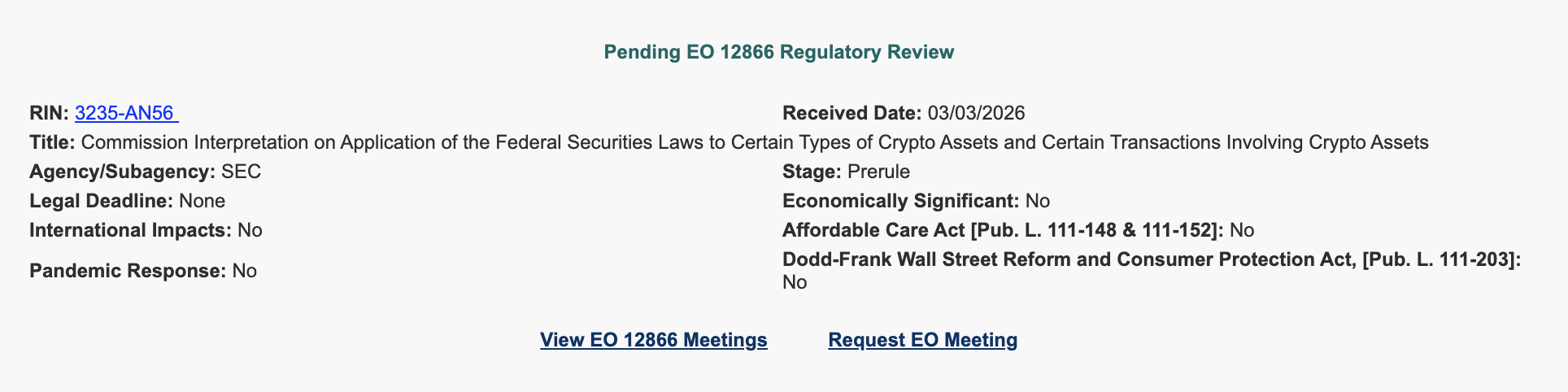
Currently undergoing inter-agency review, this guidance is interpretive in nature, distinguishing it from formal rulemaking processes. As an interpretive document, it bypasses lengthy public comment periods and legislative procedures, allowing for a more agile response to the rapidly evolving crypto market. Interpretations issued at the SEC Commission level carry substantial weight, serving as powerful policy directives that will guide future enforcement actions and industry compliance.
Industry observers widely agree that the core objective of this SEC document is to establish a comprehensive “Token Taxonomy” framework. This framework is designed to systematically categorize different types of crypto assets, providing clear criteria for determining which assets fall under the SEC’s jurisdiction as securities and which may be regulated under alternative frameworks.
Token Taxonomy: The Cornerstone of Crypto Regulation and Industry Evolution
SEC Chairman Paul Atkins has consistently emphasized the critical importance of a clear token taxonomy in resolving ongoing regulatory ambiguities within the digital asset space. By implementing a robust classification system, regulators can precisely define the legal attributes of various tokens – distinguishing between investment contract-type assets, utility tokens, or other emerging forms of digital assets.

Once this foundational classification framework is established, crypto enterprises will gain greater certainty regarding regulatory requirements for registration, information disclosure, product issuance, and investor protection. This clarity will directly impact the operational models and compliance strategies of exchanges, issuing platforms, and investment firms across the blockchain ecosystem.
Analysts suggest that while the SEC’s interpretive guidance doesn’t alter existing laws, it will become an indispensable reference for regulatory enforcement. Unlike informal statements previously issued by staff, commission-level interpretations are endowed with higher authority, making them more likely to be cited in enforcement and judicial proceedings, thus solidifying their impact on the industry.
Regulatory Action Accelerates Amidst Legislative Stagnation
The timing of the SEC’s guidance is particularly noteworthy, coinciding with a standstill in U.S. Congressional discussions on crypto market structure legislation. This proposed bill aimed to clearly delineate the regulatory authority of the SEC and the Commodity Futures Trading Commission (CFTC) over digital assets. However, its progress in the Senate has been hampered by disagreements between the banking industry and crypto firms, particularly concerning stablecoin yield mechanisms.
In the absence of clear legislative progress, regulatory bodies are proactively issuing guidance within existing legal frameworks to address the growing regulatory vacuum. The White House has also recently convened multiple meetings with representatives from both the banking and crypto sectors, seeking consensus on crucial market structure and jurisdictional issues.
Concurrently, the CFTC has also submitted its own regulatory proposals concerning Prediction Markets to OIRA. This synchronized activity underscores a broader trend: both major financial regulators are intensifying their strategic efforts to shape policy and oversight for the burgeoning digital asset market.
Navigating a New Era of Digital Asset Oversight
The current composition of U.S. financial regulatory bodies adds another layer of complexity. The SEC currently operates with 3 commissioners, while the CFTC has only 1, despite both agencies being designed as 5-person bipartisan committees. With most current regulatory leaders stemming from Republican backgrounds and Democratic representation yet to be fully appointed, the future impact of personnel changes on regulatory direction remains a key point of observation.
Furthermore, jurisdictional disputes between the SEC and CFTC persist in certain market sectors. For instance, CFTC Chairman Michael Selig recently asserted that prediction markets should fall entirely under his agency’s purview, emphasizing its “exclusive jurisdiction” over such instruments.
As the global digital asset market continues its rapid expansion, U.S. regulatory agencies are diligently working to construct a more comprehensive legal and oversight framework. The SEC’s initiative to establish a token taxonomy represents a crucial stride towards the institutionalization of crypto regulation, a move poised to exert profound influence on global crypto market trends and policies.
(The above content is an excerpt and reproduction authorized by our partner CryptoCity, original link)
Disclaimer: This article is for market information purposes only. All content and views are for reference only, do not constitute investment advice, and do not represent the views and positions of BlockBeats. Investors should make their own decisions and trades. The author and BlockBeats will not bear any responsibility for direct or indirect losses incurred by investors’ transactions.