Florida Pioneers Nation’s First Comprehensive Stablecoin Regulatory Framework
Florida is cementing its position as a leader in the digital asset industry by officially enacting the nation’s first state-level stablecoin regulatory framework. On March 6, 2026, the Florida Senate overwhelmingly passed Senate Bill 314 (SB 314) with a unanimous vote of 37-0. This legislative achievement marks a pivotal step for the state in fostering transparency and legitimacy within the burgeoning cryptocurrency sector.

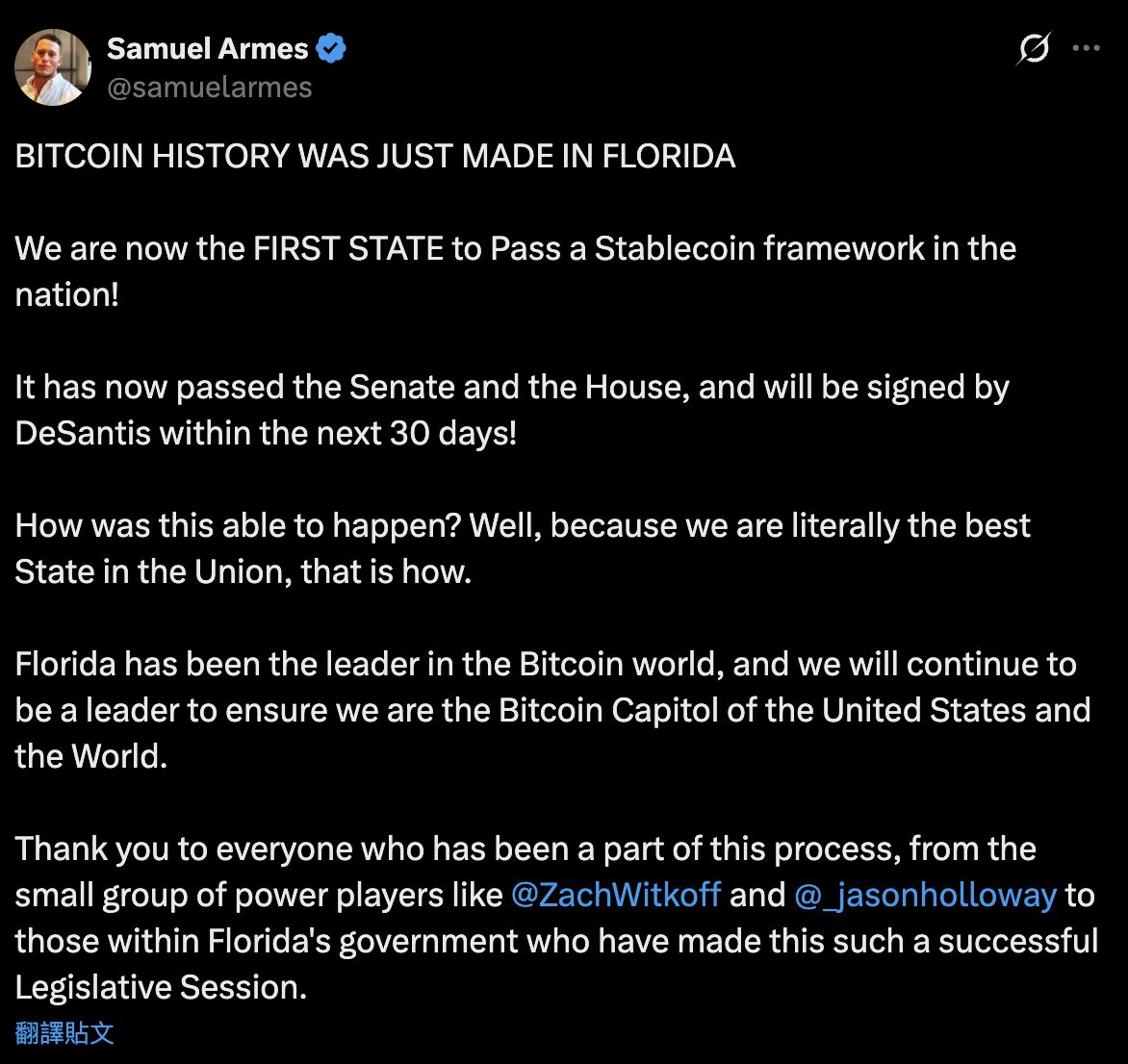
Samuel Armes, founder and president of the Florida Blockchain Business Association (FBBA), hailed the move as a historic accomplishment on social media. The bill is expected to be sent to Governor Ron DeSantis for his signature within the next 30 days. While a spokesperson for the Governor’s office noted that the final text is still awaiting legislative presentation, widespread anticipation suggests that the pro-digital asset governor will sign the bill into law, establishing Florida as a new benchmark for crypto legal frameworks nationwide.
Florida’s decisive action underscores the current divergence between state and federal regulatory paces. While Washington D.C. continues to grapple with the fundamental definition of cryptocurrencies, Florida has proactively moved to establish clear industry boundaries.
Samuel Armes emphasized that Florida will continue to lead global Bitcoin and blockchain innovation, asserting that this legal framework will attract more Web3 enterprises to the state. This initiative is more than just a legislative update; it’s a concrete endorsement by the state government of the future of digital assets, aiming to build a stable foundation for the digital economy.
Integrating Stablecoins into the Established Money Services Regulatory Framework
The core of SB 314 lies in its amendment to the existing Florida Money Services Business Anti-Money Laundering Act. The new law explicitly defines payment stablecoins as “Monetary Value,” a legally significant classification. This means stablecoin issuers will be required to adhere to the same rigorous compliance standards as traditional money services businesses.
Under the bill’s provisions, stablecoin issuers operating within Florida must obtain relevant authorization and strictly implement consumer protection measures and Anti-Money Laundering (AML) procedures. Furthermore, the bill complements House Bill 175 (HB 175), which stipulates that certain payment stablecoins meeting specific criteria will not be classified as securities. This crucial clarification offers invaluable legal certainty to issuers, providing a safe harbor in the current climate of frequent conflicts between federal regulators and the crypto industry over securities classifications.
The bill also sets clear thresholds for inter-state operations. Qualified issuers headquartered outside Florida must submit written notification to the Florida Office of Financial Regulation (OFR) before commencing business, ensuring local regulators maintain effective market oversight. Additionally, the bill mandates that stablecoin transactions exceeding $10,000 must maintain complete records, a standard perfectly aligned with traditional banking regulatory mechanisms. By integrating digital assets into the existing monetary regulatory system, Florida successfully mitigates compliance risks associated with innovative technologies while offering a valuable legislative template for other states.
Strategic Alignment with Federal Frameworks: Navigating the Red Line for Yield-Bearing Stablecoins
Florida’s recent legislation demonstrates a high degree of strategic foresight, proactively aligning with the federal GENIUS Act, which is set to take effect in July 2025. In terms of regulatory authority, the bill establishes a dual-track system: some issuers will be solely regulated by the Florida Office of Financial Regulation (OFR), while others will be subject to joint oversight by both local authorities and the federal Office of the Comptroller of the Currency (OCC).
Of particular note is the bill’s approach to interest paid on stablecoins. It stipulates that if federal law prohibits stablecoin issuers from paying yield or interest to holders, qualified Florida issuers must comply with this prohibition. This design precisely addresses one of the most contentious debates in the U.S. financial sector.
Currently, the traditional banking industry argues that stablecoins with yield-bearing capabilities could directly threaten commercial banks’ deposit bases and even trigger systemic financial risks. Indeed, another significant federal bill, the CLARITY Act, remains stalled in the Senate due to strong opposition from the banking sector regarding interest payments. Florida’s decision to adopt a conservative stance on yield-bearing products, aligning with federal positions, aims to balance the demand for innovation with financial stability while minimizing institutional resistance to the bill’s implementation. This pragmatic approach by Florida lawmakers prioritizes establishing the legitimacy of stablecoins as payment instruments over blindly pursuing comprehensive functionality.
Beyond Regulation: Government Pilot Programs and Robust Data Protection
Beyond its core regulatory framework, Florida’s SB 314 also reveals an ambitious vision for integrating blockchain technology into public administration. The bill authorizes the state’s Department of Financial Services to launch an innovative pilot program, exploring and permitting government agencies to accept approved stablecoins for state license fees, taxes, and other government services.
This signifies the state government’s formal recognition of digital assets as legitimate payment methods. To further optimize the investment environment, the Florida Legislature simultaneously passed the accompanying bill, CS/CS/SB 1440, which significantly enhances the confidentiality protection for operational data of digital asset service providers.
This protective measure applies to virtual currency businesses, trust companies acting as issuers, and qualified payment stablecoin issuers. Its purpose is to safeguard corporate trade secrets and sensitive operational data from being exposed due to regulatory scrutiny. Supporters argue that robust confidentiality mechanisms are crucial for attracting top-tier enterprises, as businesses need assurance that their core technologies and commercial secrets are legally protected while embracing regulation.
Despite ongoing federal political debates over regulatory rulings, Florida has chosen a path of robust local legislation to solidify its status as a global hub for digital asset innovation. Moving forward, the integration of Florida’s civil services with digital assets will serve as a critical case study for practical blockchain applications.