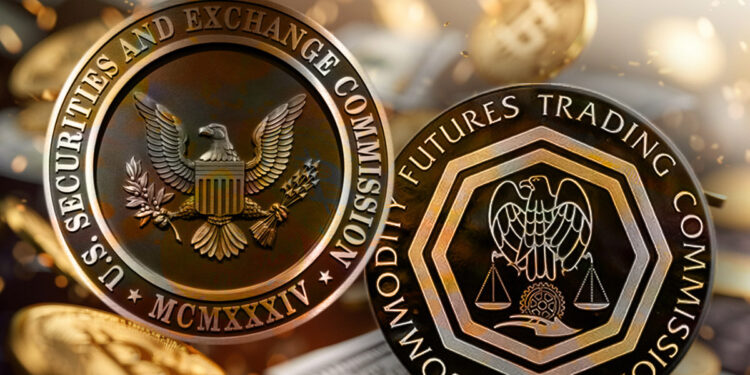
A protracted “turf war” between the United States’ two principal financial regulators has officially concluded. The U.S. Securities and Exchange Commission (SEC) and the Commodity Futures Trading Commission (CFTC) have formally signed a Memorandum of Understanding (MOU), signaling a concerted effort to integrate overlapping functions and jointly establish a comprehensive regulatory framework for cryptocurrencies.
Released on Wednesday, the landmark MOU outlines a future of significantly enhanced collaboration between the two agencies. This includes strengthening oversight mechanisms, streamlining financial product approvals, and harmonizing policy interpretations. Crucially, the agreement also commits to coordinating enforcement actions and promoting a “dual registration” system for entities operating in the digital asset space. Given that many crypto asset businesses inherently span both securities and derivatives regulatory domains, these measures are poised to profoundly impact the entire cryptocurrency industry.
The memorandum explicitly prioritizes “establishing a regulatory framework applicable to crypto assets and other emerging technologies.” This underscores a clear intent from U.S. regulators to forge a more consistent and coherent regulatory ecosystem for the digital asset market, an area that has historically operated within a complex and often ambiguous “gray zone.”
SEC Chairman Paul Atkins had foreshadowed this collaborative agreement in a public address on Tuesday. He noted that regulated financial companies and cryptocurrency firms will soon have access to dedicated contact points, enabling them to schedule joint meetings with both agencies to discuss policy direction and the intricacies of financial product applications.
In a statement issued Wednesday, Paul Atkins articulated the challenges this MOU seeks to overcome: “For too long, inter-agency ‘turf wars,’ cumbersome duplicate registration processes, and divergent regulatory requirements between the SEC and CFTC have not only stifled innovation but also compelled many market participants to seek development in other jurisdictions.”
He further pledged, “Moving forward, by unifying regulatory definitions, coordinating oversight mechanisms, and fostering seamless, secure information sharing across departments, we will ensure that future regulations provide the market with much-needed clarity.”
Under the new accord, the SEC and CFTC will institute a system of regular meetings and a robust information-sharing mechanism. This is a critical departure from past practices where crypto enterprises often faced the daunting prospect of “being targeted by both agencies for the same case.” In instances of overlapping jurisdiction, the agencies will now engage in prior consultation regarding charges, penalty specifics, litigation strategies, and even public communications.
During the previous administration, the SEC and CFTC frequently held differing stances on crypto asset regulation. A particularly contentious issue revolved around classifying certain crypto assets as either “securities” or “commodities,” leading to regulatory uncertainty.
Now, under the leadership of U.S. President Donald Trump, both agencies are demonstrating unprecedented enthusiasm for cooperation. The current SEC is steered by Chairman Atkins and two other Republican commissioners (with Democratic seats currently vacant), while the CFTC is led solely by Republican Chairman Mike Selig. Notably, both Atkins and Selig brought significant industry experience, having served cryptocurrency clients prior to their appointments, suggesting a deeper understanding of the sector’s unique challenges.
While the MOU is not inherently legally binding, this inter-agency “declaration of cooperation” undoubtedly provides a significant boost of confidence for cryptocurrency advocates. Despite the Trump administration’s strong backing for digital assets, translating these political aspirations into concrete legal statutes and a fully functional regulatory system will still require considerable effort.
Disclaimer: This article is for market information purposes only. All content and views are for reference only, do not constitute investment advice, and do not represent the views and positions of BlockBeats. Investors should make their own decisions and trades, and the author and BlockBeats will not bear any responsibility for direct or indirect losses resulting from investor transactions.