
The highly anticipated U.S. Consumer Price Index (CPI) data, released last night, largely aligned with market expectations. While typically a significant market mover, its impact was notably muted this time, overshadowed by escalating geopolitical tensions in the Middle East. Consequently, U.S. stock indices lacked clear direction, and Bitcoin (BTC) continued to hover around the critical $70,000 resistance level. Despite appearing to stabilize in the short term, prevailing market sentiment remains pessimistic, casting doubt on BTC’s ability to firmly hold above $70,000. Ultimately, the trajectory of global markets, including cryptocurrencies, seems intrinsically linked to developments in the Middle East.
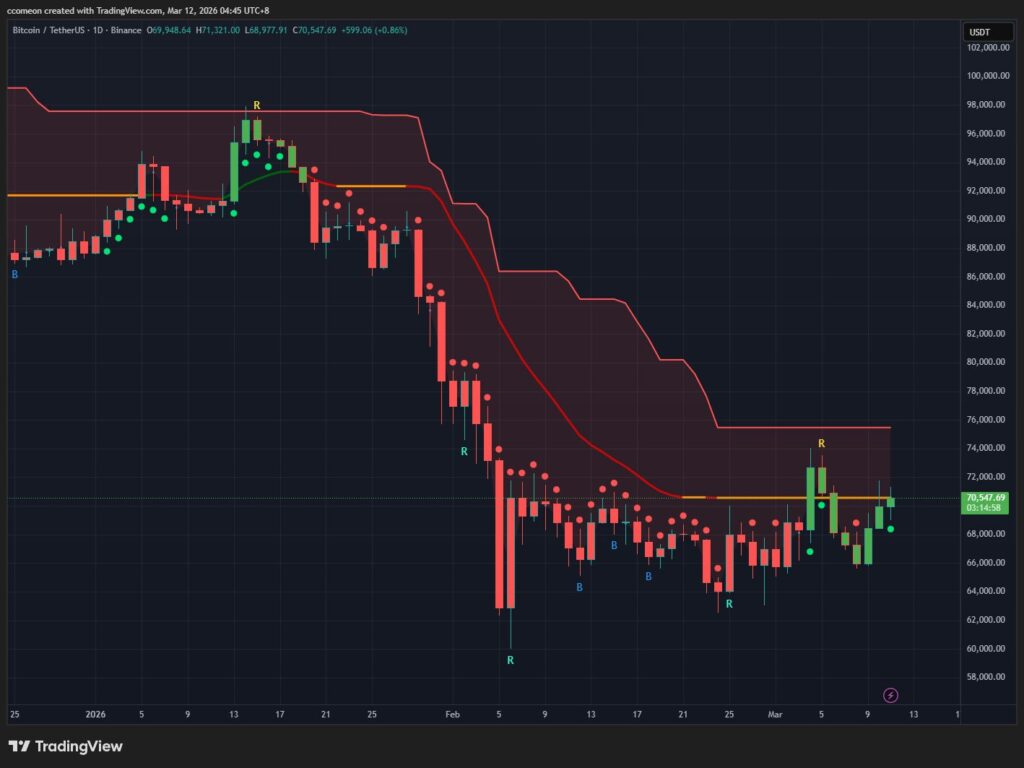
In recent weeks, BTC experienced a notable correction, retracing from last week’s peak of $74,000 to settle near the $70,000 mark. Throughout this downturn, CryptoQuant’s Binance Netflow data frequently registered strong negative peaks. This trend suggests that investors are actively seizing the opportunity to withdraw BTC from exchanges during periods of market weakness, potentially indicating accumulation. However, the intermittent appearance of net inflow peaks – where coins move onto exchanges as prices fall – serves as a reminder that selling pressure has not entirely dissipated.
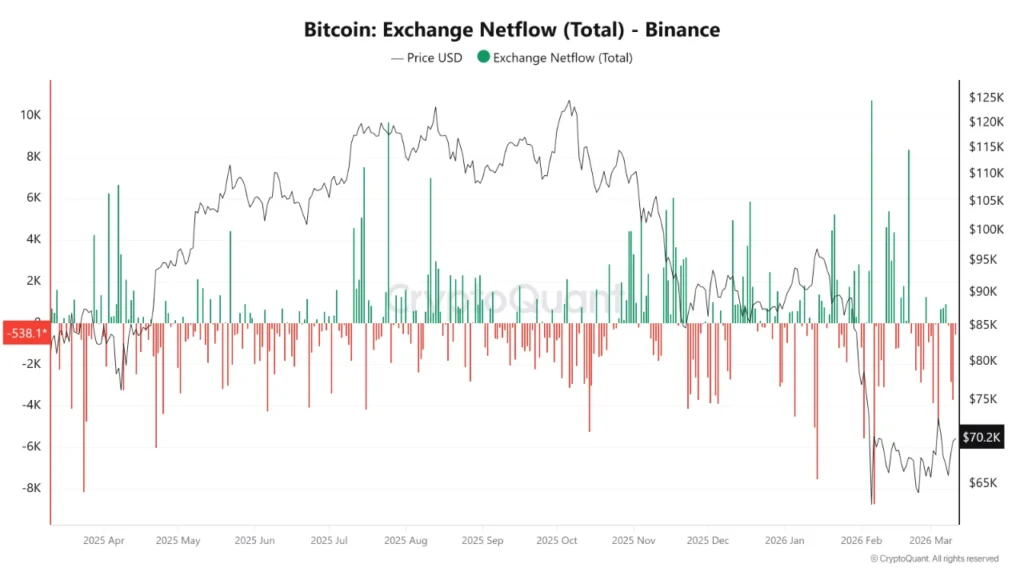
Analyzing the latest chart period, the overall net flow has predominantly remained in negative territory, signifying a sustained outflow of BTC from exchanges. Yet, despite this persistent withdrawal, BTC’s price performance continues to be lackluster, with any rebound post-decline proving remarkably limited. Objectively, even with a consistent exodus of coins from exchanges, the market has failed to ignite robust demand. This indicates lingering weak market momentum and persistent downward pressure on prices. In essence, the current market landscape is characterized by liquidity exhaustion and a severe deficiency in demand, contributing to a fragile and continuously weak overall price structure.
Disclaimer: This article is intended solely to provide market information. All content and opinions are for reference purposes only and do not constitute investment advice. They do not represent the views or positions of BlockTempo. Investors should make their own decisions and trades. The author and BlockTempo will not bear any responsibility for direct or indirect losses incurred by investors’ trading activities.