Wall Street Embraces On-Chain: Nasdaq and Kraken Forge New Digital Asset Gateway
In a groundbreaking move signaling the deepening integration of traditional finance with blockchain technology, Nasdaq, the world’s second-largest stock exchange, recently announced a strategic partnership with Payward, the parent company of cryptocurrency exchange Kraken. This collaboration aims to develop a sophisticated, issuer-centric infrastructure for tokenized equities, dubbed the “Equities Transformation Gateway.”
This ambitious initiative seeks to seamlessly blend the robust regulatory frameworks of conventional securities markets with the inherent flexibility and efficiency of blockchain technology. The joint venture anticipates launching the system by the first half of 2027, enabling regulated equity assets to flow effortlessly between on-chain and traditional markets.
Nasdaq’s decision to align with Kraken and its tokenization infrastructure provider, Backed, underscores a clear objective: to establish an on-chain trading environment that upholds issuer control while strictly adhering to existing regulatory standards. This plan builds upon Nasdaq’s earlier tokenization proposal submitted to the U.S. Securities and Exchange Commission (SEC) in September 2025, which advocated for the parallel trading of tokenized stocks and exchange-traded funds (ETFs) alongside their traditional counterparts.
Tal Cohen, President of Nasdaq, emphasized the transformative potential of tokenization, stating it could unlock a “24/7 financial ecosystem.” This innovation promises to optimize investor access to markets and fundamentally redefine how issuers and shareholders interact.
To guarantee the fungibility and integrity of asset pricing, all tokenized and traditional securities will be settled through the Depository Trust Company, ensuring their complete legal equivalence. This strategic embrace of blockchain infrastructure by a major financial exchange marks a significant milestone for the digital asset landscape.
Unlocking Global Capital: Tokenized Securities Gain Full Legal Standing and Enhanced Efficiency
Under the terms of the partnership, Kraken will deploy its highly successful xStocks platform as the core technological backbone for the new gateway. Since its launch in June 2025, xStocks has demonstrated remarkable performance, accumulating over $25 billion in trading volume within its first year, with $4 billion settled directly on-chain. The platform currently serves over 85,000 holders across various global networks.
This innovative gateway will empower international investors, particularly those in the European market, to hold tokenized shares of U.S. listed companies on a one-to-one basis. Crucially, these digital securities will grant holders identical rights to traditional shareholders, including participation in proxy voting and the receipt of dividends.
Beyond rights protection, tokenized equities promise a qualitative leap in capital operational efficiency. Arjun Sethi, Co-CEO of Kraken, highlighted that traditional stocks are often confined within brokerage systems, limiting their utility to mere buying, selling, or specific margin arrangements.
In contrast, tokenized stocks can move freely across different trading venues and blockchain networks. This flexibility allows the same asset to serve as collateral in multiple trading strategies simultaneously, dramatically boosting capital liquidity. For international investors, this addresses critical pain points associated with limited access to traditional brokerage services. Furthermore, Kraken’s recent approval for a Master Account from the U.S. Federal Reserve provides a robust financial settlement foundation, enabling direct USD settlement through the Fed system, bypassing intermediary banks.
Nasdaq’s European Vision: Tackling Fragmentation with Boerse Stuttgart and DLT
Parallel to its global equity tokenization efforts, Nasdaq is also driving structural adjustments within the European capital markets. On the same day, Nasdaq announced a collaboration with Seturion, the tokenized settlement platform under Germany’s Boerse Stuttgart Group. The European market has long grappled with fragmentation due to diverse national laws and varied post-trade infrastructures, leading to protracted settlement cycles and increased operational complexities.
Nasdaq intends to connect its European trading venues to Seturion, leveraging Distributed Ledger Technology (DLT) to facilitate real-time settlement of cross-border assets. Launched in September 2025, Seturion supports a wide array of assets on both public and private blockchains and enables cash settlement using central bank digital currencies or on-chain cash.
The initial phase of this European strategy will concentrate on structured products, with strict adherence to the EU’s Markets in Financial Instruments Directive (MiFID II) and the DLT Pilot Regime.
- Roland Chai, Nasdaq Vice President, views tokenization as an effective solution to European market fragmentation, enhancing settlement efficiency while maintaining market stability and stringent regulatory oversight.
- Matthias Voelkel, CEO of Boerse Stuttgart Group, emphasized Seturion’s role as an open network, actively welcoming more issuers, brokers, and financial institutions to join.
This partnership signifies a concerted effort by traditional exchanges to dismantle existing national settlement silos, utilizing blockchain technology to construct an integrated European capital market infrastructure that fundamentally optimizes asset flow processes.
The Trillion-Dollar Race: Traditional Finance Stakes Its Claim in Blockchain
The alliance between Nasdaq and Kraken underscores a rapid blurring of lines between traditional finance and the crypto industry. These concerted actions reveal a fierce “on-chain race” among traditional exchange giants. Just last week, Intercontinental Exchange Group (ICE), the parent company of the New York Stock Exchange, announced an investment in cryptocurrency exchange OKX, with plans to introduce NYSE-listed tokenized stocks and derivatives onto the OKX platform by Q2 2026.
Simultaneously, leading banks, including Goldman Sachs and J.P. Morgan Asset Management, have been actively developing tokenized money market funds. This collective institutional shift reflects an improving regulatory environment, with the passage of the “GENIUS Act” in 2025 providing clear legal guidance for the deployment of institutional-grade digital asset infrastructure.
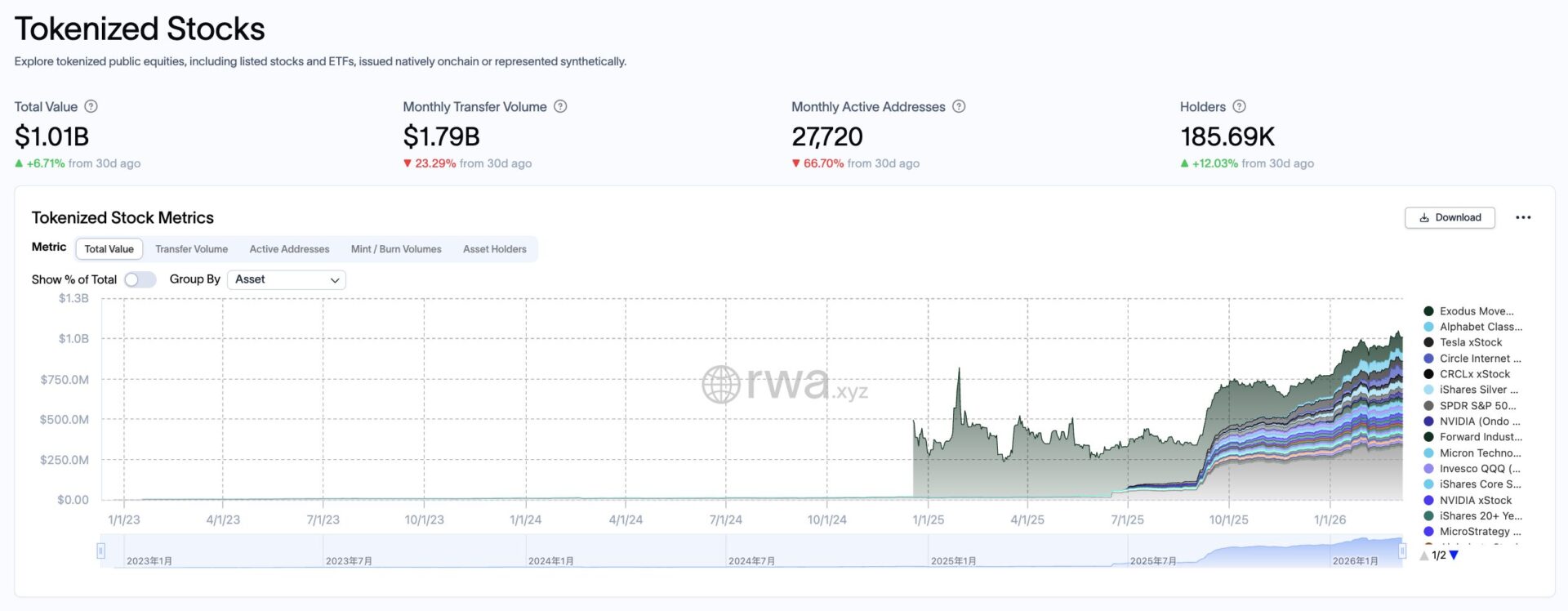
The market potential for tokenized assets is immense and rapidly expanding. According to data from RWA.xyz, the total value of on-chain tokenized public equities has already grown to approximately $1.01 billion. Investment research firm Ark Invest further projects that by 2030, the global tokenized asset market size will exceed a staggering $11 trillion.
This Nasdaq-led transformation is set to migrate traditional securities from the confines of closed brokerage systems to a 24/7, global, on-chain network. While the price volatility of crypto assets like Bitcoin ($BTC) may still cause hesitation among some investors, the upgrade of stock market infrastructure is an undeniable and inevitable trend. With the official launch of Nasdaq’s tokenization framework in 2027, the operational logic of traditional capital markets will be fundamentally reshaped, ushering in a new financial ecosystem characterized by unparalleled interoperability and programmability.