
By: Max, CryptoCity
CFTC Reclassifies Prediction Markets: A Landmark Shift in Financial Regulation
In a pivotal move set to redefine the landscape of digital finance, the U.S. Commodity Futures Trading Commission (CFTC) issued crucial regulatory guidance on March 12, formally integrating the rapidly expanding prediction market sector into the federal regulatory framework. This advisory opinion, originating from the Division of Market Oversight, establishes explicit requirements for Designated Contract Markets (DCMs) offering “Event Contracts,” underscoring the imperative for exchanges to rigorously adhere to the foundational principles of the Commodity Exchange Act (CEA).

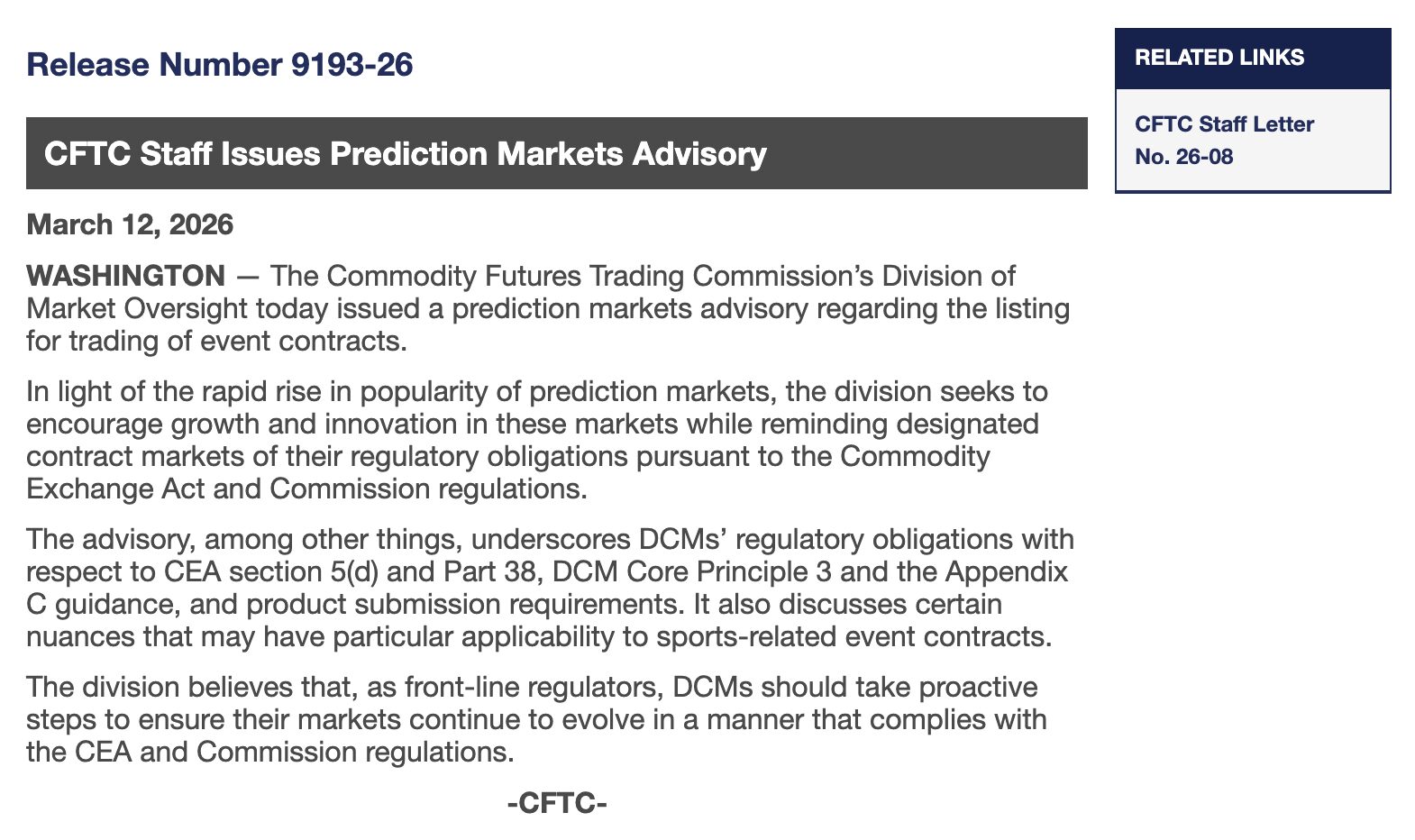
Since assuming office in December 2025, current CFTC Chairman Michael S. Selig has spearheaded a notable shift from the previous administration’s more restrictive stance, adopting an inclusive yet stringent regulatory approach. Selig unequivocally stated that the prior failure of regulatory bodies to provide adequate guidance for prediction markets, utilized by millions of Americans, concludes today. He announced via social media that this marks the official commencement of a new regulatory process, grounded in rational legal interpretation, designed to solidify the CFTC’s exclusive jurisdiction over this burgeoning market.
Under these newly unveiled regulations, the CFTC officially defines prediction markets as a distinct financial asset class, acknowledging their growing importance as a reliable source of information for news organizations, sports leagues, and financial institutions. To fortify market integrity, the regulator simultaneously issued an Advance Notice of Proposed Rulemaking (ANPRM), inviting public commentary on the application of the Commodity Exchange Act to prediction markets. This expedited regulatory initiative includes a 45-day public comment period, underscoring the authorities’ commitment to efficient implementation.
As the agency’s sole commissioner in the absence of other White House nominations, Selig has demonstrated formidable executive resolve. Exchanges are now tasked with serving as the primary line of defense, responsible for identifying and thwarting manipulative practices. Diverging from past legal confrontations with platforms, the CFTC is now focused on establishing a clear “rules of the road” framework, enabling this innovative financial instrument to operate legitimately under robust legal oversight.
Fortifying Integrity: Exchanges Assume Primary Regulatory Responsibility
With the increasing diversification of prediction market contracts, the CFTC’s new guidance places particular emphasis on the critical need to prevent market manipulation and insider trading. Regulators have issued a stern reminder to exchanges: all listed contracts must inherently resist manipulation. To achieve this, exchanges are mandated to implement sophisticated monitoring systems capable of real-time detection of suspicious trading activities, price distortions, and settlement anomalies. Specifically for sports-related event contracts, the guidance stipulates that exchanges must maintain close communication and collaboration with relevant sports organizations and governing bodies when drafting contract terms, compliance protocols, and market surveillance programs.
This collaborative mechanism is designed to proactively prevent players, referees, or other insiders from exploiting non-public information for illicit gains. The guidance highlights that certain contracts, particularly those narrowly defined around specific sports events like a single player’s injury or a referee’s decision, are highly susceptible to creating undue incentives for participants to influence game outcomes. Such products will face heightened scrutiny before being listed. Data reliability and settlement impartiality are also paramount in this regulatory upgrade. Given that most prediction market contracts are cash-settled and heavily reliant on external data sources, the CFTC requires exchanges to ensure that all referenced data is precise, transparent, and tamper-proof.
Furthermore, platforms must develop robust technical safeguards to prevent unauthorized access or leakage of data prior to its official release. The regulatory body warns that any breach of these regulations could trigger federal investigations and civil enforcement actions.
In a media interview, Chairman Selig underscored the vital importance of eradicating manipulation, insider trading, and all forms of abuse within the derivatives market. This policy is designed to protect investors, uphold the integrity of the broader financial system, and prevent the burgeoning field of event trading from devolving into a hotbed for illegal gambling or unfair competition.
Explosive Growth: Institutions and Political Forces Deepen Involvement
Prediction markets have witnessed an astonishing surge in growth over the past year, transforming from niche platforms into highly influential financial products. According to data from The Block, in February 2026, the combined monthly trading volume for leading platforms Kalshi and Polymarket reached approximately $18.6 billion, marking a sixth consecutive month of record highs. By mid-March alone, trading volume had already surpassed $8 billion, indicating sustained market momentum.
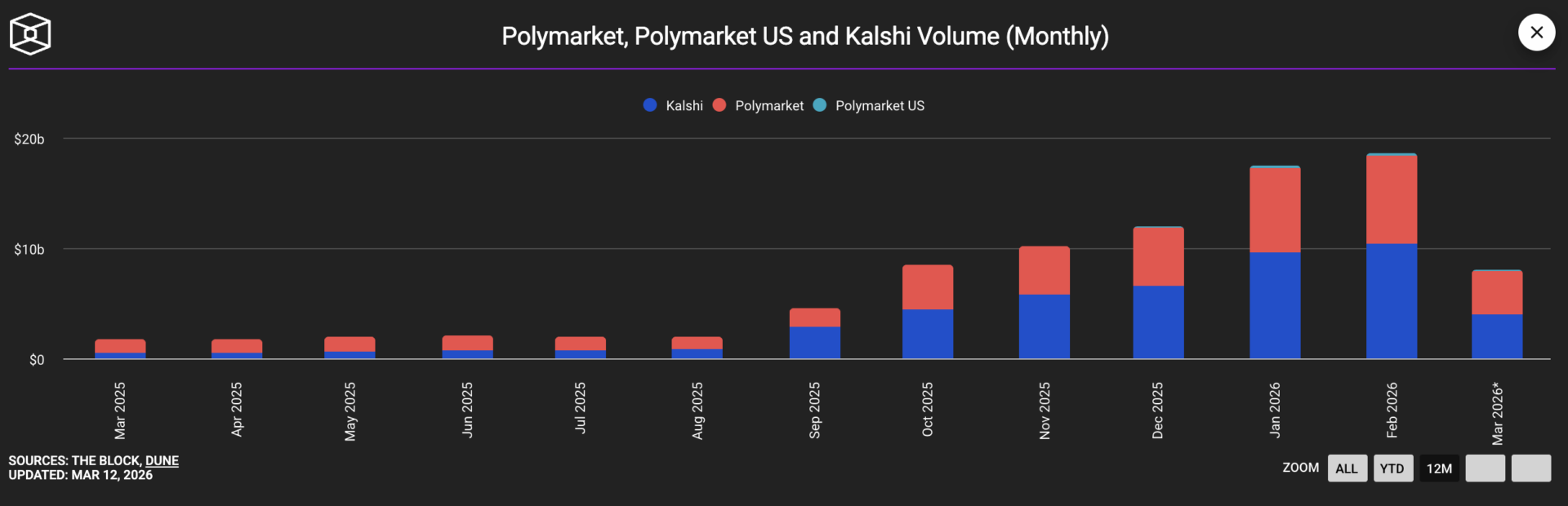
This remarkable expansion is partly attributed to a 2024 court ruling that paved the way for U.S. election-related contracts, subsequently unleashing a torrent of diverse sports and economic data contracts. Both Kalshi and Polymarket are currently in discussions for new funding rounds, with valuations projected to reach around $20 billion—a doubling from their previous valuations. The sheer volume of capital and the burgeoning user base have compelled regulators to accelerate the establishment of clear, enforceable rules.
The political and economic footprint of the prediction market industry is also deepening. Donald Trump Jr. currently serves as an advisor to both Kalshi and Polymarket, while Trump Media & Technology Group (TMTG) is collaborating with Crypto.com to develop prediction market products. Concurrently, the engagement of traditional financial institutions is on the rise; asset management giants like Grayscale have launched Exchange Traded Funds (ETFs) on Nasdaq that blend spot holdings with staking returns, broadening access for institutional investors into the digital asset landscape.
Beyond individual retail investors, media organizations and financial institutions are increasingly leveraging prediction market prices as leading indicators for political and economic trends. This cross-sector influence bestows prediction markets with a powerful price discovery function, progressively positioning them as a dynamic macroeconomic dashboard.
Jurisdictional Conflicts and Ethical Quandaries Fuel Legislative Scrutiny
Despite federal efforts to standardize regulation, prediction markets continue to grapple with multifaceted legal challenges and ethical examinations. Currently, several state-level gaming regulatory bodies are at odds with the CFTC over jurisdictional authority.
- For instance, an Ohio judge recently dismissed Kalshi’s request for an injunction against the state’s Casino Control Commission, ruling that the platform failed to definitively prove its contracts were exempt from state laws.
- Authorities in states such as Iowa and Utah have also voiced concerns regarding the potential for prediction markets to facilitate illegal sports betting.
Chairman Selig maintains a resolute stance, repeatedly affirming the CFTC’s exclusive jurisdiction and signaling readiness to litigate any challenges aimed at undermining federal authority. Industry analysts suggest that the fundamental debate—whether prediction markets constitute financial derivatives or a form of gambling—may ultimately be resolved by the Supreme Court.
On the ethical front, controversies surrounding contracts related to war, death, or assassination are escalating. Recent analyses indicate that several new wallets collectively earned approximately $1.2 million on Polymarket contracts just before U.S. airstrikes on Iran, sparking allegations of war-related insider trading. Furthermore, Kalshi faced criticism for listing contracts concerning whether Iranian leaders would be ousted, with critics labeling it a de facto “death market.”
In response to these concerns, U.S. Democratic congressional representatives have introduced the Death Bets Act, a legislative proposal aimed at prohibiting prediction trading linked to war, death, or assassination. The CFTC’s new guidance also addresses these issues, stating that contracts involving public order and morality will undergo rigorous review. In a complex geopolitical environment, balancing the informational utility of prediction markets with fundamental societal ethical boundaries remains a crucial challenge for regulatory advancement.
A New Phase of Institutional Development: Public Commentary to Shape Future Rules
Looking ahead, the heightened regulation of prediction markets reflects a broader trend of increased inter-agency collaboration within U.S. regulatory bodies. The CFTC and the Securities and Exchange Commission (SEC) recently signed a Memorandum of Understanding (MoU), pledging cooperation on digital asset policy and market oversight to foster legitimate innovation while upholding market transparency.
Selig emphatically stated that prediction markets require clear rules. With the commencement of the 45-day public comment period, regulators will actively solicit feedback from industry stakeholders, academia, and consumers to further refine the regulatory specifics. While major trading platforms are still evaluating compliance costs, there is a general consensus that achieving formal financial asset status will significantly contribute to the industry’s long-term institutionalization.
The ultimate implementation of these new regulations will have profound implications for the cryptocurrency and Web3 industries, given that many prediction market platforms operate on blockchain technology. As evidenced by the MoneyX 2026 financial summit held in Japan earlier this year, a consensus is emerging among governments, major banks, and regulatory bodies that the widespread social application of financial technology must be accompanied by robust legal and regulatory support.
For investors, clearer guidelines translate to enhanced transparency and greater protection of rights. For industry participants, while regulatory pressure increases, it also confers legitimate status to compete within the mainstream financial system. This regulatory evolution is propelling prediction markets toward a new phase of maturity and stability, positioning them to play a pivotal role in the future digital economy.
(The above content is an authorized excerpt and reproduction from our partner, “CryptoCity.” Original Link)
Disclaimer: This article provides market information only. All content and views are for reference only and do not constitute investment advice. They do not represent the views and positions of BlockTempo. Investors should make their own decisions and trades. The author and BlockTempo will not bear any responsibility for direct or indirect losses resulting from investor transactions.