
Journalist Receives Death Threats Over Missile Report: Unpacking the Dark Incentives of Prediction Markets
In a startling revelation, Emanuel Fabian, a military correspondent for The Times of Israel, recently disclosed that he has been subjected to relentless harassment and even death threats from bettors associated with the prediction market platform Polymarket. This alarming backlash followed his report on an Iranian ballistic missile strike that landed in an open area near Beit Shemesh, on the outskirts of Jerusalem.
The incident is not merely shocking due to its intersection of frontline war reporting with a prediction market boasting a liquidity pool exceeding $14 million. More profoundly, it exposes a burgeoning and critical question: when the profits of market participants become contingent on media narratives, public information, or even the violent events themselves, are prediction markets truly facilitating “price discovery,” or are they inadvertently creating dangerous incentives that manipulate real-world outcomes?
The Unsettling Incident: When Journalism Meets Prediction Markets
“That day, I reported on The Times of Israel’s live blog that a missile had struck an open area, causing no casualties. The report cited rescue services and subsequent footage showing a massive explosion caused by the missile’s warhead. What I believed to be a minor incident during wartime, however, escalated into days of harassment and death threats,” Fabian wrote.
In an article published on March 16th, Fabian detailed how, after reporting on Iran’s ballistic missile attack on Israel on March 10th – based on rescue unit information and on-site footage – he began receiving messages from strangers. These individuals demanded he alter his report from “missile strike” to “intercepted debris” or a similar phrasing. Their motivation: to influence the settlement of a Polymarket wager concerning whether “Iran attacked Israel on March 10th.”
“After you (Emanuel Fabian) made us lose $900,000, we will invest at least that much to utterly deal with you,” Fabian revealed receiving such chilling threats via WhatsApp.
Fabian stated that initially, the demands were framed as mere requests for correction, with phrases like “this will help many people.” However, the tone quickly escalated to overt intimidation, culminating in death threats sent via WhatsApp. Fabian steadfastly refused to alter his reporting, asserting that military intelligence confirmed the impact was a missile warhead, not simply intercepted fragments. He has since contacted Israeli police regarding these threats.
“My small report about a missile hitting an open area has now become entangled in a massive gambling battle. Those who bet that Iran would not attack Israel on March 10th are demanding I change my article to ensure they win big,” Fabian wrote.
With the prediction market in question boasting over $14 million in trading volume, a seemingly minor semantic distinction transformed into a critical determinant of wins, losses, and significant capital distribution. When news reporting ceases to be mere information and is instead perceived by gamblers as a “manipulable settlement lever,” journalists inevitably become targets in the bettors’ crosshairs.
Polymarket’s Response: A Band-Aid on a Deeper Wound?
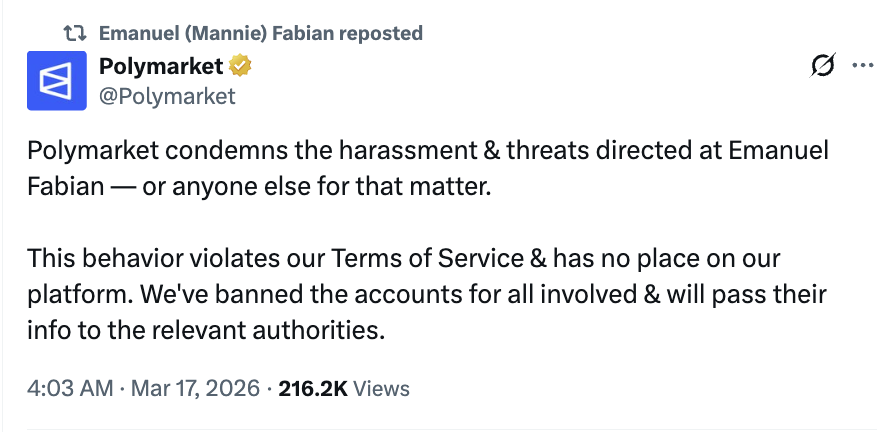
Polymarket responded by condemning the harassment and threats against Emanuel Fabian, stating that such behavior violates its terms of service. The platform emphasized that prediction markets rely on the integrity of independent reporting, and any attempt to pressure journalists into altering their coverage not only undermines journalism but also the market itself. This principled stance is undeniable; if market prices depend on external factual sources, then pressuring those who provide these facts directly erodes market integrity.
In a statement released later on Monday, Polymarket announced it had “banned all involved accounts and will hand over their information to relevant authorities.”
However, the core issue remains: platform condemnation alone cannot automatically resolve deeper structural risks. This incident starkly illustrates that when prediction markets trade on highly sensitive events—such as wars, attacks, deaths, coups, or impeachments—participants are not merely “predicting” outcomes. Instead, they may develop an impulse to interfere with information sources, narrative frameworks, or even the events themselves. In essence, while platforms can penalize individual threatening users, post-hoc measures are insufficient to eliminate the distorted incentives inherent in the market’s design. This particular aspect is the true cause for alarm in the current controversy.
When ‘Prediction’ Morphs into ‘Pressure’: Three Risks of Prediction Market User Behavior
- Treating Information Sources as Manipulable Settlement Objects: The Fabian incident is a prime example: bettors are not passively awaiting facts but actively attempting to alter the narrative of events to influence market outcomes. This shifts prediction markets from passively observing reality to actively interfering with information production.
- Attracting Insiders and Influencers to High-Sensitivity Markets: Markets dealing with highly sensitive events are prone to attracting individuals with non-public information, or even those who can influence outcomes. A February 25th enforcement advisory from the U.S. Commodity Futures Trading Commission (CFTC) explicitly stated that event contracts are subject to existing anti-fraud, anti-manipulation, and anti-insider abuse regulations. The advisory cited two cases: politicians trading contracts related to their own election prospects, and individuals with employment or affiliation with a YouTube channel trading on potentially non-public information.
- Moral Hazard from Linking Market Rewards to Real-World Harm: Events like war, death, assassination, and terrorist attacks inherently carry moral risks, as market rewards can become linked to real-world suffering. Six Democratic U.S. Senators, in a February 23rd letter to CFTC Chairman Michael Selig, highlighted that certain event contracts could not only allow informed parties to profit from non-public information but also create dangerous incentives for physical harm, mission failure, or escalating geopolitical conflicts. The letter directly questioned whether contracts highly correlated with war, terrorism, assassination, and death violate the Commodity Exchange Act’s prohibitions against categories contrary to the public interest.
Legislative Scrutiny: From Ethical Quandary to Regulatory Imperative
This controversy unfolds amidst significantly heightened alarm within U.S. political circles regarding prediction markets. Terry Duffy, CEO of CME Group, has unequivocally stated that prediction markets require clearer, stricter rules to distinguish between event contracts serving legitimate economic hedging functions and those that are essentially gambling masquerading as financial instruments. He further suggested that the current debate might ultimately reach the U.S. Supreme Court, where the judiciary would define its legal boundaries.
Democratic Representative Mike Levin and Senator Chris Murphy are actively advancing legislation to tighten regulation over platforms like Polymarket and Kalshi. Furthermore, reports from The Wall Street Journal and The Associated Press indicate that Congress has recently seen bills explicitly targeting event contracts related to highly sensitive topics such as war, death, assassination, terrorist attacks, and elections. Some proposals even seek to grant states greater authority to directly restrict or prohibit prediction market products associated with sports and violent events.
Senator Richard Blumenthal’s proposed “Prediction Markets Security and Integrity Act” defines prediction markets as services highly analogous to gambling, betting, and sports wagering. It asserts that these platforms have become “havens for insider trading, market manipulation, and underage gambling.” Reports indicate the bill would require prediction markets operating in a given state to obtain authorization under a state-approved regulatory plan, while simultaneously prohibiting dangerous and unethical wagers.
An Associated Press report on March 12th highlighted action at the state government level as well. Utah Governor Spencer Cox vehemently criticized these platforms for putting “a casino in every American’s pocket,” particularly targeting young people. The state is advancing legislation to expand its ban on “prop bets” and engage in a direct legal battle against the new wave of prediction markets represented by Kalshi and Polymarket. The report also noted that federal legislator Blake Moore, also from Utah, has introduced a bipartisan bill advocating for a ban on prediction contracts related to war, assassination, terrorist attacks, and election outcomes, while permitting states to limit sports-related products.
Future Regulatory Landscape: Four Key Directions
Based on currently public regulatory discussions, four key directions are likely to emerge for the future of prediction market oversight:
- Designating topics such as war, death, assassination, and terrorist attacks as explicit prohibited zones.
- Mandating stronger identity verification, transaction monitoring, and suspicious activity review.
- Increasing state regulatory authority, potentially reclassifying certain products as gambling rather than financial derivatives.
- Requiring platforms to be more transparent about their reliance on external information and to establish more robust market settlement and dispute resolution mechanisms.
When ‘Gamblers’ Turn ‘Fanatics’: The Problem Extends Beyond Individual Misconduct
While the death threats against Emanuel Fabian are unequivocally an unjustifiable act of harassment and intimidation, to view this incident merely as a case of a few rogue users would be to profoundly underestimate the controversy’s true significance. The genuine cause for alarm lies in how certain prediction markets are transforming real-world wars, deaths, and crises into tradable, speculative assets, ripe for rent-seeking. Under the allure of high-leverage profits, market participants are being incentivized to view journalists, researchers, official information, and even the events themselves as objects to be pressured and manipulated.
“These gamblers tried to pressure me into changing my report to help them win their bets, but their attempts failed and will never succeed,” Fabian stated, expressing his concern. “However, I worry that if other journalists are promised a share of the winnings, their professional ethics might be compromised.”
From this perspective, the notion of “gamblers turning fanatics” is not mere rhetoric but an increasingly tangible regulatory challenge. When prediction markets cease to merely reflect the world and begin to exert pressure upon it, can legal frameworks and platform governance continue to treat them as neutral information tools? This question, it seems, can no longer be avoided.
Disclaimer: This article is for market information purposes only. All content and views are for reference only and do not constitute investment advice, nor do they represent the views or positions of the author or BlockBeats. Investors should make their own decisions and trades. The author and BlockBeats will not bear any responsibility for direct or indirect losses incurred by investors’ transactions.