SBI VC Trade Pioneers USDC Lending in Japan, Offering Competitive Yields and Signaling a New Era for Stablecoins
SBI VC Trade, the cryptocurrency exchange platform under the prominent Japanese financial conglomerate SBI Holdings, has announced a groundbreaking development: the official launch of its “USDC Lending” service. Commencing March 19, 2026, this innovative offering will enable users to lend their USD-pegged stablecoin, USDC, to the platform and earn returns over a specified period.
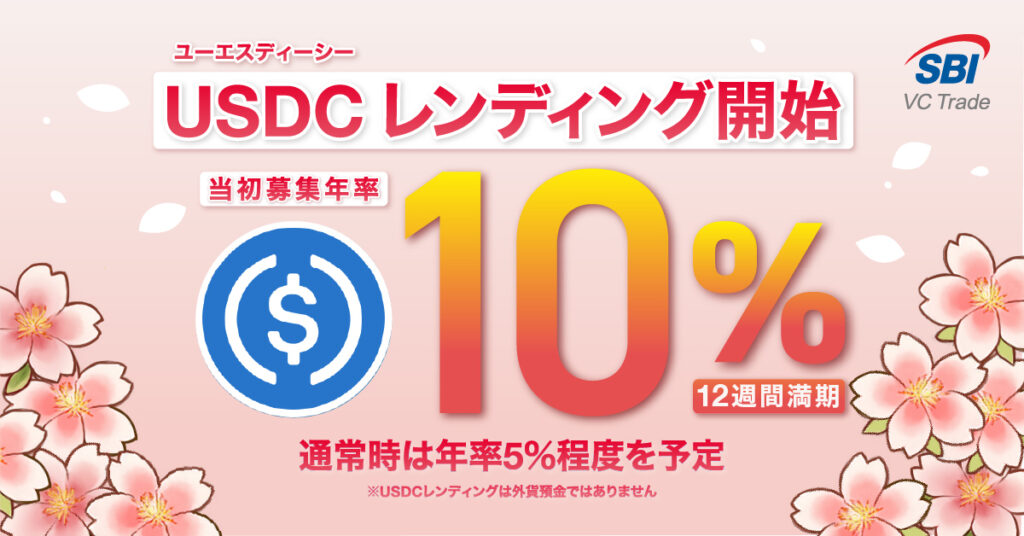
This initiative marks a significant milestone, as it represents the first time a licensed operator in Japan has introduced a stablecoin-denominated lending service of this kind. The inaugural phase will feature an attractive introductory annual interest rate of 10% for a 12-week term, with a projected normalization to approximately 5% annually thereafter. This not only introduces a novel USD asset yield opportunity to the Japanese retail market but also strategically expands the role of stablecoins in the country, transforming them from mere “tradable digital dollars” into “deployable digital financial instruments.”
Understanding the USDC Lending Service
According to SBI VC Trade’s official announcement, the new service is structured as a consumer lending transaction. Users will lend their USDC holdings to the platform, which will then return the principal and accrued earnings in USDC upon maturity. The initial campaign offers a 12-week term with a 10% annualized interest rate, with subsequent regular offerings targeting around 5% annual returns. Each subscription is capped at 5,000 USDC per account, and early termination is generally not permitted.
Important Disclosure: The official statement explicitly emphasizes that this product is neither a foreign currency deposit nor a bank-type product fully protected by deposit insurance or general segregated management. Users must acknowledge and bear the platform’s credit risk and potential price fluctuation limitations during the holding period.
SBI’s strategic positioning of this product is twofold: firstly, it aims to present USDC as an easily comprehensible “USD yield tool.” Secondly, it endeavors to elevate stablecoins beyond their traditional role as simple trading mediums, integrating them into wealth management applications that resonate more closely with conventional financial practices.
The announcement further highlights the competitive advantage of USDC Lending by drawing a comparison with common USD fixed deposits in Japan. While typical USD foreign currency fixed deposit rates generally range from 0.01% to 4% annually, USDC Lending is poised to offer potentially superior yields under favorable market conditions.
Japan’s Pioneering Approach: Regulation First, Then Innovation
Viewing SBI’s latest service within the broader industry landscape reveals a rapid evolution in the global role of stablecoins. Visa’s recent dedicated stablecoin page indicates that the global stablecoin circulating supply has surpassed $272 billion, with an adjusted global transaction volume reaching an astounding $10.2 trillion over the past 12 months. This data underscores that stablecoins have transcended their initial function as mere hedging tools within the crypto market, progressively establishing themselves as critical infrastructure for cross-border payments, on-chain settlements, and the broader circulation of digital dollars.
Earlier this year, Circle also reported that USDC’s on-chain transaction volume soared to $9.6 trillion in Q3 2025, marking a remarkable 680% year-over-year increase. This surge reflects the expanding applications of stablecoins, moving beyond exchange-centric scenarios into institutional finance, payment clearing, and capital market utilization. This growing recognition is why leading financial institutions, including Visa and Circle, increasingly view stablecoins as an essential component of an “internet-native financial system.” SBI’s launch of the USDC yield service is thus not an isolated event but a localized manifestation of a global trend: the transition of stablecoins from “crypto products” to sophisticated “financial products.”
Japan’s Landmark Stablecoin Breakthrough: USDC Leads the Way
Japan’s distinctive path to stablecoin development has garnered significant international attention. Unlike many markets that experienced uncontrolled growth followed by reactive regulation, Japan adopted a “legislation first, then market opening” strategy. Following amendments to its laws in 2022, the revised Payment Services Act and its accompanying orders were fully implemented in 2023. This legislative framework officially brought stablecoins and their circulation intermediaries under comprehensive regulation, introducing “Electronic Payment Instruments” and a robust system for their exchange service providers.
The Financial Services Agency (FSA) subsequently integrated stablecoin transfers into critical Anti-Money Laundering (AML) and Combating the Financing of Terrorism (CFT) frameworks, including the Travel Rule, Know Your Customer (KYC) protocols, and suspicious transaction reporting. This proactive stance unequivocally clarifies Japan’s position on stablecoin legality: stablecoins can lawfully exist, provided they are seamlessly embedded within a strictly regulated financial system.
Within this meticulously constructed regulatory framework, a pivotal moment for the Japanese stablecoin market was SBI VC Trade’s acquisition of the necessary licenses and its pioneering introduction of USDC. In March 2025, SBI VC Trade successfully completed its registration as an “Electronic Payment Instruments Exchange Service Provider,” becoming the first operator in Japan to achieve this status and thereby gain authorization to handle stablecoins. This was swiftly followed by Circle’s announcement of a strategic partnership with SBI, officially commencing USDC circulation in Japan on March 26, 2025.
These developments signify that the fundamental “legality” question for stablecoins in Japan has been decisively addressed. The market now enters its next phase: “ubiquity.” This transition envisions a gradual expansion from compliant circulation by a select few licensed intermediaries to broader adoption across numerous trading platforms, diverse payment scenarios, and sophisticated corporate treasury management applications.
While the Japanese stablecoin market is still in its nascent stages, particularly when compared to the nation’s established traditional payment instruments and banking systems, its trajectory is exceptionally promising. Judged by regulatory clarity, institutional participation, and foundational market infrastructure, Japan stands out globally as one of the few major economies to have adopted a clear and comprehensive legal pathway for stablecoins, positioning itself at the forefront of digital asset innovation.
Disclaimer: This article is intended solely to provide market information. All content and opinions are for reference only and do not constitute investment advice. They do not represent the views or positions of BlockTempo. Investors should make their own decisions and trades. The author and BlockTempo shall not bear any responsibility for direct or indirect losses incurred by investors’ transactions.