
Author: HIBKI, CryptoCity
Pioneering Quantum Security: BTQ Testnet Deploys BIP 360
The quest to fortify Bitcoin against potential quantum threats is rapidly evolving from theoretical whitepapers into tangible, operational infrastructure. In a significant leap forward, Canadian blockchain innovator BTQ Technologies has announced the successful, full deployment of Bitcoin Improvement Proposal 360 (BIP 360) on its Bitcoin Quantum Testnet v0.3.0.
While BIP 360 remains a draft within the broader Bitcoin ecosystem, yet to undergo formal review by core developers, BTQ has proactively transformed it into a live, testable environment. This crucial step allows developers, miners, and researchers to actively evaluate the mechanics of quantum-resistant transactions in a practical setting.
BTQ Technologies reports impressive engagement, with over 50 miners already participating and more than 100,000 blocks of the testnet’s native BTQ token successfully mined. Furthermore, a vibrant open-source community has coalesced, boasting over 100 cryptographers, developers, and miners dedicated to advancing this critical initiative.
The Imperative of BIP 360: Addressing Taproot’s Quantum Vulnerability
To fully grasp the profound importance of BIP 360, one must understand its relationship with the Taproot upgrade, activated in 2021.
Taproot is a foundational pillar of Bitcoin’s scalability roadmap, underpinning pivotal innovations such as the Lightning Network, BitVM, and Ark. It is widely recognized as essential infrastructure for Bitcoin’s next generation of applications. However, Taproot’s key path spend mechanism harbors a subtle yet critical vulnerability: it can expose users’ public keys on the blockchain.
In a future where sufficiently powerful quantum computers exist, these exposed public keys could be targeted by Shor’s Algorithm. Theoretically, an attacker could then derive the corresponding private key from the public key, enabling them to forge signatures and illicitly seize funds.
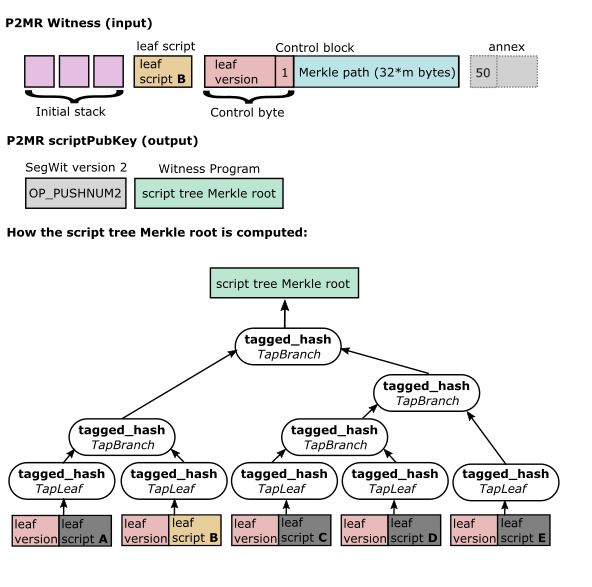
BIP 360 introduces an ingenious solution: a new output type called “Pay-to-Merkle-Root” (P2MR). P2MR utilizes a hash tree structure that directly commits to the Merkle root of the script tree, thereby eliminating reliance on internal keys or fine-tuning operations. This innovation effectively preserves Taproot’s script functionality while decisively severing the pathway that could lead to quantum vulnerability.
Testnet v0.3.0: Bridging Concept to Executable Reality
BTQ’s technical documentation details that the BIP 360 implementation in v0.3.0 incorporates comprehensive P2MR consensus rules. It leverages Segregated Witness v2 outputs with the bc1z address format (bech32m encoding) and integrates robust Merkle root commitment verification alongside control block validation mechanisms.
A particularly noteworthy advancement is the activation of all five Dilithium post-quantum signature opcodes within the P2MR tapscript environment on the testnet.
Dilithium, a post-quantum digital signature algorithm standardized by the U.S. National Institute of Standards and Technology (NIST), signifies that the testnet now possesses genuine quantum-resistant signature verification capabilities, moving far beyond mere conceptual demonstration.
In terms of practical utility, this release provides a complete command-line interface (CLI) wallet tool and full RPC support. Users can now execute the entire lifecycle of P2MR transactions on the testnet, encompassing creation, funding, signing, broadcasting, and confirmation, offering comprehensive end-to-end functional verification.
Quantum Threats: A Recognized Risk, Not an Imminent Catastrophe
Discussions surrounding quantum threats within the industry have become largely polarized, ranging from optimists who believe the threat is decades away to “Q-Day” alarmists predicting an imminent crisis.
Alex Thorn, Head of Research at Galaxy Digital, recently clarified in an interview with CoinDesk that while a quantum threat to Bitcoin is indeed real, it currently only impacts specific “exposed” wallets and does not pose an immediate threat to the overall network’s security. He emphasized that the risk is both real and acknowledged, and those best equipped to address it are actively engaged in finding solutions.
- Further Reading: Debunking “Quantum Doomsday”! CoinShares: Only “10,200 Bitcoins” Face Substantial Risk
On the Bitcoin network, vulnerability is currently limited to funds whose public keys have already been exposed on-chain. Common scenarios include users reusing addresses, some custodial services employing less secure operational practices, or funds residing in older address formats.
Security research firm Project Eleven estimates that approximately 7 million Bitcoins fall into this potentially exposed category. However, under the currently known quantum computing capabilities, these funds remain secure.
Even with optimistic projections, only a select few highly specialized research institutions are anticipated to achieve breakthrough quantum computing capabilities in the foreseeable future.
BIP 360’s Path Forward: A Marathon, Not a Sprint
BTQ’s testnet deployment marks a significant milestone, yet the journey for BIP 360 to become an integral protective layer for the Bitcoin network remains extensive.
Currently in its draft stage, BIP 360’s ability to navigate the formal Bitcoin Improvement Proposal review process and garner widespread support from miners and Bitcoin core developers will be the critical determinant of its eventual implementation.
The Bitcoin community is renowned for its cautious approach to protocol changes. The Taproot upgrade itself took several years from proposal to activation. A quantum-resistant upgrade involves even greater cryptographic migration complexity, and the associated governance challenges should not be underestimated.
For investors and industry professionals, a pragmatic approach involves diligently tracking BIP 360’s progress within the development community and the ongoing consensus-building process, rather than forming premature conclusions about the timeline of quantum-resistant upgrades based solely on testnet deployment news.
(The above content is an authorized excerpt and reproduction from our partner “CryptoCity”, original link )
Disclaimer: This article is for market information purposes only. All content and views are for reference only, do not constitute investment advice, and do not represent the views and positions of BlockBeats. Investors should make their own decisions and transactions. The author and BlockBeats will not be responsible for any direct or indirect losses resulting from investor transactions.