
Leading cryptocurrency market maker Wintermute has identified a pivotal factor behind Bitcoin’s recent reclaim of the $70,000 mark: a swift reduction in the geopolitical risk premium within the crude oil market, spurred by a temporary de-escalation of tensions in the Middle East.
As Brent crude oil prices rapidly cooled from their recent wartime highs, market anxieties concerning inflation, supply disruptions, and global growth pressures simultaneously eased. This shift redirected capital flows back into risk assets, including Bitcoin. Wintermute explicitly stated that actions, such as proposed pauses in further strikes, significantly diminished the geopolitical risk premium embedded in crude oil, leading to a decline in Brent crude prices and simultaneously propelling Bitcoin back above $70,000.
Wintermute: Oil Price Decline — A Key Macro Indicator for Bitcoin’s Rebound
Wintermute’s market observations suggest that the recent trading dynamics were not merely driven by internal cryptocurrency market news but were more directly influenced by broader macroeconomic and geopolitical developments. Their core assessment posits that as the market perceived no further escalation in the Middle East conflict and energy supply risks were temporarily contained, previously inflated oil prices began to retract. This, in turn, improved investor sentiment towards higher-risk assets, culminating in a notable Bitcoin rebound.
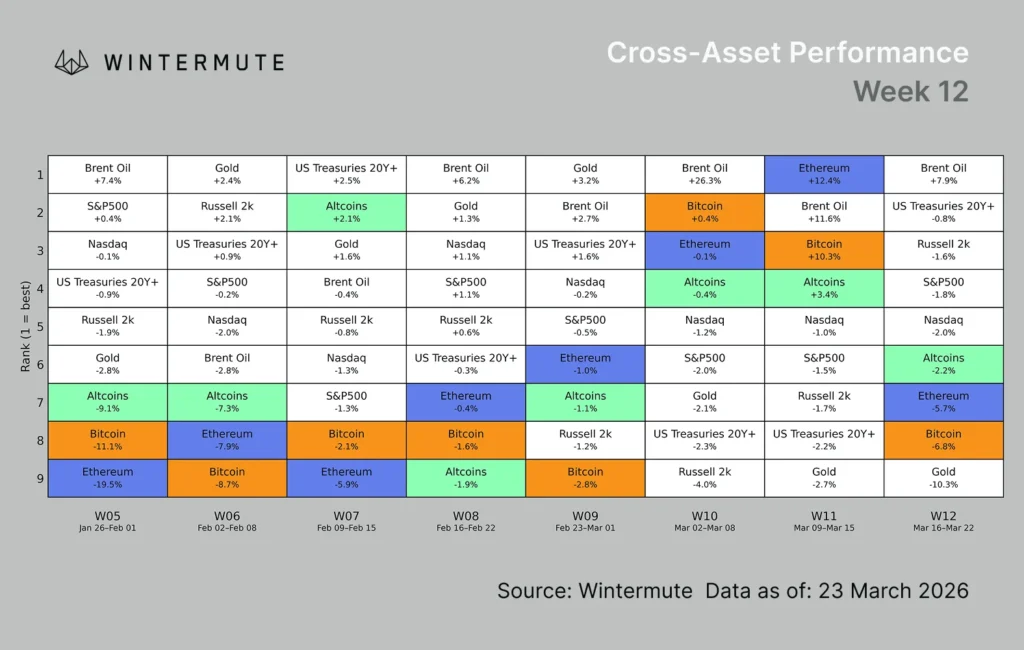
This analysis aligns broadly with global market performance over the past few days. Reuters reported that following a US proposal for a ceasefire and de-escalation plan involving Iran, the market began to anticipate a potential easing of Middle East supply disruption risks. Consequently, Brent crude (May futures) gave back earlier gains, with prices fluctuating around parity. As of March 25th (Taiwan time), it stood at $96.01 per barrel, nearly flat. US West Texas Intermediate (WTI) futures, meanwhile, saw a modest increase of 0.4% to $88.49 per barrel.
Indeed, oil prices had previously emerged as a central variable suppressing market sentiment. A Reuters report from March 19th indicated that Brent had surged to an intraday high of $119.13 per barrel, while WTI surpassed $100, primarily due to intensifying Iranian attacks on Middle Eastern energy facilities, which amplified fears of supply disruptions. At the time, concerns mounted that a prolonged blockage of the Strait of Hormuz could trigger soaring energy prices, further negatively impacting global risk asset performance.
However, the situation subsequently shifted. The US signaled an openness to “constructive dialogue” with Iran and proposed a temporary halt to certain strike operations, prompting the market to rapidly adjust its most pessimistic expectations. Both the Associated Press and Reuters noted that Brent subsequently retreated from near $120 to around $100, as the market began to re-price energy supply risk. For investors, stabilizing oil prices not only signified reduced pressure in the energy market but also temporarily lowered the probability of inflation spiraling out of control, thereby enhancing the willingness to allocate capital to risk assets like stocks and cryptocurrencies.
Bitcoin Reclaims $70,000, Highlighting Its ‘High Beta Risk Asset’ Status
In this latest rally, Bitcoin’s performance once again underscored its characteristic as a high-beta risk asset. At the time of writing, Binance data showed Bitcoin trading at approximately $70,669, with a 24-hour range between $68,920.69 and $71,371.30, indicating its continued high volatility even after firmly re-establishing itself above $70,000.
This trend is consistent with Wintermute’s analysis. When crude oil prices sharply increased due to escalating conflict, Bitcoin had previously dipped below $70,000. Conversely, as oil prices fell and equities alongside other risk assets simultaneously rebounded, Bitcoin swiftly recovered its losses. Following the announcement of a pause in further strikes against Iran, Bitcoin briefly returned to $70,000, and the overall cryptocurrency market capitalization increased by approximately $60 billion in a single day, reflecting a clear inflow of short-term capital.
From an asset pricing logic perspective, Wintermute’s observations highlight a dominant theme in the recent market: Bitcoin’s short-term performance is increasingly influenced by broader macroeconomic risk sentiment rather than solely by crypto-specific narratives.
Crude oil serves as a direct barometer for global inflation expectations and geopolitical risk. A sudden surge typically signals a market shift towards risk aversion, defensive positioning, and deleveraging. Conversely, a decline in oil prices indicates that the most severe supply shock expectations have been revised, providing risk assets with room to breathe. The accompanying rise in Asian, European, and US stock markets, alongside falling oil prices, further suggests that this rebound is not unique to the crypto market but rather a more widespread restoration of risk appetite.
Key Outlook: If Oil Prices Surge Again, Bitcoin Pressure May Resurface
“The macroeconomic ceiling has changed. The developments over the next five days (this week) will determine the market’s direction,” Wintermute stated in its market analysis report.
The report elaborated that the five-day pause in actions targeting Iranian energy infrastructure temporarily reduced the geopolitical risk premium in the oil market and recalibrated positions ahead of the March 27th options expiry. If Brent crude prices stabilize around $100 and diplomatic efforts are sustained, inflation concerns linked to energy supply disruptions should ease. This would allow for the restoration of some interest rate cut expectations that were erased last week, thereby removing the macroeconomic headwinds that have suppressed Bitcoin’s ascent since the conflict escalated.
Positive developments regarding tanker traffic in the Strait of Hormuz or signs of cooperation from Iran could propel Bitcoin towards the $74,000 to $76,000 resistance zone, a level where it has previously faced rejection twice. With Bitcoin now back above $70,000 and the maximum pain point for options prices concentrated around this figure, favorable news could continue to drive prices higher before options expiry.
Conversely, should negotiations break down or shipping restrictions persist, the crude oil risk premium could resurface. This would keep inflation concerns elevated, further delaying interest rate cut expectations, and potentially send the market back into a risk-off sentiment. In such a scenario, Bitcoin might retest the mid-$60,000 support level.
“Continued easing and normalization of Strait of Hormuz flows will eliminate inflationary pressure, grant the Federal Reserve greater flexibility, and improve the macroeconomic environment for risk assets. In this scenario, if institutional dip buying continues, Bitcoin is poised to reach $80,000,” Wintermute unequivocally stated in its market analysis report.
Nevertheless, the market maintains a degree of caution regarding this rebound. Iran’s continued denial of direct negotiations with the US implies that the prospect of a ceasefire or de-escalation remains highly uncertain. Should the situation deteriorate once more, with Strait of Hormuz supply risks re-escalating, oil prices could surge again, potentially reversing the recently restored risk appetite.
Disclaimer: This article is for market information purposes only. All content and views are for reference only and do not constitute investment advice. They do not represent the views and positions of BlockTempo. Investors should make their own decisions and trades. The author and BlockTempo will not be liable for any direct or indirect losses incurred by investors’ transactions.