
Bitcoin Emerges as Premier Safe Haven Amidst Geopolitical Unrest, Outperforming Gold and Silver
As geopolitical tensions escalate in the Middle East, a significant reshuffling of the global safe-haven landscape is underway. JPMorgan Chase reports that during periods of heightened conflict, particularly in regions like Iran, Bitcoin—often dubbed “digital gold”—has witnessed substantial capital inflows and a surge in trading activity. This phenomenon highlights Bitcoin’s remarkable resilience, far surpassing that of traditional safe havens like gold and silver, which have simultaneously faced massive capital outflows and severe liquidation of long positions.
Why Traditional Safe Havens Faltered
The unexpected underperformance of gold and silver in the face of crisis begs the question: why did these conventional “safe-haven assets” falter? A report released by JPMorgan’s analysis team, led by Nikolaos Panigirtzoglou, on Wednesday, sheds light on this. Gold prices, for instance, have plummeted by approximately 15% this month. This decline is primarily attributed to the relentless ascent of interest rates and a robust U.S. dollar, which collectively exerted immense pressure on what were described as “previously overcrowded positions.”
Analysts further elaborated that both gold and silver had surged to historical highs earlier this year, with gold approaching $5,500 per ounce and silver hitting $120. Such elevated valuations made them particularly susceptible to profit-taking and extensive position liquidations once market sentiment began to shift.
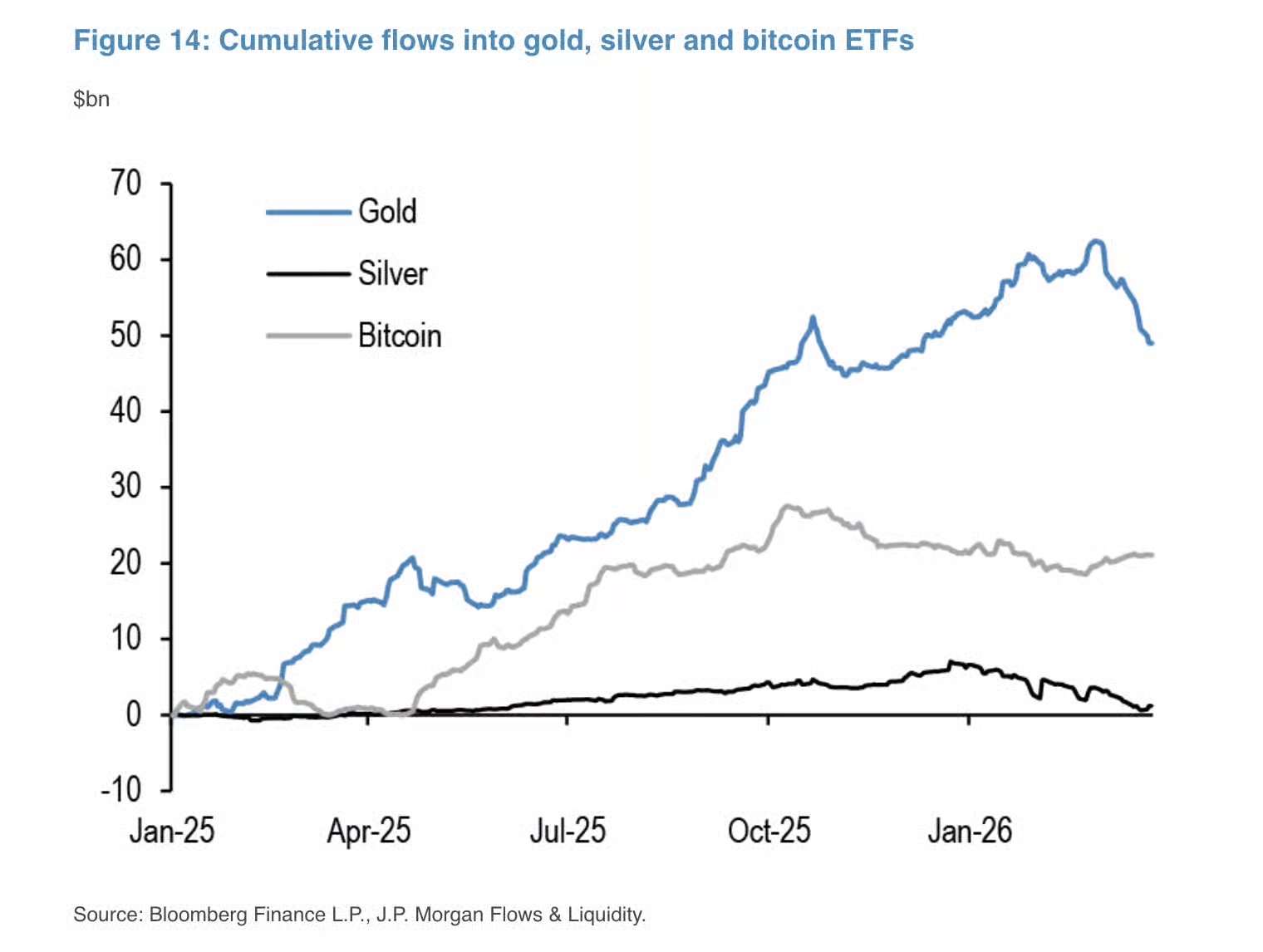
Empirical data underscores this divergence: the first three weeks of March alone saw gold exchange-traded funds (ETFs) bleed nearly $11 billion in capital. Silver ETFs fared even worse, completely reversing all capital inflows accumulated since the summer of last year. In stark contrast, Bitcoin recorded net capital inflows during the identical period, drawing a sharp distinction from its precious metal counterparts.
Bitcoin’s Unique Appeal in Times of Crisis
The appeal of Bitcoin extends beyond mere price resilience. Citing data from Chainalysis, analysts noted an explosive growth in local crypto asset activity within Iran as the conflict intensified. Citizens, facing economic instability, currency devaluation, and the threat of state capital controls, actively moved their funds from local exchanges to self-custody wallets and international platforms.
JPMorgan analysts posit that Bitcoin’s inherent characteristics—its borderless nature, the ability for self-custody, and 24/7 uninterrupted trading—make it an unparalleled tool for individuals in conflict-ridden areas to transfer and safeguard their wealth. It offers a lifeline when traditional financial systems falter or become inaccessible.
Institutional Shifts and Market Dynamics
Changes in institutional investment patterns further corroborate this narrative. JPMorgan referenced CME open interest data, revealing that while gold and silver positions saw significant accumulation from late last year into early this year, they experienced a sharp decline since January, signaling widespread profit-taking by institutional investors. Bitcoin futures positions, conversely, have maintained relative stability in recent weeks.
Momentum traders appear to have amplified this significant asset rotation. Indicators associated with momentum strategies, such as those employed by commodity trading advisors, show gold and silver transitioning from “overbought” levels to “below neutral,” suggesting that forced liquidations were a primary driver of the recent price collapse in precious metals. Simultaneously, Bitcoin’s momentum signals have steadily recovered from “oversold” levels to neutral, reflecting an improving market sentiment.
Furthermore, the liquidity landscape for various assets has undergone a notable transformation. Historically, gold, as measured by the “Hui-Heubel Ratio” (an indicator of market breadth and liquidity), boasted superior liquidity compared to silver and Bitcoin. However, this trend has recently reversed. Gold’s liquidity conditions have deteriorated, while Bitcoin now exhibits superior market breadth. Silver’s liquidity, in particular, has seen a drastic contraction.
Conclusion: The Ascendance of Digital Assets
In conclusion, the JPMorgan analysis unequivocally highlights a paradigm shift. “Silver ETFs have completely reversed all capital inflows since last summer,” the analysts stated. “Gold liquidity conditions have deteriorated, and market breadth is currently lower than Bitcoin. Reports of a surge in cryptocurrency trading activity in Iran indicate that in countries experiencing economic turmoil, currency instability, and geopolitical pressure, cryptocurrencies are playing an important safe-haven role.” This underscores Bitcoin’s growing prominence as a vital hedge against economic uncertainty and geopolitical instability in an increasingly complex global environment.
Disclaimer: This article is for market information purposes only. All content and views are for reference only and do not constitute investment advice, nor do they represent the views and positions of BlockTempo. Investors should make their own decisions and trades. The author and BlockTempo will not be liable for any direct or indirect losses incurred by investors’ transactions.