Wall Street’s Triple Play: Nasdaq, NYSE, and CME Lead the Tokenization Revolution in Global Finance
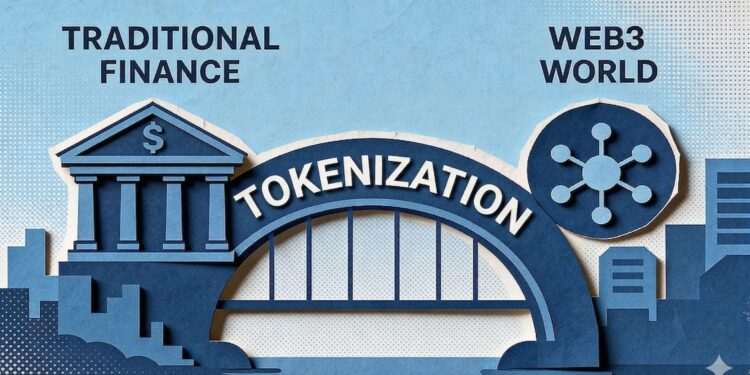
While the crypto market often captures headlines with its volatile swings, a quieter, yet profoundly transformative revolution is unfolding in the heart of traditional finance: Wall Street. In a remarkable 48-hour sprint, three titans of global capital – the New York Stock Exchange (NYSE), Nasdaq, and CME Group – unveiled groundbreaking initiatives to integrate blockchain technology and tokenization into their core operations. This concerted ‘triple play’ signals a deep overhaul of the very infrastructure that underpins global liquidity, promising unprecedented efficiency and a fundamental rewriting of market rules.
Nasdaq’s Collateral Revolution: Unlocking $35 Billion and Beyond T+1
Nasdaq, a vanguard of technological innovation in capital markets, is tackling the estimated $35 billion in ‘dormant’ collateral currently locked within the global financial system. Hampered by legacy settlement cycles (T+1), cross-border complexities, and traditional banking hours, highly liquid assets like stocks and U.S. Treasury ETFs often remain underutilized.
On March 23rd, Nasdaq announced a strategic alliance with digital asset infrastructure provider Talos. This partnership will integrate Nasdaq’s Calypso risk and collateral management platform with Talos’s digital asset frontend, enabling the tokenization of collateral for instantaneous transfers. This leap from T+1 to atomic settlement represents an exponential boost in capital efficiency, allowing institutions to:
- Meet margin calls in seconds: During periods of market volatility, firms can instantly deploy tokenized assets to satisfy clearinghouse requirements, bypassing traditional bank transfer delays.
- Optimize asset utilization: The same tokenized asset can serve as margin for U.S. equities in the morning and as collateral for Asian market trades at night, maximizing its utility around the clock.
- Enhance market integrity: Nasdaq is also extending its robust ‘Trade Surveillance’ system to Talos’s client base, embedding a crucial compliance safety valve against illicit activities like wash trading and market manipulation.
This strategic move follows SEC approval on March 18th for Nasdaq’s tokenized stock trading pilot program, paving the way for investors to leverage tokenized collateral for future stock margin trading. Initially, tokenized assets will be confined to Russell 1000 index components and major ETFs tracking the S&P 500 and Nasdaq 100 – a prudent choice given their deep liquidity, which can absorb the initial technical integration while maintaining stable pricing. Crucially, these assets will operate under a ‘dual-track’ model, sharing identical CUSIP codes and trading identifiers with their traditional counterparts, ensuring full equivalence and interchangeability. This approach also provides regulators with a controlled environment to observe blockchain settlement’s impact on traditional market dynamics.
NYSE Pioneers Native Tokenization: A Fundamental Shift in Securities Trading
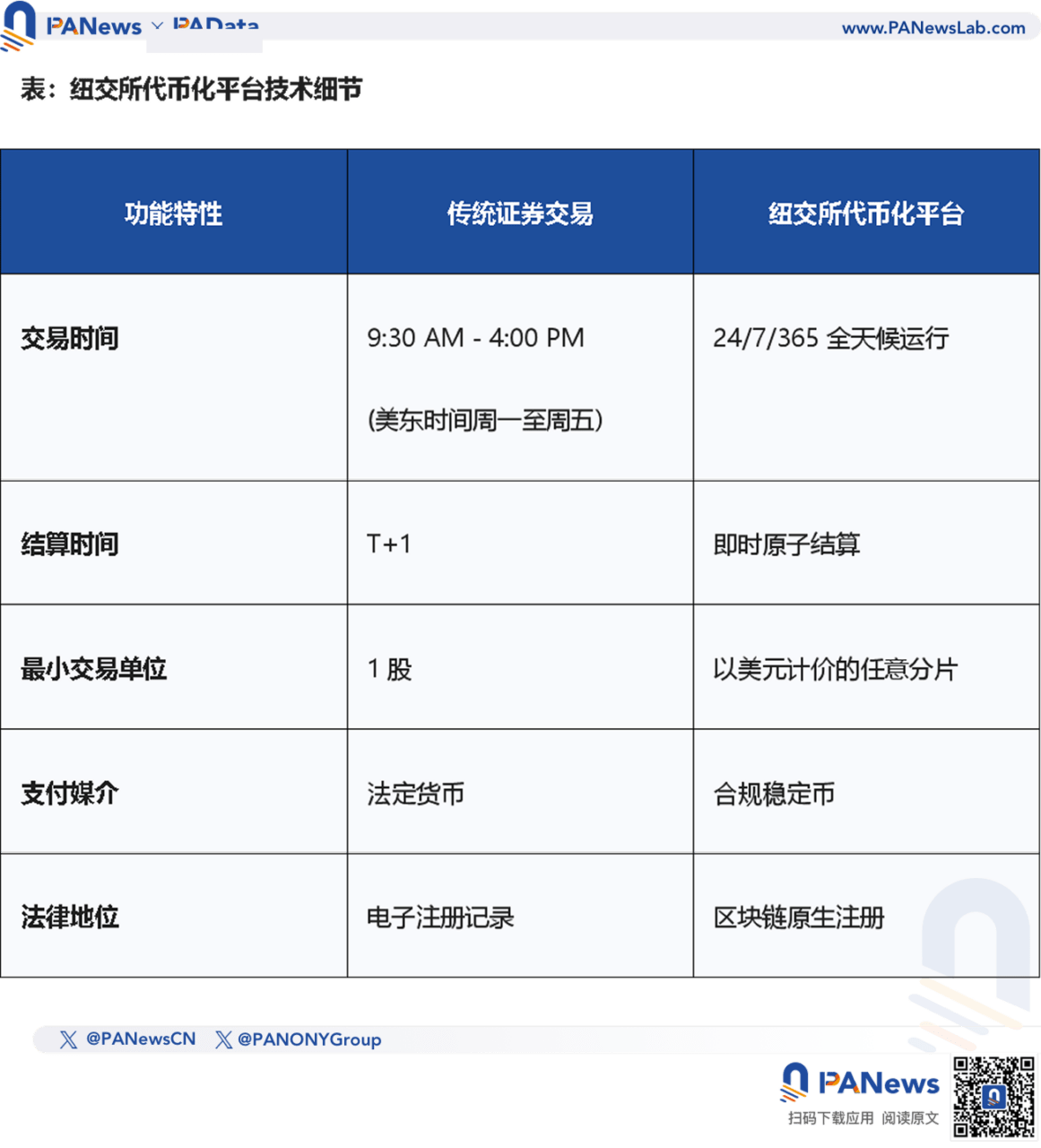
While Nasdaq focuses on optimizing existing institutional workflows, the New York Stock Exchange is embarking on a more fundamental transformation of securities trading itself. On March 24th, the NYSE signed a Memorandum of Understanding (MOU) with tokenization pioneer Securitize, outlining plans to develop a tokenized securities platform supporting instant settlement and stablecoin payments.
Securitize, a key player in Real World Asset (RWA) tokenization and instrumental in BlackRock’s BUIDL tokenized Treasury fund, is central to this vision. Securitize CEO Carlos Domingo emphasized that the NYSE’s objective is ‘native tokenization,’ a stark contrast to the ‘stock certificates’ often issued by crypto exchanges. In this groundbreaking model, Securitize will act as the NYSE’s first designated Digital Transfer Agent, directly maintaining ownership records on the blockchain.
This means that each token held by an investor will represent direct legal ownership of the underlying security, complete with full dividend, voting, and liquidation rights. This fundamentally differs from third-party custodial models where ‘tokenized certificates’ merely represent an equity mapping. The NYSE’s approach aims to create genuinely native securities on the blockchain.
However, the pursuit of native tokenization also introduces new complexities. Potential risks include operational errors by underlying asset custodians or inaccurate oracle pricing during off-market hours, which could lead to significant deviations between token value and its anchored stock, potentially triggering cascading on-chain liquidations.
CME Group’s Tokenized Cash: Defusing Margin Call Crises
Completing Wall Street’s tokenization trifecta, CME Group, the world’s largest derivatives exchange, is addressing the critical challenge of cash settlement. On March 24th, CME, in collaboration with Bank of Montreal (BMO) and Google Cloud, unveiled a tokenized cash solution designed to synchronize funding within the tokenization ecosystem, establishing a robust foundation for capital flow.
The technical backbone of this initiative is the Google Cloud Universal Ledger (GCUL), a highly programmable, permissioned distributed ledger tailored for traditional financial institutions. Unlike public blockchains, GCUL offers the dual advantages of real-time settlement and transaction privacy, while rigorously adhering to financial regulatory standards like KYC/AML – a crucial factor for institutional adoption.
BMO, the inaugural bank to integrate with this system, will enable its institutional clients to convert their in-house USD deposits into ‘tokenized cash.’ The primary application for these tokens will be as a margin medium for CME Clearing, directly tackling a long-standing vulnerability in the derivatives market: the ‘margin call crisis.’
Derivatives trading demands immediate availability of margin, and with markets trending towards 24/7 operation, intraday margin calls during extreme volatility are becoming more frequent. Traditionally, bank closures could prevent timely cash allocation, often resulting in forced liquidations. Tokenized cash will dismantle this barrier. As CME COO Suzanne Sprague noted, it will:
- Enable real-time margin fulfillment: Institutions can meet margin obligations instantly, eliminating the need for vast idle buffer capital held against bank holidays.
- Reduce liquidity costs: Freeing up previously trapped capital.
- Enhance system stability: Significantly bolstering the resilience of the entire clearing system and mitigating the risk of systemic cascading liquidations.
Nevertheless, integrating a distributed ledger with CME’s sophisticated clearing system presents considerable complexity. The potential for network partitioning failures or smart contract vulnerabilities in a 24/7 financial system could pose ‘nuclear reactor meltdown-like’ risks, where operations cannot be halted mid-process.
The Triple Play: Reshaping Global Finance for a 24/7 Future
The synchronized tokenization initiatives from Nasdaq, NYSE, and CME Group are more than just an embrace of new technology; they signify a relentless pursuit of efficiency and a bold vision for the future of global capital. From Nasdaq’s unlocking of $35 billion in idle collateral, to NYSE’s pioneering of native tokenized securities for direct investor ownership, and CME’s establishment of a tokenized cash foundation for real-time settlement, a monumental ‘value network’ is rapidly taking shape on Wall Street. This new paradigm promises a future where capital flows ceaselessly, 24/7, across an interconnected, blockchain-powered ledger, fundamentally reshaping how global finance operates.