
Bitcoin Mining Faces Unprecedented Q1 Decline as Miners Pivot to AI: A New Era for Hash Rate Dynamics?
For the first time in six years, Bitcoin’s global hash rate experienced a notable decline in the first quarter of the year, signaling a significant shift in the cryptocurrency mining landscape. This unprecedented dip comes as soaring operational costs push the profitability of Bitcoin mining to breaking point, forcing miners to re-evaluate their strategies and pivot towards more stable and lucrative ventures in Artificial Intelligence (AI) and High-Performance Computing (HPC) infrastructure. Is the “hash rate growth myth” of Bitcoin finally unraveling, or is this a necessary evolution towards a more decentralized future?
A Historical Shift: The End of Uninterrupted Growth
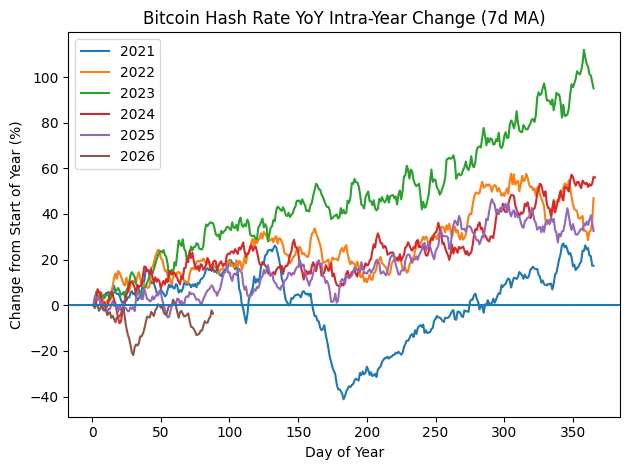
According to Glassnode data, Bitcoin’s total network hash rate currently hovers around 1 Zettahash (ZH/s), reflecting an approximate 4% decrease year-to-date. This recent downturn stands in stark contrast to the past five years, which saw the hash rate surge tenfold, from roughly 100 Exahash (EH/s) to its current Zettahash levels.
Historically, the first quarter of each year has been a period of robust growth for Bitcoin’s hash rate, often preceding annual increases exceeding 10%, with an astounding near-doubling in 2022. This year, however, that momentum has come to an abrupt halt.
The Economic Squeeze: Why Miners Are Exiting
The primary driver behind this deceleration is the rapid deterioration of the mining industry’s economic model. Current estimates place the average production cost for a single Bitcoin at nearly $90,000, significantly higher than the prevailing spot price of approximately $67,000. This stark disparity means that for many miners, simply operating their equipment results in immediate losses.
The Great Pivot: From Bitcoin to AI and HPC
Faced with an existential crisis, many large, publicly traded mining companies are strategically re-aligning their operations. They are increasingly shifting their focus and resources towards Artificial Intelligence (AI) and High-Performance Computing (HPC) infrastructure.
This transition is fueled by the allure of more stable and predictable returns offered by AI computing services, a stark contrast to the notorious volatility of cryptocurrency prices. For these mining operators, AI represents a “new blue ocean” of opportunity.
The funding for this transformation largely relies on a “sell coins, raise debt” strategy. Miners are reducing reinvestment in dedicated mining hardware, instead liquidating their Bitcoin holdings or issuing debt to secure capital for building advanced AI data centers. This strategy significantly increases the hash rate’s sensitivity to Bitcoin’s price, meaning that sustained market weakness could accelerate the exodus of smaller, individual miners, potentially leading to further hash rate declines.
Implications for Bitcoin’s Network Security and Decentralization
A continuous decrease in hash rate inevitably sparks concerns about the overall security of the Bitcoin network. However, a different perspective suggests that the degree of network decentralization might be a more critical metric than the absolute scale of hash rate.
Historically, publicly listed U.S. miners alone commanded over 40% of the global hash rate. As these North American giants shift their focus to AI, their concentrated influence may naturally dilute. This redistribution of computing power across a broader global base could, in the long run, foster greater decentralization – a core tenet of Bitcoin’s philosophy.
Future Outlook
Despite the current slowdown, industry insights offer a glimpse of potential recovery. CoinShares predicts that if Bitcoin’s price can rebound to approximately $100,000, the network’s hash rate still has the potential to grow to around 1.8 ZH/s by the end of 2026.
Disclaimer: This article is for market information purposes only. All content and views are provided for reference and do not constitute investment advice. They do not represent the views or positions of BlockTempo. Investors should make their own decisions and trades. The author and BlockTempo will not be liable for any direct or indirect losses incurred by investors’ transactions.