
Quantum Threat to Ethereum: The Unseen $100 Billion Vulnerability
When Google’s Quantum AI team released its latest report, the cryptocurrency community fixated on Bitcoin’s vulnerabilities: a mere nine minutes to crack, a 41% theft probability, and 6.9 million BTC exposed. Yet, largely overlooked in the market’s frenzy was the report’s stark warning regarding Ethereum – a threat far more insidious and potentially catastrophic, demanding the highest level of vigilance from all investors.
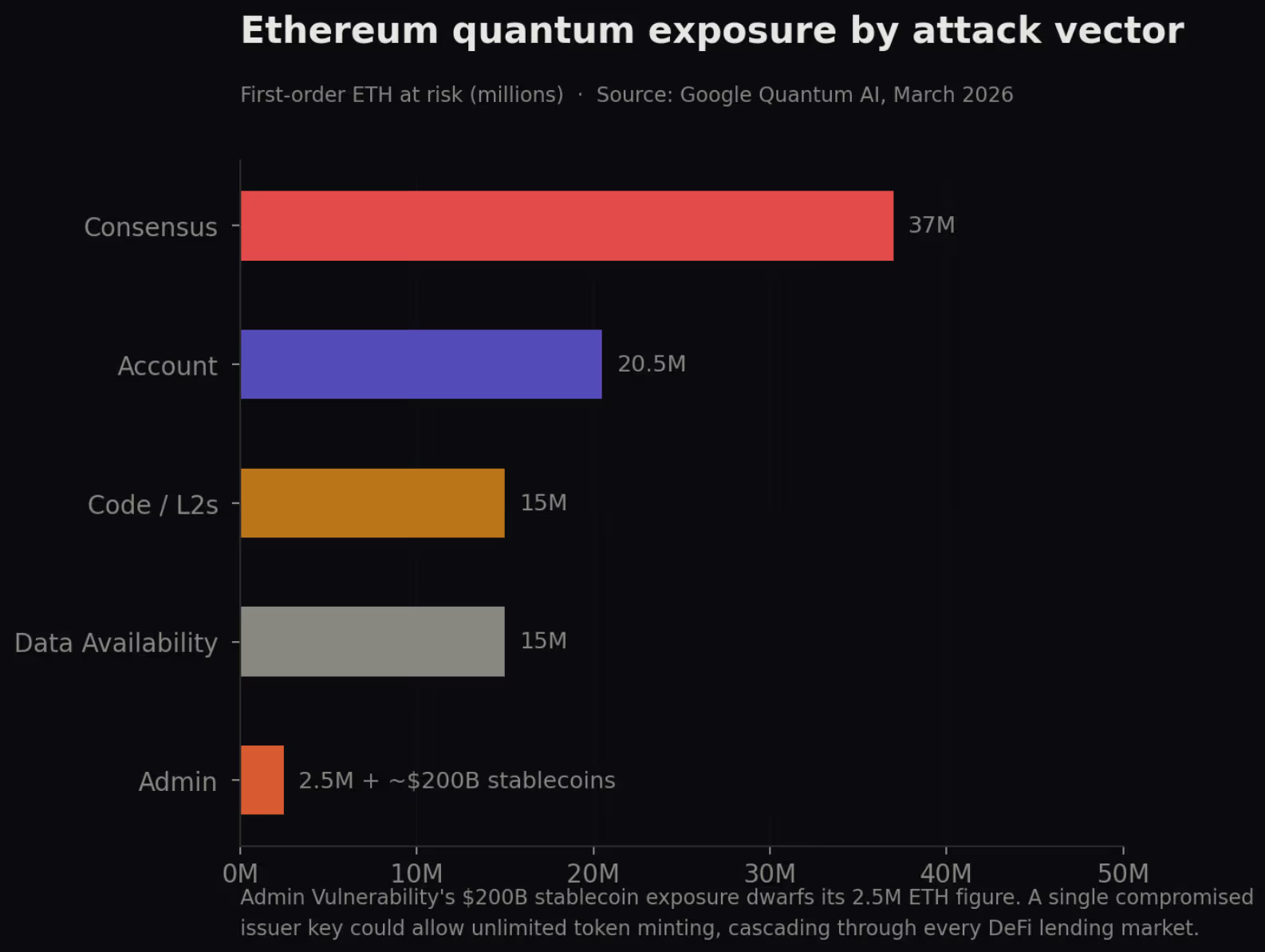
Co-authored by Google, Ethereum Foundation core researcher Justin Drake, and Stanford cryptography luminary Dan Boneh, this groundbreaking whitepaper meticulously dissects “five fatal pathways” through which quantum computers could breach Ethereum. Each pathway targets a distinct, critical facet of the Ethereum ecosystem. Based on current market prices, the direct assets exposed to these risks already exceed an staggering $100 billion. Should a domino effect ensue, the ripple consequences could be immeasurable.
1. The Exposed “Whale” Wallets
In the Bitcoin network, a user’s public key remains concealed behind a hash function (a digital fingerprint) until the funds are actually spent. Ethereum operates differently: once a transaction is initiated, the public key is “permanently public” on the blockchain. There is no mechanism to change it without entirely abandoning the account and transferring all assets.
Google’s team estimates that the top 1,000 Ethereum “whale” wallets, collectively holding approximately 20.5 million ETH, are fully exposed. If a quantum computer can crack a single private key in just nine minutes, these 1,000 colossal wallets could be systematically plundered in less than nine days.
2. Super Administrators: The Keys to DeFi’s Kingdom
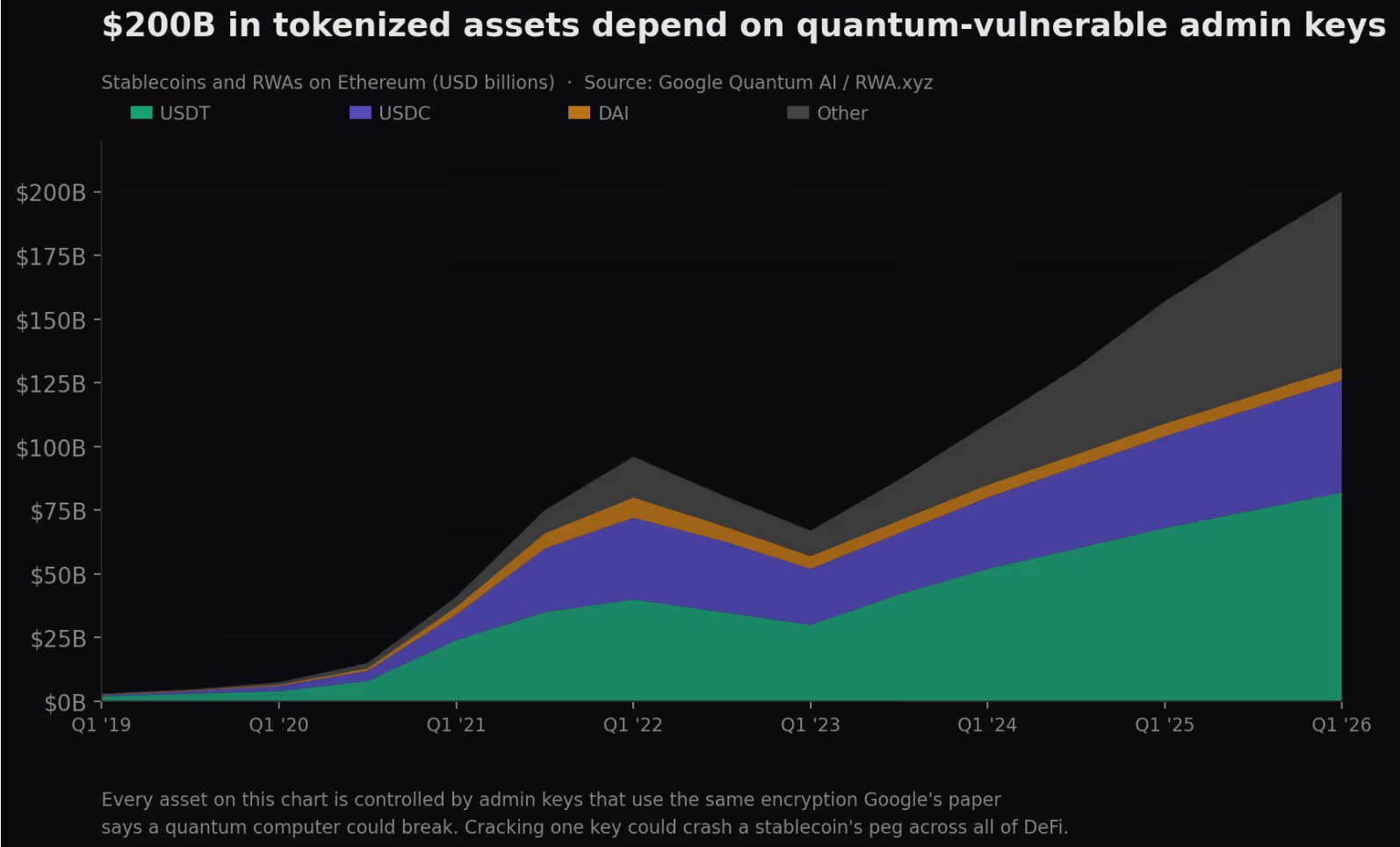
The smart contracts underpinning Ethereum’s vast DeFi landscape – from lending and trading to stablecoin issuance – often delegate “special privileges” to a select few administrators. These “super administrators” wield immense power, capable of pausing contracts, upgrading code, or even transferring substantial sums of capital. The report shockingly reveals that at least 70 large contract administrator keys are already exposed on-chain, implicating approximately 2.5 million ETH.
The implications extend far beyond Ethereum itself. These administrator accounts frequently control the “minting rights” for major stablecoins like USDT and USDC. This means a quantum hacker, by compromising just one set of these keys, could effectively become an unlimited token printer, triggering a catastrophic chain reaction across all lending markets collateralized by these tokens. The whitepaper estimates that a staggering $200 billion worth of stablecoins and tokenized assets on Ethereum are currently reliant on these vulnerable administrator keys.
3. Layer 2 Networks: A Shared Cryptographic Vulnerability
To enhance transaction speed and scalability, the majority of Ethereum transactions are processed off-chain by Layer 2 solutions such as Arbitrum and Optimism, with results subsequently relayed back to the mainnet. The critical flaw lies in their reliance: these Layer 2s universally leverage Ethereum’s inherent cryptographic tools, none of which possess “quantum-resistant” capabilities.
The report roughly estimates that at least 15 million ETH are at risk across various Layer 2 networks and cross-chain bridges. Currently, StarkNet, which employs hash algorithms rather than elliptic curve signature algorithms, is identified as the sole exception deemed secure against these specific quantum threats.
4. Staking System Attacks: Paralysis and History Rewritten
Ethereum’s network security is maintained through its Proof-of-Stake (PoS) mechanism, where validators vote to confirm transaction validity. However, the report posits that the digital signature verification processes used for these crucial votes are equally susceptible to quantum computer decryption.
With approximately 37 million ETH currently staked across the network, the consequences of a successful attack are dire. If hackers manage to control just one-third of the validator nodes, they could effectively paralyze the network, preventing transactions from being confirmed. Should they seize control of two-thirds, these malicious actors could unilaterally rewrite the blockchain’s historical record. The report also specifically warns that if staking power becomes overly concentrated in large pools (e.g., Lido, which holds around 20% market share), hackers could significantly reduce the time required for an attack by focusing their efforts on a single operator’s infrastructure.
5. The “Permanent Loophole”: A One-Time Quantum Key
Perhaps the most unique and unsettling attack vector highlighted in the report involves Ethereum’s Data Availability Sampling (DAS) system, designed to verify the integrity of transaction data relayed from Layer 2s. During its initial setup, this system generated a “strictly confidential number” that was intended to be irrevocably destroyed afterward.
However, a quantum computer could potentially reconstruct this secret number from publicly available data. The terrifying implication is that once cracked, this secret number transforms into a permanent tool, enabling hackers to forge data verification proofs indefinitely, even without the continuous use of a quantum computer. The Google team describes this vulnerability tool as possessing “high trading value,” warning that its entry into the black market would jeopardize all Layer 2 networks reliant on Ethereum’s Blob data system.
The Race Against Time: Ethereum’s Defense and Decentralized Dilemma
Naturally, the Ethereum community is not standing idly by. Justin Drake, co-author of the whitepaper and a researcher at the Ethereum Foundation, revealed that the foundation officially launched a “Post-quantum” research portal last week. He noted that related research has been ongoing for over eight years, with testnets progressing weekly and a multi-stage hard fork upgrade roadmap in place, aiming for a full transition to quantum-resistant cryptography by 2029.
Furthermore, Ethereum’s rapid 12-second block time, significantly faster than Bitcoin’s 10-minute interval, substantially increases the difficulty for hackers attempting real-time transaction interception.
However, the whitepaper also delivers a crucial warning: even if the Ethereum mainnet successfully upgrades, the tens of thousands of smart contracts already deployed on-chain will not automatically become immune. This implies that every single DeFi protocol, every cross-chain bridge, and every Layer 2 network will need to independently upgrade its code and replace its cryptographic keys. In a decentralized world, no central authority can compel these entities to press the upgrade button. For the entire cryptocurrency ecosystem, this high-stakes race for survival against quantum technology has only just begun.
Disclaimer: This article is for market information purposes only. All content and opinions are for reference only and do not constitute investment advice. They do not represent the views and positions of the author or Blockcast. Investors should make their own decisions and trades. The author and Blockcast will not be held responsible for any direct or indirect losses incurred by investors’ transactions.