
Bitcoin’s recent dip below the $67,000 mark, initially attributed to escalating geopolitical tensions following renewed threats from U.S. President Donald Trump against Iran, appears to be more than just a fleeting reaction to news. While external events often trigger market volatility, a closer examination of the derivatives market reveals a potent internal mechanism that could amplify downward price movements, potentially sending Bitcoin spiraling further.
The primary concern stems from the intricate flow of capital within the Deribit options market. Analysts are flagging a significant accumulation of defensive positions, particularly put options, at price levels below Bitcoin’s current valuation. This concentration suggests a latent risk: should Bitcoin decisively breach the critical $68,000 threshold, it could ignite a cascade of selling pressure, potentially driving the digital asset down to $60,000, with an outside chance of even touching $50,000.
In recent weeks, traders have aggressively acquired put options, essentially buying downside protection against a potential price drop. These defensive positions are heavily clustered with strike prices below $68,000, extending all the way down to $55,000. This heightened caution is understandable given the backdrop of ongoing Middle East conflicts, the long-term specter of quantum computing threats, and a lingering bearish sentiment that has persisted since late last year. In such an environment, market participants are naturally on edge.
However, when defensive positioning becomes overly concentrated, it creates what is known as a “Negative Gamma Zone.” In this scenario, market makers—the entities responsible for providing liquidity to exchanges—are compelled to adjust their hedges in response to price fluctuations. Crucially, these adjustments often serve to reinforce the prevailing market trend, meaning that in a falling market, their actions would exacerbate the decline.
Historical data shows that such dynamics in market structure have repeatedly magnified both bullish and bearish market movements in the past.
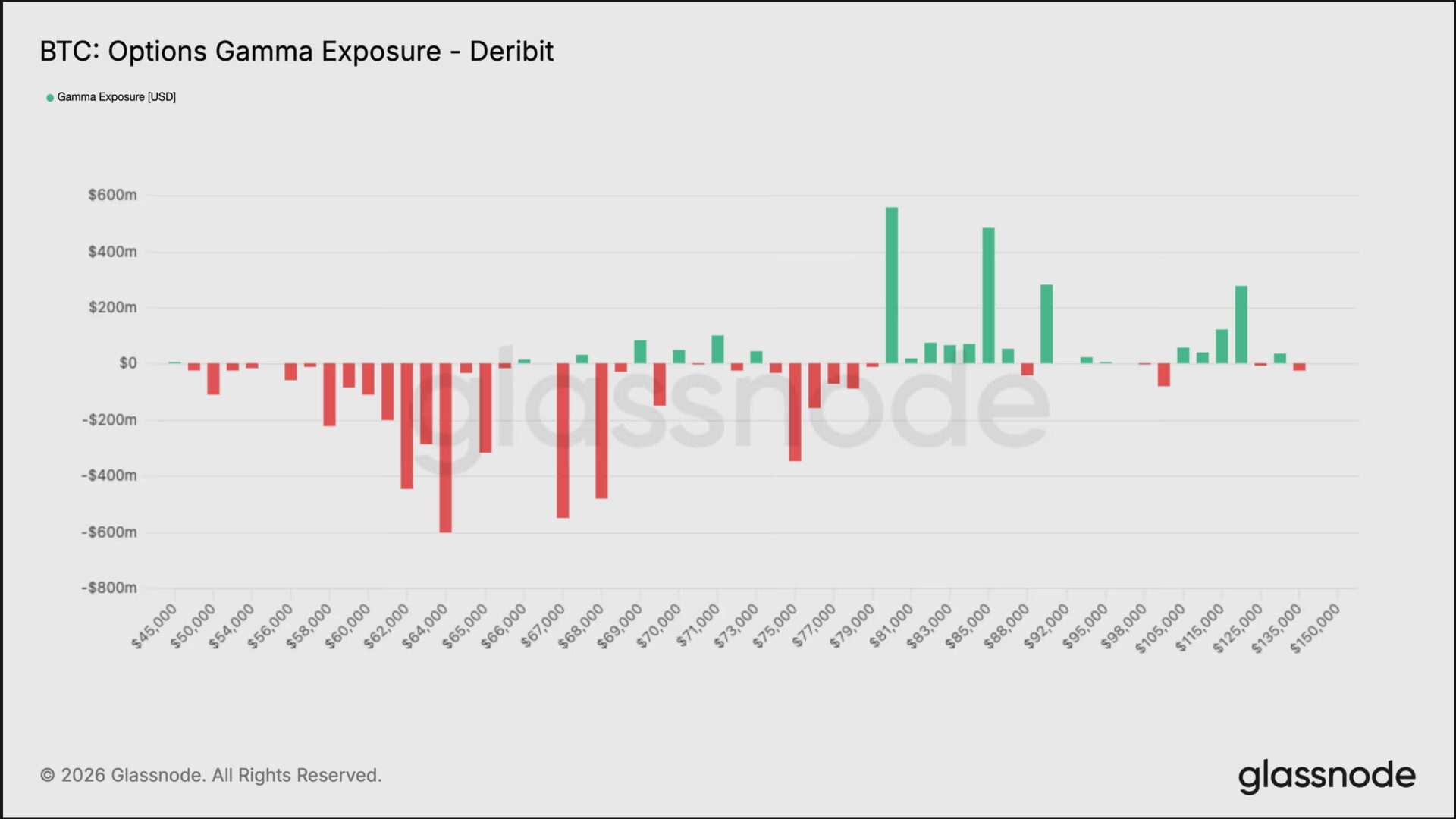
Data from blockchain analytics firm Glassnode corroborates this, indicating that market makers’ gamma exposure is almost entirely negative across the range from $68,000 down to $50,000. This situation arises because while retail and institutional traders are “long puts” (buying protection), market makers, as their counterparts, are “short puts” (selling protection).
The implications are significant: if Bitcoin’s price falls below $68,000, these market makers will begin to incur losses on their short put positions. To mitigate this risk and re-hedge their books, they are forced to “short Bitcoin” in the spot or futures market. This reflexive selling pressure further depresses the price, initiating a dangerous feedback loop where “price drops, market makers short, price drops further.”
This mechanism underscores why the $68,000 level is not merely a technical support line, but a critical psychological and structural barrier. A breach here would not only signal technical weakness but could also usher the market into a perilous zone of escalating forced selling.
Glassnode’s latest weekly report explicitly warns: “A negative gamma zone is currently forming below the spot price, spanning from $68,000 down to just above $50,000.”
Should Bitcoin’s price descend into this zone, the influx of hedging-related sell orders would dramatically intensify downward momentum. A potentially gradual decline could transform into a sharp repricing event, possibly retesting the $60,000 bottom observed during the significant downturn on February 5th.
Compounding this precarious situation is the current market environment. Following the massive options expiry on March 27th, market liquidity remains relatively thin. Furthermore, the ongoing Easter holiday period typically sees reduced trading activity, meaning there may not be sufficient buying demand to absorb the substantial hedging-induced selling pressure. This confluence of factors increases the risk that if the aforementioned vicious cycle is triggered, Bitcoin could easily breach the $60,000 mark.
In conclusion, while geopolitical headlines certainly sway Bitcoin’s immediate trajectory, the internal mechanics of the derivatives market play an equally pivotal role in shaping its price action.
If Bitcoin can regain and firmly hold the $68,000 level, this options-related “landmine” might gradually defuse over time, preventing a major market disruption. However, if this crucial defense line is consistently broken, the market risks being engulfed in a self-reinforcing cycle of “selling pressure begetting greater selling pressure,” potentially transforming a routine market pullback into a deep and prolonged capitulation.
Disclaimer: This article is for market information purposes only. All content and opinions are for reference only and do not constitute investment advice. They do not represent the views and positions of the author or BlockBeats. Investors should make their own decisions and trades. The author and BlockBeats will not bear any responsibility for direct or indirect losses incurred by investors’ transactions.