
Author: Nancy, PANews
SpaceX Leads an Unprecedented IPO Wave: A New Era for Mega-Cap Listings and Retail Investment
The U.S. stock market is bracing for an epic IPO year, with a seismic shift underway. Reports indicate that SpaceX has secretly filed for an initial public offering, eyeing a staggering valuation of over $1.75 trillion. This move positions Elon Musk’s aerospace giant to potentially shatter global records for the largest IPO in history.
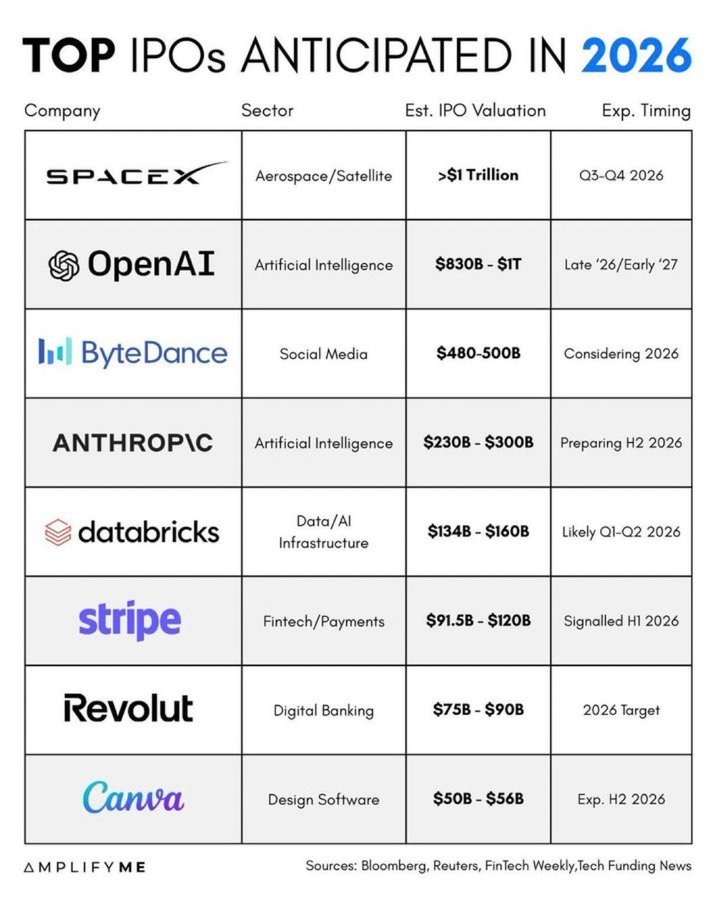
As star unicorns like SpaceX, OpenAI, and Anthropic accelerate their push towards public markets, and Nasdaq streamlines its liquidity channels, the IPO landscape is entering an unparalleled period of divergence and opportunity.
SpaceX Eyes Record-Breaking IPO, Retail Investors Poised for Significant Allocation
In 2019, Saudi Aramco, the world’s most valuable oil company, made headlines with its $29.4 billion fundraising and a $1.7 trillion valuation upon its market debut, setting a then-global record for IPO fundraising and becoming one of history’s highest-valued public companies.
Six years later, SpaceX is poised to eclipse this benchmark.
According to Bloomberg, citing informed sources, SpaceX has confidentially submitted its IPO application to the U.S. SEC, targeting a valuation that could exceed $1.75 trillion. If successful, SpaceX could list as early as June this year, becoming a formidable contender for the largest IPO ever and the first of three anticipated “super IPOs” from tech giants.
This aggressive valuation isn’t solely driven by SpaceX’s monopolistic position in space infrastructure but also by the spillover effects of the AI narrative. In February, SpaceX completed its acquisition of xAI, boosting its post-merger valuation to $1.25 trillion.
Insiders suggest that SpaceX’s IPO could raise up to $75 billion, a significant increase from earlier projections of $50 billion. Reuters reports that SpaceX’s internal “Project Apex” has engaged 21 investment banks, including Bank of America, Citi, Goldman Sachs, JPMorgan Chase, and Morgan Stanley, to manage global distribution, order collection, pricing coordination, and transaction execution. Such a formidable syndicate is designed to distribute pressure, enhance cross-regional distribution efficiency, and mitigate overall issuance risk.
Breaking from traditional IPO norms, Elon Musk is reportedly crafting an unconventional allocation mechanism. While some early investors may face lock-up periods exceeding six months, the allocation for retail investors, free from such restrictions, is expected to soar to 30%. This figure far surpasses the conventional 5% to 10% seen on Wall Street, challenging long-held industry practices.
Market observers interpret this shift as a recognition of the institutional capital’s absorption limits when faced with such a colossal valuation and massive fundraising target. Musk’s immense global fan base, coupled with SpaceX’s dominant market position and the proven success of Tesla, grants him unparalleled ability to mobilize retail investors. Beyond supplementing funding, retail participation is expected to stabilize share prices post-listing and mitigate short-term selling pressures.
However, signs of fatigue regarding high valuations are already emerging.
Recently, OpenAI, fresh off a large funding round, experienced a noticeable cool-down in the secondary market. Investors attempting to offload approximately $600 million in shares at a discount found virtually no takers. This stands in stark contrast to the fervent scramble for shares last year, primarily due to market anxieties over high valuations, significant cash burn, and an unclear path to profitability.
Similar questions and scrutiny could intensify for SpaceX.
Unicorns Flock to Market as Nasdaq Rewrites the Rules
The U.S. stock IPO market is entering a super cycle, with significant activity anticipated through 2026.
Beyond SpaceX, a cohort of other heavy-hitting unicorns, including OpenAI, Anthropic, and Databricks, are queuing up to go public, making the IPO window exceptionally crowded.
In response to this impending wave of IPOs, Nasdaq recently revised its inclusion rules for the Nasdaq 100 Index, announcing two pivotal adjustments: first, the elimination of the 10% minimum free float requirement; and second, the introduction of a “Fast Nasdaq 100 Track,” which allows mega-cap IPO companies to join the Nasdaq 100 Index within 15 trading days.
These new rules are set to take effect on May 1st, just a month before SpaceX’s anticipated listing.
Previously, large IPO companies with insufficient free float might have been excluded from the Nasdaq 100 Index. Even if eligible, they would face observation periods lasting several months or have to wait for the annual December adjustment window. With Nasdaq’s green light, SpaceX, which had already expressed a preference for listing on Nasdaq, reportedly made early inclusion in the Nasdaq 100 a condition for its debut.
Given the timing and mechanics, these relaxed rules are widely seen as tailor-made for large-cap companies like SpaceX, directly reshaping capital allocation pathways. This will facilitate faster integration of these new stocks into passive funds (ETFs, index funds), thereby boosting initial liquidity and market recognition.
However, critics argue that this mechanism also provides a rapid exit gateway for early major shareholders, while general investors passively bear more of the inherent risks associated with less mature public companies.
IPO Window Narrows, Crypto Firms Delay Public Offerings
A more pressing reality is that while the IPO window may be open, capital, valuations, and market attention are being rapidly consumed and fragmented.
The U.S. IPO market is currently experiencing a seasonal lull, compounded by stock market volatility and a wave of delayed listings, leading to a noticeable decline in investor confidence.
According to Bloomberg, despite a strong performance in the first quarter of this year, most U.S. IPOs have underperformed due to global economic instability. Seven of the top ten IPOs in Q1 now trade below their offering prices, with a median decline of 28%.
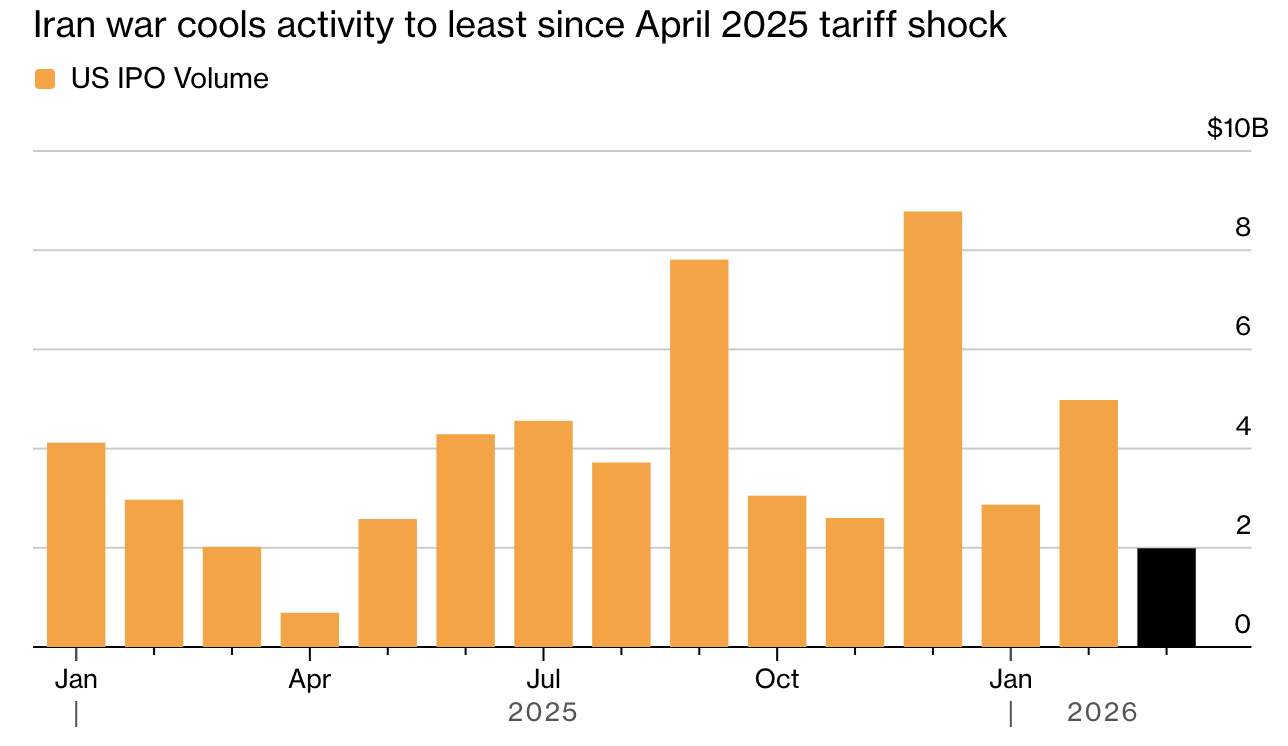
Simultaneously, escalating global uncertainties, particularly the outbreak of the Iran conflict, have prompted numerous companies to postpone their U.S. listing plans. March, in fact, became one of the quietest IPO months in nearly a year.
Many cryptocurrency enterprises have also opted to defer their U.S. IPO timelines, with firms like OKX, Ledger, Kraken, and Bithumb delaying their plans to varying degrees. This trend is driven by a confluence of factors: the cyclical downturn and profitability uncertainties within the crypto industry itself, coupled with macroeconomic volatility and a contraction in capital risk appetite.
Crucially, many high-valuation tech giants currently awaiting listing are not growth companies with strong profit elasticity. Instead, they have front-loaded unverified growth expectations. When these companies list en masse, they could not only continuously siphon market liquidity in the short term but also compress the listing windows and valuation space for other prospective companies.
(The above content is an excerpt and reproduction authorized by our partner PANews. Original link)
Disclaimer: This article provides market information only. All content and opinions are for reference purposes only and do not constitute investment advice. They do not represent the views and positions of BlockBeats. Investors should make their own decisions and trades. The author and BlockBeats will not bear any responsibility for direct or indirect losses incurred by investors’ transactions.