Author: Ariel, CryptoCity
Debunking the USDT Ban Rumor in Taiwan: Clarity on New Crypto Regulations
A recent wave of panic swept through Taiwan’s cryptocurrency community following unsubstantiated claims by an anonymous individual, self-proclaimed as a Certified Public Accountant (CPA), regarding the future of stablecoins like USDT under the nation’s new regulatory framework. This article aims to dissect these claims, provide accurate information on the Virtual Asset Service Act (VASA) draft, and guide users toward secure and legitimate cryptocurrency practices.
The Spreading Rumor: “Accountant” Claims VASA Will Ban USDT
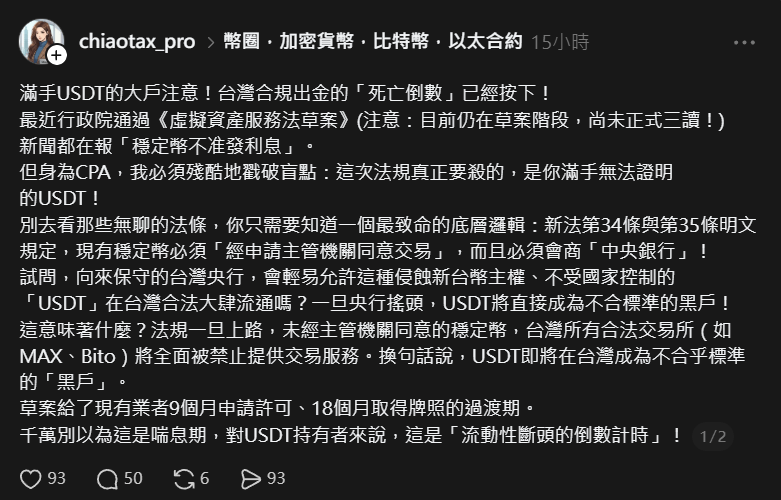
On April 8th, a post on Threads by an anonymous user, who identified as a CPA, ignited alarm with sensational pronouncements about the Executive Yuan’s recently passed draft of the Virtual Asset Service Act. The user asserted that Articles 34 and 35 of the new legislation explicitly mandate that stablecoins must receive approval from the competent authority, in consultation with the Central Bank.
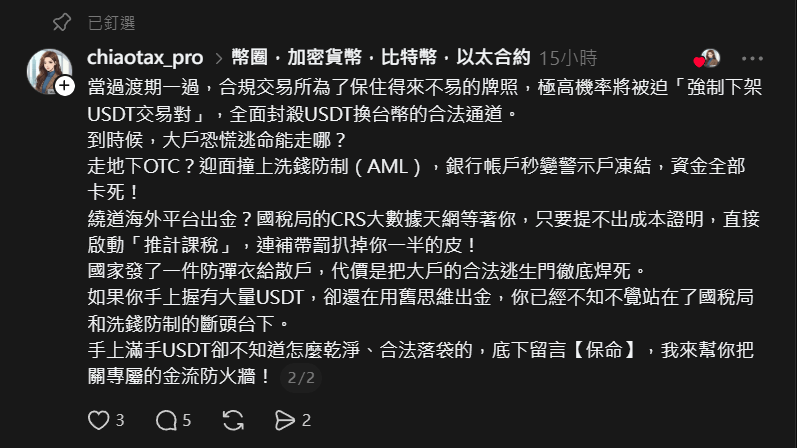
According to the anonymous poster, Taiwan’s conservative Central Bank would unequivocally reject the legal circulation of Tether ($USDT). The post further claimed that once the regulations are enacted, all legal cryptocurrency exchanges in Taiwan would be forced to cease offering USDT trading services, effectively rendering USDT an “unqualified black market asset.” This alarming post quickly gained traction, accumulating over 20,000 views.
Expert Response: Misinterpretation, Not Mandate
In response to the escalating fear, Max, Editor-in-Chief of CryptoCity, swiftly countered the narrative, acknowledging the post’s effectiveness in “fear marketing” but highlighting its profound misinterpretation of the regulations. Max emphasized that the true value of compliance lies in facilitating legal and viable pathways for capital, not in exaggerating ambiguities to suggest complete closure of options.
Max underscored a critical point: the core of the VASA draft focuses on the admission and risk control mechanisms for Virtual Asset Service Providers (VASPs), not on directly regulating the assets themselves. He dismissed the “overly linear” deduction that potential delisting of trading pairs would lead directly to “liquidity collapse” as highly irresponsible and unprofessional, characterizing the post’s framing of the draft as a “doomsday narrative.”
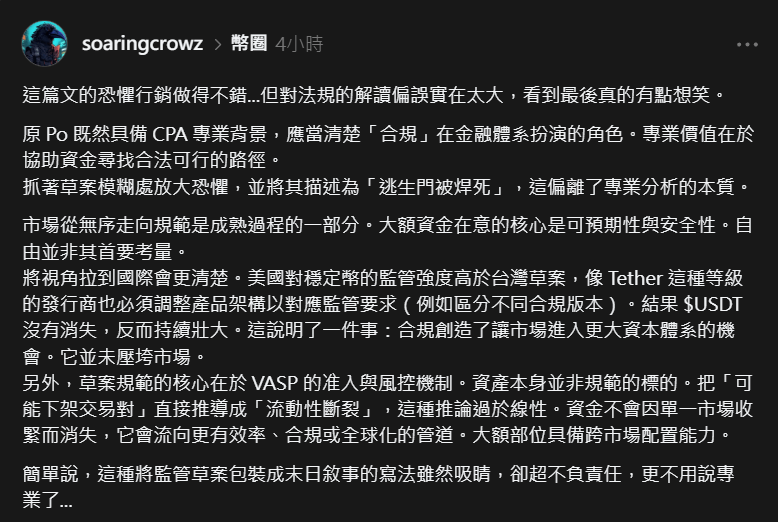
Further scrutiny of the anonymous account revealed inconsistencies. While attempting to cultivate an image as an accountant, the user’s CPA certificate name was obscured, and the profile picture appeared to be AI-generated. This raises legitimate questions about the authenticity and motives of an individual claiming professional expertise while maintaining such anonymity.

Dissecting the Law: Article 35 Confirms Pathway for Stablecoins
A direct examination of Article 35 of the Executive Yuan’s Virtual Asset Service Act draft unequivocally refutes the anonymous netizen’s erroneous claims. The “explanation field” of Article 35 clearly states:
“Virtual asset service providers offering services involving stablecoins are limited to stablecoins approved by the competent authority for issuance in Taiwan, or stablecoins not issued in Taiwan but approved by the competent authority for trading in Taiwan.”
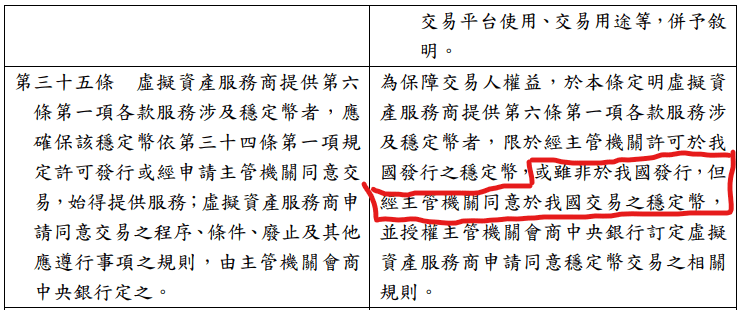
This provision explicitly outlines a mechanism for offshore stablecoins, not issued in Taiwan, to gain approval for trading within the country. The anonymous Threads user’s fundamental logical flaw was the baseless presumption that the Central Bank would automatically reject all foreign stablecoins post-legislation, presenting this speculative assumption as an established fact to incite panic.
In reality, the law’s objective is to integrate the market into a regulated framework, requiring platform operators to implement robust evaluation and application procedures before offering relevant trading pairs. To extrapolate “establishing review and compliance mechanisms” into a “complete ban on USDT” is a logical fallacy and a dangerous misrepresentation of regulatory intent.
Unmasking Social Media Misinformation Tactics
This incident is not isolated. A recurring pattern can be observed in recent social media posts designed to generate panic around cryptocurrency deposits and withdrawals in Taiwan. These posts often exhibit a distinct “AI-like” writing style and frequently conclude with explicit or implicit suggestions to seek alternative, often illicit, withdrawal channels. The typical structure of such misleading posts includes:
- Sensational Headlines: Designed to create extreme fear, often using hyperbolic language to imply an impending “guillotine-like” cut-off for crypto access in Taiwan.
- Exaggerated Negatives: Amplifying legitimate exchanges’ recent risk control upgrades, isolated hacking incidents, or specific wording in draft legislation to completely discredit official deposit and withdrawal routes.
- Call to Action for Illicit Channels: Guiding readers to private messages or requesting specific keywords in comments to obtain “exclusive, life-saving channels” for transactions.
The primary goal behind these tactics is to erode public trust in legitimate platforms, ultimately diverting traffic and funds to privately operated, often illegal, underground exchange groups run by the poster.
Navigating the Regulatory Landscape: Choose Legitimate VASPs
As Taiwan’s cryptocurrency regulatory landscape matures, it is crucial for users to remain informed and vigilant. The government has clearly stipulated that Virtual Asset Service Providers (VASPs) must complete anti-money laundering (AML) and service capacity registration. Individual crypto merchants operating without legal registration are deemed illegal, facing penalties of up to two years imprisonment or fines of up to NT$5 million.
Furthermore, the Virtual Asset Service Act draft proposes severe penalties for operating without permission or issuing stablecoins without proper authorization, including imprisonment for up to seven years and fines of up to NT$100 million. Data from the Criminal Investigation Bureau confirms that since the new regulations took effect in late 2024, police have actively pursued and arrested illegal street crypto merchants, seizing substantial funds.
Protect Your Assets: Avoid Illicit Trading and Scams
While panic-inducing posts appear periodically on platforms like Threads, the recent claim of CPA status represents a new level of deceptive authority. When confronted with such social media-driven fear, maintaining a rational perspective is paramount. Engaging with anonymous users through private messages can expose individuals to illicit crypto merchants or sophisticated scam operations, putting their funds at severe risk.
For all cryptocurrency transactions, it is imperative to choose legitimate operators approved by Taiwan’s Financial Supervisory Commission (FSC). Always conduct transactions through traceable channels, such as bank transfers, which provide clear financial records. Do not succumb to the temptation of convenience or unfounded online rumors that could lead your assets into the high-risk, unregulated underground market.
Below is a list of currently legitimate Virtual Asset Service Providers (VASPs) in Taiwan, listed alphabetically by stroke count:
- HOYA BIT (禾亞數位科技)
- ZONE Wallet (拓荒數碼科技)
- MaiCoin, MAX Exchange (現代財富科技)
- KryptoGO (重量科技)
- TWEX (富昇數位科技)
- Chainss (跨鏈科技)
- BitoPro (幣託科技)
- XREX Exchange (鏈科股份有限公司)
(The content above has been authorized, excerpted, and reproduced by partner CryptoCity)
Disclaimer: This article provides market information only. All content and views are for reference purposes and do not constitute investment advice. They do not represent the views and positions of BlockTempo. Investors should make their own decisions and trades. The author and BlockTempo will not bear any responsibility for direct or indirect losses resulting from investor transactions.