
Polymarket’s Strategic Evolution: Charting a New Course Beyond Polygon with Ambitious Upgrades
The decentralized prediction market giant, Polymarket, is once again making headlines with its anticipated migration from the Polygon network. This move has sparked a fierce competition among various public blockchains eager to host such a high-traffic, “phenomenal” application. Yet, Polygon, currently the primary beneficiary of Polymarket’s extensive activity, remains notably silent on this potential departure.
Polymarket Charts a New Course: Why a Blockchain Migration is Imperative
On April 25, Josh Stevens, Polymarket’s newly appointed VP of DeFi Engineering, publicly announced that the platform’s exponential growth had severely outpaced its existing infrastructure capabilities. To address critical pain points in high-frequency trading and significantly enhance overall performance and user experience, the team is embarking on a series of major technical overhauls.
Central to these transformation plans is Polymarket’s proactive “chain migration.” Stevens articulated the core requirements: “We need larger block space, lower Gas costs, and shorter block times to achieve instant settlement.” This declaration clearly signals Polymarket’s intent to transition to a new blockchain environment.
In its nascent stages, Polygon served as the optimal technical foundation for Polymarket’s foray into the prediction market. Its low transaction fees, rapid settlement speeds, and a relatively mature EVM ecosystem made it an ideal deployment choice, perfectly aligning with the high demands for on-chain cost-efficiency and execution speed inherent in early prediction markets.
However, as Polymarket’s transaction volume surged, particularly with the explosion of high-frequency trading, systemic issues began to surface. Users experienced increased transaction delays, frustrating order cancellation processes, and diminished execution efficiency during periods of network congestion. For Polymarket, these challenges directly impacted user retention and trading liquidity.
A notable vulnerability, previously highlighted by PANews, involved attackers exploiting the time lag between Polymarket’s off-chain order matching and on-chain settlement. This allowed malicious actors to repeatedly force transaction failures at negligible costs, effectively clearing market maker orders and facilitating arbitrage. Some individual addresses reportedly profited tens of thousands of dollars daily with minimal overhead. This architectural flaw subjected market makers and automated trading bots to forced order removals, passive position exposures, and direct financial losses.
While the community has developed monitoring and early warning tools, these remain reactive solutions, failing to address the fundamental architectural problem. A truly robust solution necessitates a redesign of the underlying matching and settlement mechanisms to eliminate such attack vectors at their core.
Ironically, Polygon, once the launchpad for Polymarket’s success, has gradually become a bottleneck to its continued expansion.
Whispers of a potential migration aren’t new. Towards the end of last year, discussions within the Discord community hinted at Polymarket exploring its own Layer 2 (L2) solution and a gradual exit from Polygon. Josh Stevens’ recent public statement is widely interpreted as the project transitioning from internal deliberation to active execution.
The Race for Polymarket: Public Chains Vie for a DeFi Powerhouse
Following Polymarket’s announcement, a flurry of public blockchains, including Sui, Solana, Sonic, Algorand, and Sei, swiftly extended olive branches. Their pitches uniformly emphasized advantages like lower fees, faster transaction confirmation times, superior throughput, and robust support for transaction-intensive applications.
For these competing chains, successfully integrating a high-profile, “breakout” application like Polymarket represents far more than just adding another project to their ecosystem. It promises a significant influx of genuine transaction volume, substantial growth in active users, and a dramatic boost in ecosystem visibility and attention. In the current landscape, where truly impactful Web3 applications are scarce, such an opportunity is exceptionally rare and highly coveted.
Polygon’s Predicament: The High Stakes of Polymarket’s Departure
For Polygon, the actualization of Polymarket’s migration plan could trigger a significant ecological setback.
Presently, Polymarket stands as Polygon’s most critical traffic generator and a core economic engine.
Dune Analytics data reveals that Polymarket accounts for a staggering 56.3% of Polygon’s daily transaction fees. This means that for every $100 in fees generated on Polygon, approximately $56 originates from Polymarket, positioning it as the primary driver of the entire chain’s revenue growth.
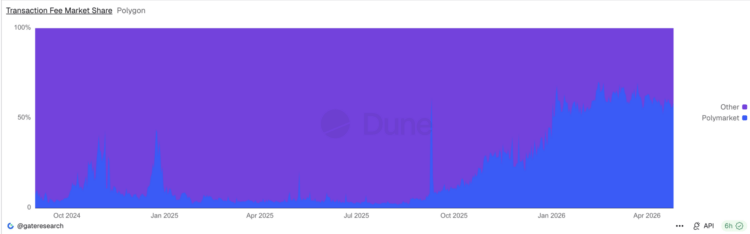
Extending this view over the current year, Polymarket has contributed an estimated $72.9 million in fee revenue, comprising 61.3% of Polygon’s total fee revenue of approximately $119 million.
Evidently, Polymarket is the single largest contributor to Polygon’s growth. An ecosystem’s over-reliance on a single flagship application carries inherent risks; its loss could not only lead to a sharp decline in revenue but also significantly impact overall ecosystem activity and market confidence.
Despite Polymarket’s explicit migration statements, Polygon’s official stance remains publicly unaddressed. However, sources cited by TheStreet Roundtable suggest that Polygon is actively collaborating with Polymarket to resolve existing issues, and that Polymarket has not formally communicated any chain migration plans to Polygon.
Beyond Migration: Polymarket’s Vision for a Self-Built Layer 2
While Polymarket has yet to disclose its future blockchain destination, market speculation widely favors the development of its own Layer 2 solution over a direct migration to another existing public chain. The specific L2 framework, be it OP Stack, Polygon CDK, or another solution, awaits further announcement.
Crypto KOL Lanhu’s analysis highlights at least three key advantages for Polymarket in building its own chain: Firstly, it would gain complete control over block space, block speed, and Gas fees, enabling highly specialized optimization for prediction markets and future perpetual contracts (Perps) products, ensuring low latency, high throughput, and minimal costs. Secondly, a dedicated chain eliminates competition with other dApps for block space and resources, fostering a more predictable and performant environment. Thirdly, a custom chain can be designed with regulatory compliance in mind, potentially simplifying future legal frameworks and attracting institutional capital.
Lanhu also suggests that a direct migration to chains like Solana, Base, or Arbitrum is less probable. While Solana offers speed and low costs, Polymarket’s Ethereum-centric architecture, including its contract design, ecosystem compatibility, and USDC asset flows, would incur substantial migration costs. Solana currently primarily supports SOL deposit bridging, with no immediate signs of a full chain migration. Similarly, L2s such as Base and Arbitrum might serve as components of a broader multi-chain strategy in the future, but are unlikely to become Polymarket’s primary operational base.
A Holistic Transformation: Polymarket’s Comprehensive Platform Overhaul
Concurrent with its blockchain migration strategy, Polymarket has initiated a sweeping upgrade across its product, infrastructure, organizational structure, and financial layers. This comprehensive overhaul aims to significantly enhance the trading experience while laying robust groundwork for future business expansion.
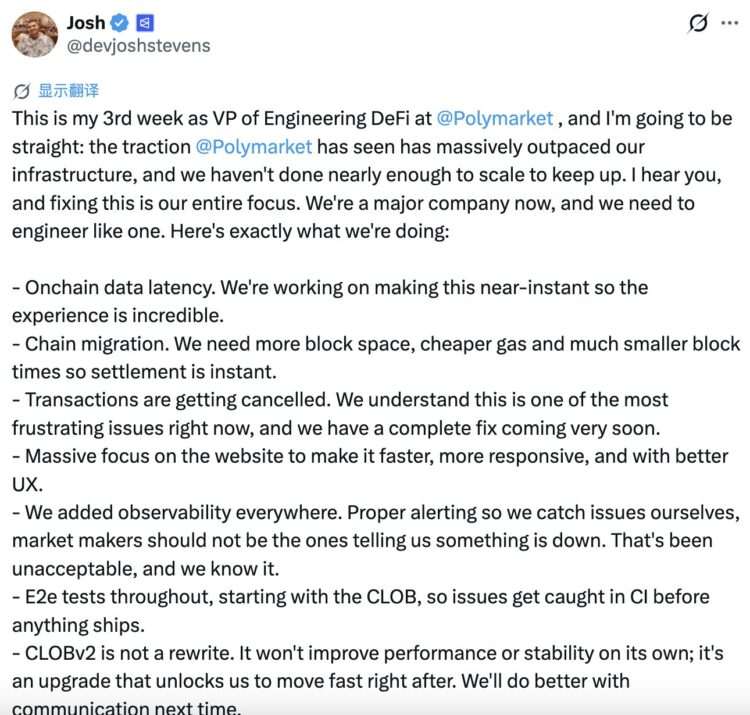
At the **product level**, Polymarket is meticulously optimizing its website to boost page loading speeds, response efficiency, and overall user interaction. The team is also developing a unified TypeScript SDK, consolidating all existing APIs. This will allow developers to access core functionalities via a single WebSocket connection, substantially lowering the barrier for external teams to integrate with Polymarket and accelerating the growth of its ecosystem tools and third-party applications.
In terms of **business expansion**, Polymarket has confirmed the launch of a perpetual contracts product. This new offering will feature an entirely new smart contract architecture and a backend system meticulously built from scratch using Rust. This strategic move signifies Polymarket’s evolution from a singular prediction market to a comprehensive on-chain trading platform.
On the **organizational front**, Polymarket is actively recruiting for pivotal roles, including Head of QA Automation, Head of Developer Tools, Head of Internal Tools, and Head of Data Engineering. The team structure is being streamlined into smaller, more focused units with clearly defined responsibilities to maximize execution efficiency and accountability.
For **security**, Polymarket emphasizes its daily collaboration with four dedicated security teams to ensure the integrity of its systems and the safety of user funds.
Among all these upgrades, the most critical is the team’s complete rebuild of its **Central Limit Order Book (CLOB)** from the ground up. Polymarket acknowledges that its current matching system can no longer sustain the platform’s escalating trading demands. The new CLOB architecture is designed to be future-proof, paving the way for perpetual contracts and a wider array of financial products.
Josh Stevens candidly admitted that Polymarket’s engineering capacity has lagged behind its business growth, acknowledging past user frustrations. He has pledged a continuous drive for significant improvements in the coming months, promising weekly engineering progress updates starting next Friday to enhance transparency and restore market confidence.
Introducing pUSD: A Game-Changer for Security and Capital Efficiency
Further demonstrating its commitment to innovation, Polymarket is rolling out a new round of upgrades on April 28. This includes the deployment of the new smart contract CTF Exchange V2, a re-architected order book system, and a crucial migration of collateral assets from USDC.e to the new native collateral token, Polymarket USD (pUSD).
USDC.e, Circle’s bridged version of USDC on Polygon, has historically been susceptible to cross-chain bridge risks, as evidenced by multiple attack incidents. For high-frequency, high-value capital flows inherent in prediction markets, this represents a significant and unacceptable vulnerability.
In stark contrast, pUSD is an ERC-20 token issued directly by Polymarket, fully backed 1:1 by real USDC. This migration to pUSD offers multiple strategic advantages: Polymarket not only mitigates systemic risks associated with bridged assets but also gains direct control over minting rights. This enables autonomous management of minting, redemption, reserve utilization, and settlement logic, thereby significantly boosting capital efficiency. Defillama founder 0xngmi previously noted that Polymarket users’ wallets hold approximately $1.25 billion in funds; retaining the interest income from these reserves, at current rates, could generate an additional $54 million annually for Polymarket.
Moreover, a self-owned stablecoin structure helps to clarify asset compliance, potentially paving the way for expansion into the US market and attracting institutional investment.
The Future of Prediction Markets: Stability, Scalability, and Sustained Growth
As prediction markets edge closer to mainstream adoption, they will increasingly cater to a broader general user base, extending beyond existing on-chain participants. For Polymarket, the immediate priorities are unwavering system stability, reliable settlement, and an optimized user experience. Concurrently, amidst intensifying competition in the prediction market landscape, Polymarket is strategically positioning itself to cultivate a more stable and diversified revenue structure.

