

Beneath the Surface: Unpacking the Recent NFT Market Resurgence
The Non-Fungible Token (NFT) market has recently experienced a notable rebound, leading many investors, particularly those focused on real-time price charts, to believe a vibrant, prosperous era has returned. However, a closer examination of on-chain transaction data reveals a more nuanced picture: this surge appears to be driven by a concentrated influx of capital into a select few assets, rather than a broad-based market recovery.
Blue-Chip NFTs Lead a Selective Rally
This latest uptrend is prominently spearheaded by established blue-chip NFT collections such as the Bored Ape Yacht Club (BAYC) and Pudgy Penguins. Both projects have witnessed double-digit percentage increases in their floor prices over recent weeks, with corresponding surges in token valuations. Yet, despite this seemingly robust comeback, the actual volume of new buying activity remains surprisingly low.
Consider Pudgy Penguins as a prime example: its floor price has now climbed above 5 Ethereum, marking a weekly increase exceeding 20%. Over the past seven days, approximately 201 transactions have been recorded, totaling nearly 1,000 Ethereum in volume. Similarly, the Bored Ape Yacht Club has seen its floor price skyrocket by 81% in the last 30 days, staging a powerful recovery from its previous troughs.
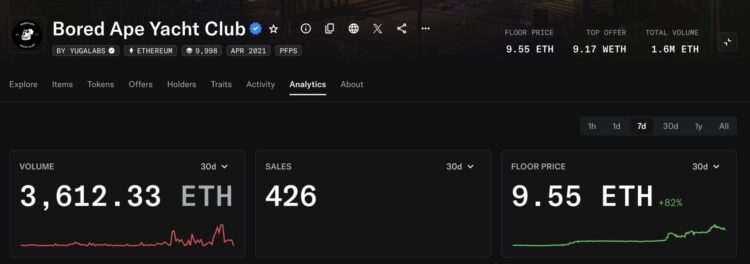
In the dynamic NFT landscape, the floor price serves as a critical indicator for investors, representing the lowest available listing price for an NFT within a given collection. For instance, if the most affordable Pudgy Penguin NFT is listed at 5.38 Ethereum, that figure defines the collection’s floor price. A rising floor price typically signals increased buyer confidence and willingness to pay higher prices, whereas a decline often indicates holders are eager to liquidate their assets.
A Shrinking Ecosystem: Declining Participation and Concentrated Capital
While top-tier projects enjoy a resurgence, the broader NFT market structure reveals underlying vulnerabilities: overall market participation is significantly contracting. According to data from the on-chain analytics platform CryptoSlam, global monthly NFT sales plummeted from $304 million in February to approximately $175 million in April. Concurrently, both the total number of transactions and active users have been cut in half.
Paradoxically, the average NFT transaction price has doubled during this period, climbing from $30.6 in March to $67.38 in April. These seemingly contradictory metrics underscore a crucial trend: the market is not experiencing a comprehensive return of widespread buying interest. Instead, an increasingly smaller pool of capital is becoming highly concentrated in a select few high-value, blue-chip NFTs.
Nuance in Buying Power and Lingering Market Challenges
Even within the realm of top-tier blue-chip NFT projects, the nature of buying activity varies considerably. Pudgy Penguins, for example, has managed to sustain relatively high trading activity alongside its price appreciation, suggesting a healthier level of market engagement. In contrast, venerable NFT projects like CryptoPunks, despite achieving similar weekly trading volumes to Pudgy Penguins, record far fewer individual transactions. This indicates that a handful of substantial transactions can disproportionately influence their prices.
Broader market signals continue to present a mixed picture. CryptoSlam data highlights that approximately 50% of the current NFT market’s trading volume is attributed to “wash trading” – artificial transactions designed to inflate trading metrics. Furthermore, the overall trading profit for the market remains negative. This suggests that despite the recent price rebounds, a significant portion of participants are still holding assets at a loss, or “underwater.”
Synthesizing these data points, the current NFT market appears to be in a phase of “bottoming out and stabilizing” rather than a true “expansionary explosion.” While prices are indeed rising, participant numbers are dwindling, and all market enthusiasm and capital are funneled into a very limited number of premier projects.
Crucially, this perceived NFT-specific rally cannot be viewed in isolation. Over the past month, Ethereum has surged by approximately 18%, with Bitcoin showing comparable gains. This suggests that a significant portion of the NFT market’s recent uplift is a direct beneficiary of a broader increase in risk appetite across the entire cryptocurrency ecosystem. Top NFTs, particularly those denominated in Ethereum, have simply caught a favorable tailwind from this influx of hot money, rising in tandem with the wider crypto market.
Disclaimer: This article is intended for market information purposes only. All content and views are for reference only, do not constitute investment advice, and do not represent the views and positions of the author or publisher. Investors should make their own decisions and trades. The author and publisher will not bear any responsibility for direct or indirect losses resulting from investor transactions.

