
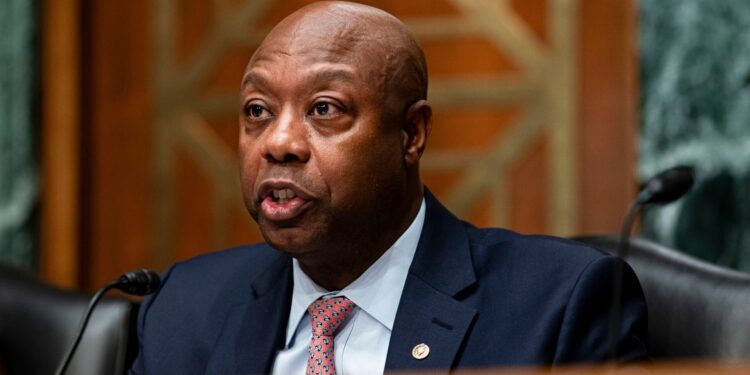
The legislative finish line for comprehensive cryptocurrency regulation in the United States appears to be within reach. Senator Tim Scott, Chairman of the Senate Banking Committee, announced on Tuesday a target for the committee to vote on a crucial crypto market structure bill “next month.” The ambitious goal is to advance the legislation to the full Senate for consideration in early next year, paving the way for President Trump’s signature into law.
This pivotal legislative push transcends mere jurisdictional disputes between the U.S. Securities and Exchange Commission (SEC) and the Commodity Futures Trading Commission (CFTC). It is widely regarded as a defining battle for America’s ability to solidify its position as the global leader in the Web3 era.
During an interview, Chairman Scott stated:
“We believe that by the end of this year, which is next month, both committees will be able to complete their review and vote on the bill, and then send it to the full Senate for consideration in early next year, so President Trump can smoothly sign the legislation into law.”
Given that the crypto market structure bill delineates the regulatory scopes of both the SEC and the CFTC, its procedural path necessitates approval from both the Senate Banking Committee and the Senate Agriculture Committee.
Senator Scott underscored the broader implications of this legislation, emphasizing that it is not solely about consumer protection. “This bill is also about ensuring that the United States maintains its status as the world’s strongest economy for the next hundred years,” he asserted. He also strongly criticized alleged deliberate delays by Democrats, which he claimed prevented the bill from passing as scheduled in September of this year.
“Democrats have been delaying, delaying, and delaying, simply because they do not want President Trump to establish the United States as the ‘global crypto capital.’ This is not just for President Trump; it is for all American people.”
Indeed, since the House of Representatives took the initiative by passing the “Digital Asset Market Clarity Act” (CLARITY Act), the Senate has been working tirelessly to craft its own version of the legislation.
The Republican-led Banking Committee is diligently working to establish clear jurisdictional boundaries between the SEC and the CFTC. A key innovation in the draft bill is the introduction of a new term, “Ancillary Assets.” This concept aims to clarify which cryptocurrencies do not qualify as securities, thereby addressing a long-standing definitional challenge that has plagued the industry.
However, securing the bill’s passage will require bipartisan support, as Senate Democrats hold crucial votes.
Disclaimer: This article provides market information only. All content and views are for reference only and do not constitute investment advice. They do not represent the views and positions of BlockTempo. Investors should make their own decisions and trades. The author and BlockTempo will not bear any responsibility for direct or indirect losses incurred by investors’ transactions.




