

Crypto Capital’s New Compass: Navigating Regulation for Long-Term Value
The cryptocurrency market recently witnessed a significant resurgence in large-scale venture capital fundraising, signaling a profound shift in investment strategy. Early this month, Haun Ventures successfully closed a new $1 billion fund, followed swiftly by a16z crypto’s announcement of its fifth dedicated crypto fund, Crypto Fund 5, totaling an impressive $2.2 billion.
These substantial capital injections are particularly noteworthy given the current market climate. Unlike the speculative fervor of past bull runs, where high-growth narratives dominated, these investments arrive amidst ongoing discussions around US crypto market legislation and stablecoin regulation. Disagreements persist between traditional banking institutions and crypto platforms regarding stablecoin yield mechanisms, adding layers of complexity to the landscape.
The willingness of limited partners (LPs) to commit such considerable sums to top-tier managers underscores a critical insight: capital has not abandoned the crypto space. Instead, it is actively recalibrating its investment logic. A clear trend emerges from this redefinition: projects now deemed worthy of long-term commitment are those prioritizing sustainable viability within an evolving regulatory framework, rather than simply explosive, short-term growth.
The Great Shift: From Hyper-Growth to Regulatory Resilience
The 2021 bull market painted a picture of unbridled expansion, where the primary market was a race for rapid growth. Project valuations were largely predicated on aggressive scaling, with venture capitalists fixated on metrics like Total Value Locked (TVL), user acquisition, trading volumes, and speculative token price forecasts. Any project that could quickly capture market share and craft a compelling narrative stood a chance of securing massive funding.
However, 2022 marked a fundamental turning point. The abrupt collapse of FTX not only triggered a severe liquidity crunch but also fundamentally reshaped regulatory perceptions of the crypto industry. Key US regulatory bodies, including the SEC, CFTC, and banking supervisors, began to intensify their scrutiny, bringing stablecoins, trading platforms, and decentralized finance (DeFi) firmly into their regulatory crosshairs.
As the secondary market languished, risk appetite in the primary market also diminished significantly. While global crypto funding in 2025 has shown some recovery from bear market lows, capital is increasingly concentrating on established infrastructure and elite projects. The era of widespread innovation and diverse new ventures has largely receded.
This paradigm shift means that VC focus has fundamentally changed. Where once capital chased “potential future growth,” an increasing number of institutions now prioritize a project’s long-term existence within an anticipated regulatory structure. Consequently, factors previously overlooked, such as robust compliance capabilities, seamless compatibility with traditional financial systems, and institutional-grade operational capacity, are now integral to valuation models.
Stablecoins: Re-emerging as the Cornerstone of Digital Finance
Over the past year, stablecoins have emerged as one of the most vibrant sectors for primary market fundraising. Unlike many crypto projects driven primarily by market sentiment, stablecoins are increasingly demonstrating tangible revenue models and foundational financial infrastructure attributes. Tether’s profitability, for instance, is largely derived from interest generated by its extensive US Treasury reserves. Meanwhile, Circle is actively transitioning from a singular stablecoin issuer to a comprehensive payment and on-chain USD network infrastructure provider.
Crucially, the US regulatory stance on stablecoins is also evolving. For an extended period, stablecoins operated in a regulatory grey area. However, entering 2025, legislative discussions in the US have accelerated, with a formal exploration underway to integrate stablecoins into the broader financial system.
Against this backdrop, stablecoins are adopting a distinct market positioning. They are no longer merely transactional tools for the crypto community but are increasingly recognized by institutions as a vital component of the next-generation USD settlement infrastructure. Major traditional payment giants like Visa, Mastercard, and Stripe are consistently expanding their stablecoin-related initiatives, validating this shift.
This explains why stablecoins have become a favored investment for venture capitalists. For the primary market, a sector that simultaneously offers genuine revenue streams, regulatory clarity, institutional demand, and the expansive vision of a “global payment network” is inherently rare and highly attractive.
Haun Ventures: Championing a ‘Crypto Finance’ Paradigm
The evolving investment landscape is unequivocally clear to the venture capital firms that have not only survived but thrived through recent market turbulences. In the current crypto primary market, a16z crypto and Haun Ventures, fresh from their monumental fundraises, exemplify two distinct yet converging strategic pathways.
Haun Ventures has always maintained a unique profile compared to traditional crypto VCs. Its founder, Katie Haun, boasts a distinguished background as a former US federal prosecutor, having been involved in numerous crypto-related investigations. In 2018, Haun joined a16z, becoming a pivotal early partner for a16z crypto. In 2022, she departed to establish Haun Ventures, rapidly securing what was then the largest fundraise for a female-founded venture firm in the crypto industry.

Her unique background has instilled Haun Ventures with an inherent, strong regulatory perspective since its inception. The firm consistently focuses on areas such as stablecoins, payments, custody, and on-chain financial infrastructure. Its core investment thesis revolves around backing crypto infrastructure that can seamlessly integrate into mainstream financial systems. Notable investments include Bridge, a stablecoin infrastructure company, and BitGo, a leading digital asset custody platform.
For its new fund, Haun Ventures has outlined three strategic priorities: the development of next-generation financial infrastructure, the expansion of asset tokenization, and the burgeoning “agent economy”—scenarios where AI systems autonomously execute transactions on behalf of humans.
While Haun Ventures does not entirely shy away from innovative, potentially risky projects, its emphasis clearly lies on identifying foundational infrastructure that can genuinely become an enduring part of the future financial ecosystem, rather than chasing high-volatility narratives. This investment philosophy aligns more with long-term financial infrastructure development than short-cycle market speculation. As regulatory frameworks solidify, projects destined for long-term survival are likely to be those that forge synergistic relationships with regulatory bodies, banking systems, and traditional financial markets, moving beyond mere token-incentivized rapid expansion.
a16z crypto: Redefining the ‘Next-Gen Internet’ Bet
In contrast to Haun Ventures’ more pronounced focus on regulatory-friendly financial infrastructure, a16z crypto’s strategy for Fund 5 reflects a top-tier crypto VC’s re-evaluation of the industry’s evolving stage.
In its latest fund announcement, a16z crypto notably shifted its rhetoric. Gone are the emphatic declarations of a “Web3 explosion” or rapid user growth that characterized previous cycles. Instead, a new keyword resonates: which products maintain consistent usage after the market’s speculative bubbles dissipate. Fund 5’s core investment directions are clearly defined across seven sectors: stablecoins, payments, on-chain finance, real-world asset (RWA) tokenization, perpetual futures, prediction markets, and AI Agents.
As Chris Dixon and his team articulated in their announcement, crypto cycles are often accompanied by intense speculation and capital inflows. However, the true measure of importance lies in the underlying infrastructure and genuine demand that persists once the market noise fades. Compared to their previous emphasis on token narratives and application breakthroughs, a16z is now distinctly focused on areas that have already begun to demonstrate practical, real-world use cases.
Stablecoins serve as the most compelling example. a16z highlighted that even amidst a market downturn, stablecoin usage has consistently grown. Individuals and businesses are genuinely leveraging them for cross-border transfers, USD savings, and payment settlements. This burgeoning demand, in turn, starkly exposes the inherent “slowness, expense, and inefficiency” of traditional payment networks.
Moving beyond the 2021 market’s enthusiasm for NFTs, GameFi, and high-yield DeFi, a16z now prioritizes on-chain finance, stablecoin payments, asset tokenization, prediction markets, and the on-chain payment and collaboration capabilities of AI agents. The unifying characteristic of these directions is their detachment from market sentiment, as they actively strive to integrate into real financial and internet infrastructure scenarios.
Guy Wuollet, a partner at a16z Crypto, captured this transformation succinctly in the first podcast following Fund 5’s launch:
“The entire space has transitioned from ‘us writing smart contracts in mom’s basement in hoodies and flip-flops’ to ‘us putting on collared shirts and ties and going to meetings with large banks that are seriously considering replacing their core ledgers with blockchain.'”
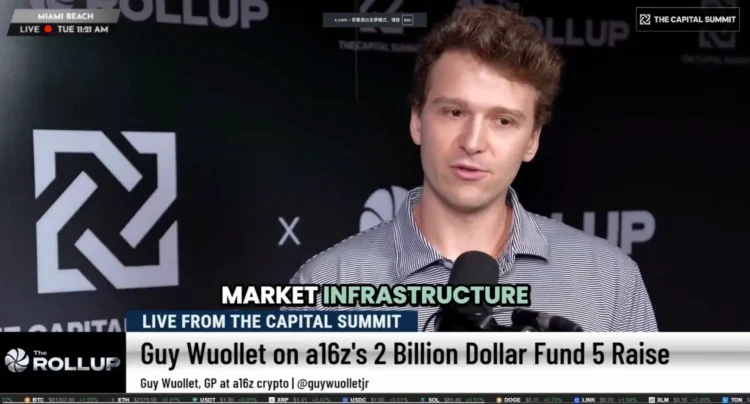
This shift reflects a16z’s updated assessment of the industry’s maturity. As regulation takes shape and the sector enters a prolonged building phase, the crucial question becomes which foundational infrastructures possess the resilience to endure for the next decade and genuinely integrate into global financial and internet systems.
Converging Paths: Navigating the Regulatory Horizon
To some extent, this shared objective explains why both a16z and Haun Ventures, despite their distinct operational styles, completed significant fundraises concurrently. Fundamentally, both firms are addressing the same core challenge: identifying the entities best equipped to navigate the increasingly complex and extended regulatory cycles ahead.
From a broader industry perspective, the primary market is currently experiencing a pronounced divergence of capital. Late-stage funding (Series C and beyond) has seen substantial year-over-year growth, while early-stage funding has noticeably contracted. Capital is rapidly consolidating towards top-tier institutions that possess the expertise and capacity for full-cycle investment.
The cryptocurrency industry is transitioning from its “wild growth adolescence” to a “coming-of-age ceremony” that involves integrating into mainstream financial systems. At this pivotal juncture, those who can successfully identify and secure certainty within the evolving regulatory framework will undoubtedly define the trajectory of the next decade in digital assets.

