Author: Max, CryptoCity
Taiwan’s Digital Finance Crossroads: Bitcoin ETFs, RWA Tokenization, and VASP Regulation Take Center Stage
Taiwan’s journey into the future of digital finance intensified on May 7, 2026, as the Legislative Yuan’s Finance Committee convened a high-stakes session. Lawmakers grilled financial regulators on critical issues surrounding virtual asset supervision and the burgeoning digital economy. The discussions highlighted Taiwan’s ambition to become a global hub for digital assets, with key commitments made by the Financial Supervisory Commission (FSC).
Bitcoin ETF Review Enters Critical Phase, FSC Promises Clarity by June End
KMT Legislator Ge Ru-jun spearheaded the debate, underscoring the accelerating global shift of digital assets towards Taiwan and the “irreversible trend” of Bitcoin Exchange Traded Funds (ETFs).
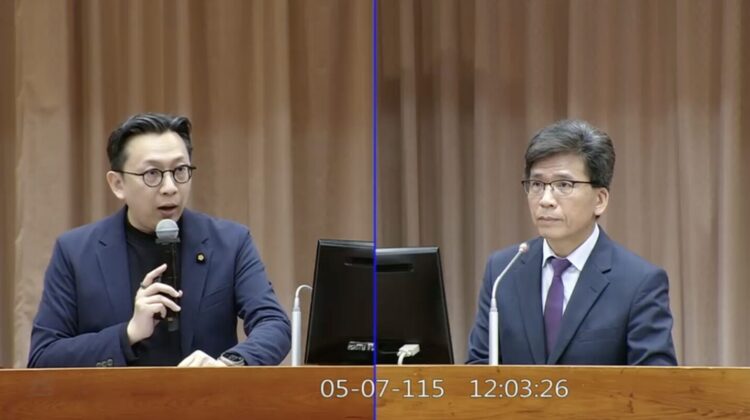
Ge Ru-jun pointed to major international financial institutions like Morgan Stanley entering the spot Bitcoin ETF arena, signaling the formal embrace of digital assets by traditional finance. He further revealed that he had submitted a research report, penned by staff from the U.S. Senate, to the FSC. This comprehensive report, titled “Bitcoin as a Reserve Asset,” delves into the pros, cons, and legal recommendations for integrating Bitcoin into national reserves.
- Related News: Bitcoin ETFs Attract $100M in First Week! Morgan Stanley Executive: Crypto Now Core to Company
FSC Chairman Peng Jin-long confirmed reviewing the report and acknowledged the diverse benefits of considering Bitcoin as a reserve asset. Addressing the most anticipated topic—the progress of Bitcoin ETF approvals—Peng Jin-long stated that the Securities Association’s semi-annual performance and analysis report had been submitted to the FSC and was under intensive internal discussion.
When pressed by Ge Ru-jun for a definitive timeline, Peng Jin-long committed to a rolling review every six months, promising to announce the feasibility and discussion outcomes regarding Bitcoin ETFs to the public by the end of June 2026.
Ge Ru-jun emphasized that nations worldwide are vying for digital asset management leadership. He argued that an early and robust legal framework would attract global capital to Taiwan, preventing the outflow of funds interested in such products.
RWA Tokenization Poised to Reshape Asset Management, Bonds and Gold Lead the Way
Beyond ETFs, the tokenization of Real World Assets (RWA) emerged as another central theme of the day’s inquiry. DPP Legislator Chung Chia-pin and Ge Ru-jun both expressed significant interest in this transformative technology.
Ge Ru-jun cited the latest developments from the U.S. Depository Trust & Clearing Corporation (DTCC), which has received SEC authorization to tokenize assets valued at a staggering $114 trillion. This groundbreaking move is seen as a pivotal milestone in digitizing asset values globally. Chung Chia-pin approached the topic from the perspective of “century-old trusts” and “asset inheritance,” questioning how the FSC plans to leverage asset tokenization to retain private Taiwanese wealth and attract overseas assets back to the island.
- Related News: Bringing Together 50 Financial Giants! U.S. DTCC Gets SEC Approval to Push RWA Tokenization Globally
Peng Jin-long affirmed the FSC’s dedication to establishing an Asia-Pacific asset management center, identifying RWA as a crucial application scenario for the future. Initial plans involve a pilot program, prioritizing the tokenization of “bonds” and “gold.” Peng Jin-long explained that these assets were chosen for their ease of valuation and lower implementation difficulty in the initial stages of tokenization, especially compared to the complex account structures of traditional funds.
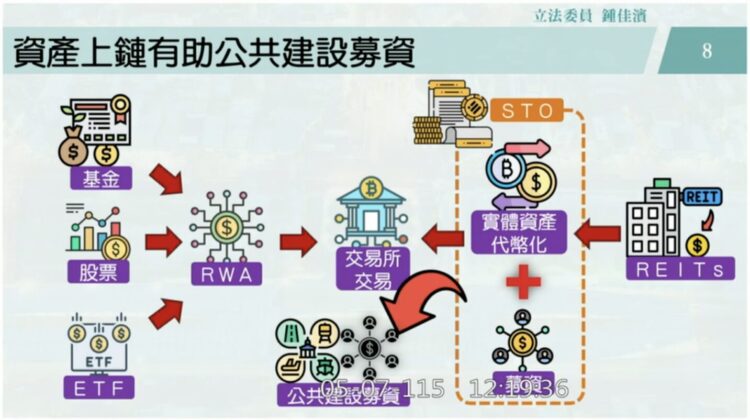
Chung Chia-pin promptly suggested expanding the RWA scope to include bills and Real Estate Investment Trusts (REITs), believing this would enrich tokenized offerings and facilitate fundraising for public infrastructure. Peng Jin-long responded positively, stating that the essence of RWA lies in the potential tokenization of any asset. He indicated that the FSC would monitor international trends and gradually broaden the scope of eligible assets, including REITs in its development roadmap.
Emulating Japan and U.S. Stablecoin Frameworks to Bridge Virtual and Fiat Currencies
Regarding the integration of virtual assets with the traditional financial system, Ge Ru-jun highlighted Japan’s successful model in digital finance. He noted Japan’s decentralized regulatory approach, where experienced financial institutions handle the underwriting and issuance of virtual assets, while trust banks are responsible for safeguarding 1:1 fiat currency reserves to issue stablecoins. Regulated Virtual Asset Service Providers (VASPs) then manage their circulation and trading, ensuring legal listing and settlement functions on platforms. Ge Ru-jun proposed this “win-win” model, which allows traditional banks and innovative startups to share profits, as a crucial reference for Taiwan’s VASP sub-law formulation.
Furthermore, Ge Ru-jun mentioned the progress of the U.S. CLARITY Act, particularly concerning the contentious issue of whether stablecoins can generate yield. A compromise solution has emerged, suggesting that passive, fixed interest might be restricted, but active user engagement linked to specific rewards could fall within compliant parameters.
Peng Jin-long affirmed that the FSC is closely monitoring regulatory developments worldwide, including new international guidelines expected in June and July.
For the enforcement direction of Taiwan dollar stablecoins, the FSC plans to enhance communication with the industry. This is to ensure that during the drafting and enforcement of the special law, promising and high-quality VASPs are integrated into the issuance system, thereby bridging the virtual and physical currency worlds and preventing Taiwan from lagging in international competition.
VASP Special Law Under Scrutiny: Balancing Regulatory Risk and Startup Growth
DPP Legislator Lin Chu-yin focused on the upcoming draft of the “Virtual Asset Service Act.” She highlighted a concerning trend: the number of local VASPs in Taiwan has shrunk from a peak of 26 to just 8, indicating a gradual exit of small and medium-sized startups from the market.
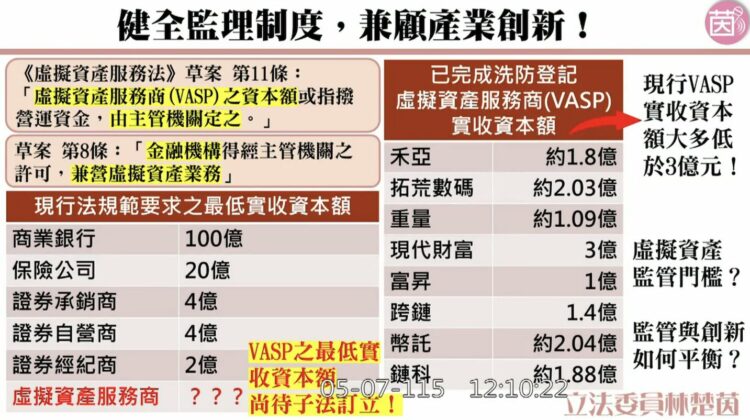
Lin Chu-yin expressed concern that if the special law imposes excessively high capital thresholds or significantly increases compliance costs, it could create a “small fish unable to compete with big whales” scenario, leaving only large, traditional financial institutions capable of survival. She cited data, noting that the EU requires approximately NT$1.84 million in assets for low-risk operators, Hong Kong between NT$20 million and NT$40 million, and the U.S. around NT$15 million. She urged the FSC to balance stringent regulation with fostering industry diversity.
Addressing legislators’ concerns about the survival of startups, Peng Jin-long explained that the future regulatory framework would adhere to a Risk-Based Capital (RBC) principle. He emphasized that capital requirements are primarily to protect traders and investors, meaning higher-risk entities would naturally require greater capital defense.
Peng Jin-long pledged that the FSC would reference international standards for substantive capital requirements when drafting enforcement details, ensuring transparent rules. He asserted that market competition is inherently free, and capable operators would naturally thrive under the regulations. He clarified that policy would not offer long-term specific protections, aiming instead to establish a fair and internationally competitive digital financial environment.
All three legislators concluded by urging the FSC to leverage Taiwan’s strengths as a technology powerhouse. They emphasized that while pursuing rigorous supervision, the virtual asset industry should be harnessed as a new engine to drive Taiwan’s financial progress.
(The above content is an authorized excerpt and reprint from our partner “CryptoCity”, original link)
Disclaimer: This article is for market information purposes only. All content and views are for reference only, do not constitute investment advice, and do not represent the views and positions of BlockTempo. Investors should make their own decisions and transactions. The author and BlockTempo will not bear any responsibility for direct or indirect losses resulting from investor transactions.