Author: Jae, PANews
The Dawn of Compute Futures: Wall Street’s New AI Battlefield
Compute power has emerged as the “new oil of the 21st century,” the indispensable engine driving global AI operations. This AI-fueled race for computational supremacy is now extending beyond the traditional boundaries of information technology, deeply embedding itself within the very fabric of modern financial infrastructure.
Larry Fink, the visionary leader of BlackRock, the world’s largest asset manager, once presciently observed that a futures market tied to compute power was inevitable, given the escalating scarcity of resources within the AI ecosystem. His prediction materialized with striking clarity this past May.
Within a single week, two titans of traditional finance – the Chicago Mercantile Exchange Group (CME Group) and the Intercontinental Exchange (ICE), parent company of the New York Stock Exchange – independently announced their strategic forays into the burgeoning GPU compute futures market.
This pivotal shift signifies the transformation of compute power from an intangible technical resource into a standardized financial asset, ripe for speculation, trading, and hedging. The intense competition among Wall Street giants to establish pricing dominance over this novel macro commodity unequivocally marks the official commencement of the era of compute asset financialization.
GPU Futures: Wall Street’s Emerging Frontline
In this high-stakes race to financialize compute assets, the two Wall Street powerhouses have adopted distinct strategic approaches.
ICE’s Comprehensive Vision: Broad Coverage and Pioneering Indices
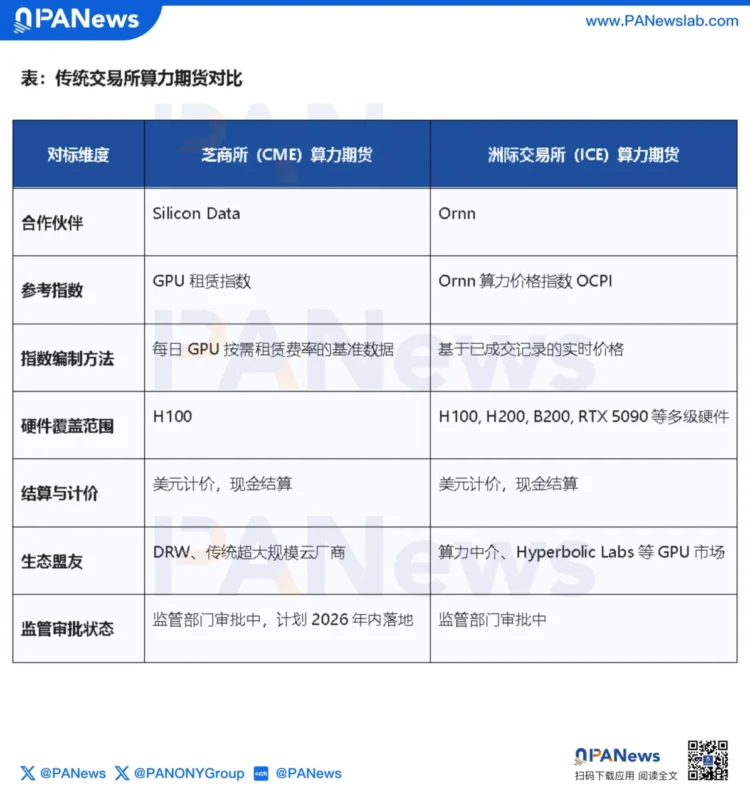
On May 19, ICE made a decisive entry, partnering with data provider Ornn to unveil a suite of GPU compute futures contracts. These contracts are underpinned by the Ornn Compute Price Index (OCPI), a groundbreaking index constructed from verifiable, real-world transaction records.
Ornn, through its subsidiary Ornn Data, ensures pricing transparency by distributing the OCPI in real-time to Bloomberg terminals, thereby mitigating the risk of “distorted listed prices.” Kush Bavaria, Ornn’s co-founder and CEO, emphasized that with compute power evolving into a trillion-dollar market, ICE’s futures listings will offer a crucial risk transfer layer for both institutional buyers and compute providers.
ICE’s ambitious contracts extend beyond mainstream enterprise-grade GPUs like the H100, H200, and B200, also encompassing high-end consumer-grade graphics cards such as the RTX 5090. This comprehensive approach provides granular hedging solutions for diverse compute demands, signaling ICE’s intent to capture global compute pricing power across the entire spectrum, from cloud to edge, and from AI training to inference.
To further solidify the index’s industry foundation, Ornn has allied with Hyperbolic Labs, a major global GPU marketplace. Jasper Zhang, Hyperbolic Labs’ co-founder and CEO, noted that the GPU market increasingly mirrors global commodity markets, and ICE’s initiative directly addresses the critical risk management needs of new compute service providers (Neoclouds) and AI laboratories.
CME’s Strategic Head Start: Precision-Focused Hedging
While ICE’s entry was significant, it followed CME’s strategic head start by a week. On May 12, CME announced its collaboration with Silicon Data, a GPU market intelligence and benchmark data provider backed by trading giant DRW. Together, they are launching the world’s first compute futures contract. CME’s involvement, as a global benchmark in the derivatives market, officially enshrines compute power within Wall Street’s recognized “macro commodity” hierarchy.
In contrast to ICE’s broad market capture, CME’s compute futures are precisely anchored to Silicon Data’s “H100 Lease Index.” This index provides a unified pricing benchmark for the notoriously fragmented and opaque spot market by daily tracking real-time, on-demand leasing rates across leading cloud service providers and emerging GPU cloud platforms.
To circumvent the complexities of physical hardware delivery, including depreciation and transportation logistics, CME’s GPU futures contracts will employ a cash settlement model. The underlying asset for trading is not the physical chip itself, but rather the expectation of future H100 leasing prices.
This mechanism offers a vital hedging tool for large-scale cloud service providers. By establishing a short position in the CME compute futures market, these providers, who invest billions in H100s, can proactively lock in a minimum return on investment (ROI) for their servers. This strategy effectively insulates them from the risk of asset impairment caused by potential sharp declines in compute prices, echoing the historical financialization of commodities like crude oil, natural gas, and electricity.
Compute Futures: A Battle for Pricing Power Amidst Opportunity and Peril
The global surge of large language models has elevated compute power from a mere “IT resource” to a “strategic imperative” fiercely sought after by AI powerhouses like OpenAI, Anthropic, Google, and Meta. Simply put, robust GPU stockpiles are now the coveted entry ticket to the AI era.
However, this critical resource comes with significant challenges: the compute market is both prohibitively expensive and inherently unpredictable.
A staggering concentration of power lies with the four major cloud giants – Amazon AWS, Microsoft Azure, Oracle, and Google GCP – which collectively command approximately 78% of global IT power capacity and 69% of H100 supply. Spot leasing prices can skyrocket multiples within short periods, only to plummet with subsequent chip iterations. An AI lab seeking to secure compute capacity a year in advance might face a hefty premium, while failing to do so risks critical supply disruptions.
Compounding these issues is the glaring absence of effective hedging instruments in the current compute market. Don Wilson, founder of DRW, candidly acknowledged that the explosive growth of capital-intensive investments like data centers has historically been hampered by a lack of robust risk management tools. The advent of the compute futures market directly addresses this critical pain point.
Indeed, the entity that masters compute pricing power will effectively control the Bretton Woods system of the AI age.
The fierce contest between Wall Street’s two dominant players for this pricing authority underscores that compute power, as an emerging factor of production, stands at a historic juncture of “financialization” and “commoditization.” This evolution is supported by underlying industry cycles but is also accompanied by considerable potential risks.
From a supply-demand perspective, the global compute market is transitioning into a new phase of rebalancing. While initial explosive growth in AI applications led to severe mismatches in high-end GPU supply and demand, causing leasing prices to surge, the large-scale completion of data center construction and advancements in chip manufacturing processes are expected to introduce significant spot price volatility. This necessitates forward pricing tools to mitigate risk.
However, the “intangible nature” of compute power means it cannot simply replicate the physical delivery model of traditional commodities. Physical chips have a relatively short lifecycle, typically facing technological obsolescence or significant depreciation within 18 to 24 months. This rapid iteration renders long-term physical delivery contracts impractical. Consequently, the industry has converged on a cash settlement model, utilizing a “standard compute unit” – such as one hour of H100 runtime – as the benchmark. While optimal, this approach inherently increases the complexity of pricing models.
Furthermore, the supply side of compute power is highly concentrated, rendering the spot market an effective oligopoly. Establishing a derivatives market atop such a structure introduces inherent fragility into the price discovery mechanism, making futures prices susceptible to indirect manipulation by spot market dynamics.
More critically, the full activation of a compute derivatives market, with its inherent leverage, could significantly amplify price volatility in the underlying spot market. An influx of leveraged capital and heightened speculative fervor could inflate compute procurement costs, potentially transforming small and medium-sized AI enterprises into “harvested” entities. This scenario could even escalate into a “financial hunt,” further exacerbating the already uneven distribution of vital compute resources.
Wall Street Awaits Approval, Crypto Innovators Seize the Lead
While Wall Street’s behemoths await regulatory green lights, players within the cryptocurrency market have already demonstrated their agility.
As early as January of this year, Architect Financial Technologies, founded by the former president of FTX US, collaborated with Ornn to launch perpetual contracts linked to the OCPI-H100 via its AX platform.
As more platforms join this trend, it is highly probable that Centralized Exchanges (CEXs) will progressively introduce their own compute futures markets. Beyond this, they may also roll out structured finance products tailored for general users or regular investment plans pegged to GPU leasing rates, fostering a seamless integration between the crypto market and traditional financial macro assets.
In stark contrast to CME and ICE, which operate under stringent regulations and face protracted approval processes, Decentralized Perpetual Contract Exchanges (Perp DEXs) leveraging smart contracts enjoy superior agility and the inherent advantages of permissionless innovation.
Perp DEXs circumvent the lengthy listing procedures typical of CEXs. For instance, developers can launch compute perpetual contracts linked to GPU indices on Hyperliquid’s HIP-3 market by staking a relatively modest 500,000 HYPE tokens (with potentially lower thresholds in the future). This product development capability empowers DeFi to cultivate a global compute speculation market that transcends geographical boundaries and traditional barriers, operating beyond Wall Street’s standard trading hours.
Nevertheless, compute futures, as an nascent asset class, carry a high-risk coefficient in their early stages. The compute market’s predominantly Over-The-Counter (OTC) nature makes data sources susceptible to manipulation. More extreme scenarios, such as black swan events like technological breakthroughs or chip embargoes, could trigger non-continuous, abrupt surges or crashes in compute indices. Both situations risk price distortion, potentially leading to cascading liquidations of high-leverage contracts.
Irrespective of these challenges, the Wall Street giants’ pursuit of compute futures represents a pivotal moment – the convergence of AI infrastructure with modern finance.
GPU compute power, traditionally viewed primarily as an IT resource, is now undergoing a profound transformation into a measurable, tradable, and hedgeable standardized asset, thereby embedding the logic of technical resource allocation within the global financial system.
As compute assets become commoditized, their resource allocation logic is poised to shift from sole reliance on spot purchases to being increasingly influenced by financial market price signals. In the future, compute power, much like foundational production elements such as energy and electricity, is expected to develop more mature price discovery mechanisms and capital allocation systems.
Disclaimer: This article is for market information purposes only. All content and views are for reference only and do not constitute investment advice. They do not represent the views and positions of BlockTempo. Investors should make their own decisions and transactions. The author and BlockTempo will not bear any responsibility for direct or indirect losses incurred by investors’ transactions.