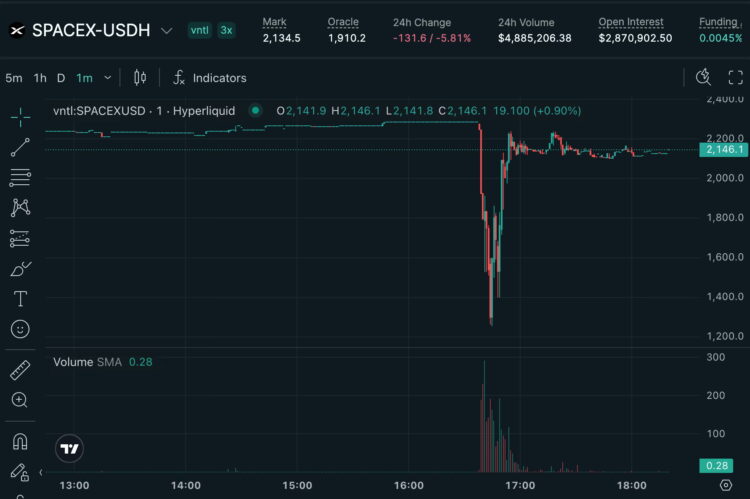
The highly anticipated public listing of SpaceX is still on the horizon, yet its “Pre-IPO Perpetual Contract” within the cryptocurrency market has already endured a brutal “bloodbath.” On May 28th, the SPACEX-USDH perpetual contract on the decentralized derivatives exchange Hyperliquid experienced a dramatic flash crash, plummeting by nearly 45%—from $2,277 to $1,254—in a mere 30 minutes, before staging a partial recovery to approximately $2,169.
This swift and severe market event had significant repercussions. According to Hyperliquid’s on-chain data, the sudden downturn led to the forced liquidation of 1,393 trading positions belonging to 405 traders, resulting in an estimated notional value loss of $1.51 million.
Liquidity Scarcity: The Root Cause of the Collapse
The market’s attention quickly turned to the unusually concentrated trading volume that preceded and defined this flash crash. In the 24 hours leading up to the incident, the contract’s trading activity was notably subdued, with a total volume of only about $4.87 million and open interest barely reaching $2.9 million.
The sudden influx of a massive sell order into such a thin market proved catastrophic. With insufficient depth and liquidity to absorb the selling pressure, the price defense crumbled instantly, triggering a cascading effect that exacerbated the decline.
Analysis of the liquidation data reveals a stark reality: this event disproportionately impacted retail investors. The median margin for liquidated positions was a meager $31, indicating a market heavily populated by small-scale traders, often leveraging their positions around 3x. This limited buffer left them highly vulnerable to rapid price swings.
But what exactly is SPACEX-USDH? It’s a “synthetic perpetual contract” meticulously crafted by Hyperliquid to allow speculation on Elon Musk’s aerospace venture, SpaceX. Crucially, SpaceX remains a privately held company, with its IPO not expected until June. This means direct investment in its shares is currently inaccessible to the general public.
Hyperliquid introduced this derivative to cater to the market’s appetite for speculating on SpaceX’s future valuation. However, it’s vital to understand that investors are not acquiring actual SpaceX stock. Instead, they are trading a speculative contract based on the perceived value of SpaceX, without any associated corporate ownership or shareholder rights.
The Peril of Unanchored Valuation: Why Spot Market Support is Crucial
Unlike perpetual contracts for established cryptocurrencies like Bitcoin or Ethereum, which are firmly anchored to transparent spot markets with robust liquidity, the SpaceX Pre-IPO perpetual contract faces a fundamental challenge: the absence of a publicly verifiable spot price benchmark.
Currently, SpaceX shares are traded exclusively in opaque secondary markets, accessible only to a select group of qualified accredited investors. This lack of transparency and restricted access makes the derivative contract’s price highly susceptible to manipulation, extreme speculative sentiment, and unverified information.
Intriguingly, even in the wake of this severe flash crash, the speculative fervor surrounding SpaceX appears far from extinguished. At settlement, the contract’s mark price—a fair price used for calculating unrealized profit/loss and liquidation thresholds—stood at $2,132. This figure remained over $220 higher than the oracle’s reported price of $1,908, signaling the persistence of an irrational “high premium” bubble in the market, despite the recent volatility.
Disclaimer: This article is intended solely for market information purposes. All content and opinions provided are for reference only and do not constitute investment advice. They do not represent the views or positions of the author or BlockBeats. Investors are advised to conduct their own due diligence and make independent trading decisions. Neither the author nor BlockBeats will assume any responsibility for direct or indirect losses incurred by investors as a result of their transactions.