Bitcoin’s Structural Support Falters: CryptoQuant Warns of Cooling Market Demand
The cryptocurrency market is witnessing a significant cooling of buying interest, with Bitcoin’s ownership structure showing continuous deterioration. A recent report from CryptoQuant highlights that not only have major “whale” investors ceased accumulation, but even the institutional-grade buying from ETFs and corporations, which previously fueled the bull run, is notably decelerating.
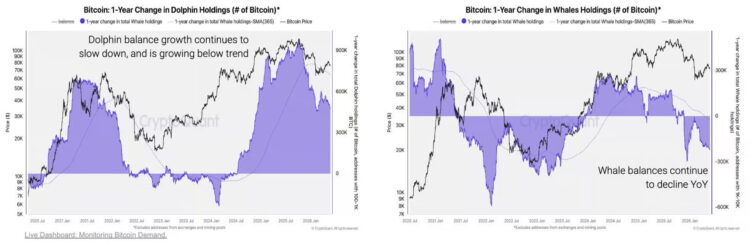
Julio Moreno, Head of Research at CryptoQuant, stated in the report that Bitcoin whale balances are shrinking year-over-year at their fastest pace yet. This trend bears a striking resemblance to the early phase of the 2022 bear market, where large holders initially paused accumulation before shifting to net selling, ultimately triggering a prolonged downturn for Bitcoin.
Meanwhile, “dolphins”—representing institutional buyers—are also showing signs of waning enthusiasm. While their asset balances still exhibit growth, the pace has slowed dramatically. Moreno observed that the annual growth in dolphin holdings peaked at 970,000 Bitcoins in October 2025, but has since retreated sharply below the trend line. He emphasized:
“This unequivocally confirms one thing: the structural demand engine driving this rally is continuously cooling down.”
Major Holders Shift to Sidelines, Structural Support Under Threat
To ensure a precise capture of “real investor behavior,” CryptoQuant meticulously excluded cryptocurrency exchanges and mining pools from their calculations. They define “whales” as wallets holding between 1,000 and 10,000 Bitcoins, while “dolphins” are classified as wallets holding 100 to 1,000 Bitcoins. This latter group predominantly comprises Bitcoin spot ETF issuers and corporations integrating cryptocurrencies into their balance sheets.
The report further reveals a concerning trend: the monthly growth rates for both whale and dolphin holdings are now nearing zero. Dolphin-class monthly growth has been on a consistent decline since September 2025, and whale monthly growth has stagnated entirely since February 2026.
Julio Moreno’s analysis suggests that large non-exchange holders have transitioned from “aggressive accumulation” to a “neutral, wait-and-see” stance, with some even beginning to offload positions. He cautioned that historical data indicates such synchronized deceleration in whale and dolphin accumulation often precedes extended periods of price weakness. These two influential groups, after all, represent the core source of long-term demand in the Bitcoin market.
The Deception of “Passive HODLing”: Short-Term Demand Fails to Absorb Supply
Moreno also highlighted a potentially misleading data point: the supply of Bitcoin held by long-term holders has reached an all-time high of 15.8 million BTC. However, he argues this is not necessarily a bullish indicator.
He clarifies that the rise in long-term holder supply isn’t due to robust new investment but rather a lack of significant supply transfer in the market. In essence, an overly weak short-term buying demand is failing to absorb the existing supply held by long-term investors. This apparent growth, therefore, stems from existing investors being “forced” to hold their assets rather than a surge of new capital entering the market.
Concurrently, the asset balance of short-term holders (those holding Bitcoin for less than 155 days) has experienced a dramatic contraction, plummeting from 6.4 million BTC in December 2025 to approximately 4.2 million BTC currently—a staggering evaporation of over 2.1 million Bitcoins.
Addressing this discrepancy, Moreno pinpointed a technical blind spot: a substantial 900,000 Bitcoins from this “missing” supply simply transitioned from “short-term” to “long-term” classification. This occurred because the holding period within Coinbase’s reserves crossed the 155-day threshold. Such “mechanical inflation” driven by time, he argues, not only skews the long-term holder data but also fails to inject genuine new demand into the market.
In recent weeks, Julio Moreno has consistently issued warnings, emphasizing that Bitcoin demand remains subdued. He notes that the current market landscape eerily mirrors that of March 2022, just prior to the onset of a significant bear market.
According to CoinGecko data, Bitcoin has seen a sharp decline since breaking its all-time high of $126,000 last October. With the current price oscillating around $73,700, investors navigating these market conditions are advised to exercise extreme caution and prepare for potential volatility.
Disclaimer: This article is intended solely for market information purposes. All content and views are for reference only and do not constitute investment advice, nor do they represent the views and positions of BlockTempo. Investors should make their own decisions and trades. The author and BlockTempo will not be liable for any direct or indirect losses incurred by investors’ transactions.