
Author: Jae, PANews
As market enthusiasm soared in anticipation of SpaceX’s Nasdaq debut, less than a month away, its pre-IPO assets experienced a dramatic overnight “cliff-edge” plunge on May 28th. The preSPCX stock token on Bitget saw its price plummet by approximately 80%, while SpaceX perpetual contracts on the decentralized perpetual exchange (Perp DEX) Hyperliquid flash-crashed by 45% within 30 minutes, forcing over 400 retail investors into liquidation.
Even before SpaceX’s official listing bell could ring, the market had already penned a stark warning for its pre-IPO assets.
Bitget: An 80% Plunge, The Truth Behind a Token Split
Yesterday, many traders glued to their screens gasped as the preSPCX/USDT spot trading pair on Bitget’s platform suddenly charted an 80% vertical red candle. Such extreme volatility could easily lead uninformed investors to suspect market manipulation or a “rug pull” by the exchange.
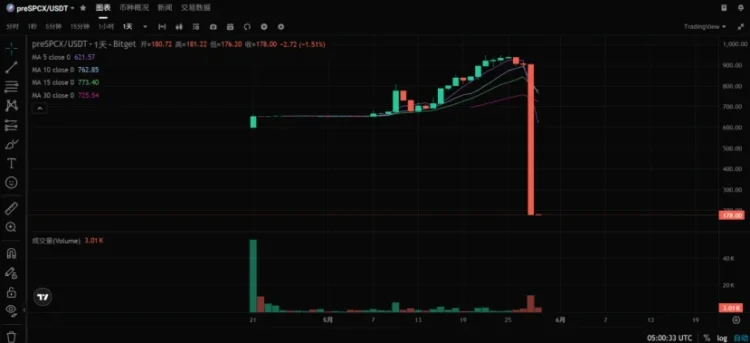
According to investigations by PANews, this “plunge” was not due to a sudden deterioration in asset fundamentals. Instead, it was the result of a pre-announced token split.
As per an official announcement from Bitget, the platform temporarily suspended trading of the original pre-IPO stock token, preSPAX, on May 28th at 2 PM. A 1:5 token split was then implemented, updating the ticker symbol to preSPCX.
A 1:5 split means that investors’ token holdings are multiplied by five. Assuming the total value of their holdings remains constant, the unit price of each token post-split is adjusted to one-fifth of its original value. This manifested on the trading chart as a nominal 80% price drop.
With a trading price hovering around $900 at the time, the adjusted price after the split was approximately $180.
While this was purely a technical accounting adjustment, the K-line chart on the trading interface did not synchronize historical prices upon reopening, creating a visually dramatic “crash.”
For inexperienced, emotionally sensitive, or information-asymmetric retail investors, this visual shock could easily be misinterpreted as an “asset implosion.”

Hyperliquid: A 45% Flash Crash in 30 Minutes, Oracle Anomaly Triggers Domino Liquidations
In contrast to Bitget’s “technical adjustment,” the flash crash of SPACEX perpetual contracts on Hyperliquid was a genuine disaster, born from an oracle error, thin liquidity, and a cascade of leveraged liquidations.
At 11 PM last night, the SPACEX-USDH contract on the HIP-3 Ventuals market free-fell from $2,277 to a low of $1,254 in just 7 minutes—a staggering 45% drop, almost halving its value. Although the price swiftly recovered to around $2,200 within the subsequent 10 minutes, the position wipeout was complete, leaving long positions with severe losses.
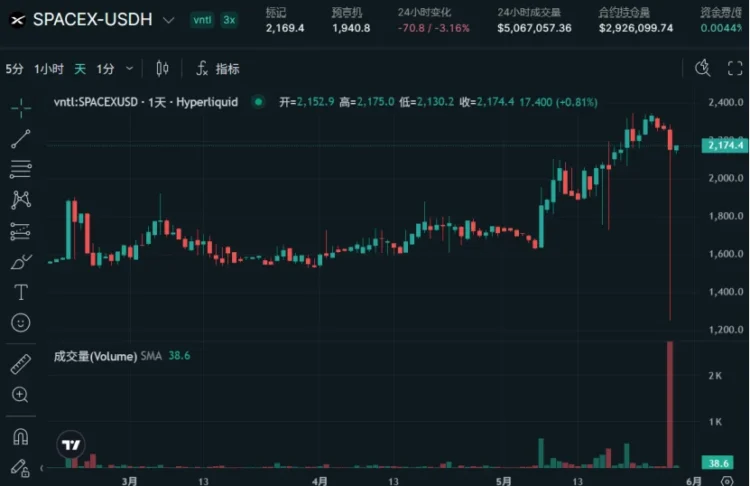
As a consequence, 1,393 positions belonging to 405 users were forcibly liquidated, accumulating a nominal loss of approximately $1.51 million. The median margin for liquidated positions was a mere $31, indicating that market participants were predominantly retail investors.
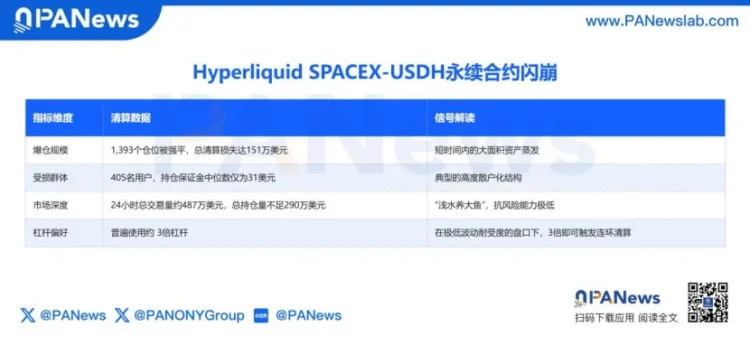
This flash crash stemmed from abnormal liquidations triggered by an erroneous oracle price feed. According to Ventuals, the perpetual contract platform within the Hyperliquid ecosystem, the incident was caused by an off-chain data provider used by the oracle component returning incorrect data. This led to severe fluctuations in the market’s oracle and mark prices, consequently triggering forced liquidations for some users’ positions. Emergency measures have been taken, and the development team is currently assessing the impact on users. Ventuals later updated, stating that affected users would receive compensation within the next 48 hours.
Moreover, a deeper underlying cause of this plunge lies in the common issues plaguing pre-IPO assets: insufficient order book depth and fragile market liquidity. This, combined with a cascading collapse of retail leverage, further amplified the market’s stampede effect, accelerating the downward trend.
This was a remarkably “shallow” market, akin to a puddle barely covering one’s ankles; even a slightly larger stone thrown into it could create significant ripples.
In a market with less than $3 million in open interest and a 24-hour trading volume of just over $4 million, a single sell order in the hundreds of thousands of dollars was enough to instantly sweep through large swathes of buy orders. As prices dipped, long positions hit their liquidation thresholds, triggering market sell-offs that further breached deeper price supports. The late-night liquidity drain then ignited a domino effect.
In less than 20 minutes, a leveraged game turned into a forced exit for retail investors.
Conclusion
Undeniably, pre-IPO assets represent one of the most imaginative innovation directions in the crypto industry. They offer ordinary individuals a chance to gain early exposure to the value proposition of top-tier unicorns, transcending the high walls of private equity markets. In a sense, this not only expands the boundaries of market participation but also provides a novel price discovery mechanism for non-public assets.
However, until these real-world assets officially land on public markets and trading depth is fully cultivated, such assets are inherently characterized by high volatility, intense speculation, and pricing distortions. Lacking unified valuation benchmarks, mature arbitrage mechanisms, and ample market depth, their prices are often more susceptible to emotional swings, liquidity constraints, and the amplification effects of leveraged capital. The recent extreme volatility in SpaceX’s synthetic assets once again exposes the inherent fragility of pre-IPO products in the market.
As more popular unicorns are brought onto the blockchain in the future, and speculative capital continues to pour in, the question of whether the pre-IPO sector can establish more mature pricing mechanisms, liquidity systems, and risk control frameworks remains a persistent challenge for the industry.
(The above content is an authorized excerpt and reprint from our partner PANews. Original Link)
Disclaimer: This article is for market information purposes only. All content and opinions are for reference only and do not constitute investment advice. They do not represent the views and positions of BlockTempo. Investors should make their own decisions and trades. The author and BlockTempo will not bear any responsibility for direct or indirect losses incurred by investors’ transactions.