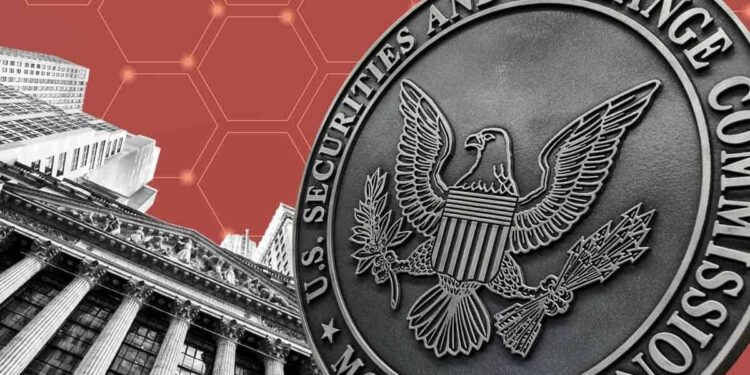
SEC Draws Clear Line: Tokenized Securities Are Still Securities, Paving Way for Traditional Finance
The long-standing debate between Wall Street and the burgeoning cryptocurrency industry over the regulatory status of “tokenized securities” has received definitive clarity from the U.S. Securities and Exchange Commission (SEC). In its latest guidance, the SEC unequivocally states that even when securities are issued and traded on a blockchain, their fundamental nature as securities remains unchanged, thus falling squarely within the commission’s jurisdiction.
Form Over Substance: A Core Principle
Issued by the SEC’s Divisions of Corporation Finance, Investment Management, and Trading and Markets, the guidance, published on a Wednesday (referencing the official statement), emphasizes that tokenized securities represent merely a “change in form, not a change in nature.” This means any digital asset meeting the definition of a “security” under federal law must adhere to the same stringent registration, disclosure, and compliance obligations as traditional stocks and bonds.
The SEC precisely defines tokenized securities as:
“Financial instruments that meet the definition of ‘security’ as enumerated in federal securities laws, whose format is a crypto asset or is presented in the form of a crypto asset, and whose full or partial ownership records are stored on one or more cryptographic networks, or stored via cryptographic networks.”
Continuing a Regulatory Push for Clarity
This guidance aligns with the SEC’s ongoing efforts to establish regulatory clarity in the crypto asset market. The commission has consistently signaled its intent to categorize digital assets, ensuring investor protection and market integrity.
Three Primary Models of Tokenized Securities
The SEC’s latest directive categorizes tokenized securities into two main types, with a further explanation of a third, more complex derivative structure:
1. Issuer-Led Tokenization
In this model, the issuer directly integrates blockchain technology into their ownership registration system. A transfer of tokens on the blockchain directly signifies a true transfer of the underlying security.
The SEC clarifies that the only distinction from traditional issuance is the shift from a conventional central database to an “on-chain database” for recording shareholder information. This is a digital evolution, not a fundamental alteration of the security’s legal status.
2. Third-Party Custody Models
This involves a third party holding physical securities and issuing corresponding tokenized “certificates of interest.” The SEC views this as functionally identical to traditional securities custody arrangements, making existing securities regulations fully applicable.
The SEC underscores: “Under this framework, crypto assets merely represent the holder’s ‘indirect interest’ in the underlying securities, and their form of issuance does not affect the applicability of federal securities laws.”
3. Synthetic Tokenized Securities
The guidance also addresses a more contentious category: “synthetic tokenized securities.” These assets are typically created by a third party tokenizing securities issued by others, offering economic exposure (e.g., price appreciation or depreciation) without conveying shareholder rights like voting privileges.
The SEC classifies these as “linked securities,” akin to structured products or certain equity derivatives. “Security-Based Swaps,” which provide synthetic exposure and often entail stricter qualification requirements for participants, may also fall under this umbrella.
Reaffirming a Consistent Stance
Ultimately, this SEC guidance serves as a systematic consolidation and reaffirmation of its long-held position. As SEC Commissioner Hester Peirce, a long-time observer of cryptocurrency policy, has frequently stated, “Tokenized securities are still securities.”
Paving the Way for TradFi’s Digital Leap
What truly captures market attention is the accelerating pace at which traditional financial institutions are embracing tokenization. A prime example is the New York Stock Exchange (NYSE), which has expressed its intent to launch a tokenized trading platform for U.S. stocks and ETFs, pending regulatory approval. The SEC’s clear guidance effectively “paves the way” for these traditional financial giants to confidently enter the digital asset space, offering a clearer regulatory landscape for innovation within established legal frameworks.
Disclaimer: This article is for market information purposes only. All content and views are for reference only, do not constitute investment advice, and do not represent the views and positions of BlockTempo. Investors should make their own decisions and trades. The author and BlockTempo will not be held responsible for direct or indirect losses resulting from investor transactions.