
In a powerful stride against the escalating threat of virtual asset fraud, the Taiwan Fintech Association (TFTA) recently convened a pivotal online forum titled “Financial Cybersecurity and Anti-Fraud: Deconstructing Virtual Asset Scam Tactics.” Hosted by Justin Cheng, Founder and CEO of BitoGroup, the event united a formidable panel: Detective Captain Hung Cheng-chi of the Criminal Investigation Bureau and renowned blockchain YouTuber Shuifengdao. Together, they offered a multi-faceted exploration of emerging tech-driven scams from the distinct perspectives of cryptocurrency exchanges, law enforcement, and public education, laying the groundwork for a robust financial defense strategy.
Unmasking the Layers of Deception: Shuifengdao on “Secondary Fraud”
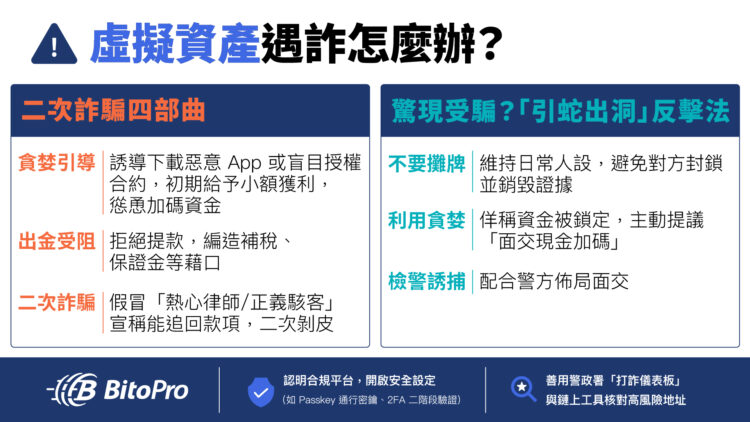
Shuifengdao, a leading voice in blockchain education, revealed “secondary fraud” as the ultimate evolution of virtual asset scams. These sophisticated schemes unfold in four insidious stages:
- Initial Enticement: Scammers first offer victims small, seemingly legitimate profits, building trust before pressuring them to invest substantial capital for promised high returns.
- Withdrawal Obstruction: As investments grow, withdrawal requests are denied under fabricated pretexts like “taxes” or “margin calls,” coercing victims into injecting more funds. They are then lured to transfer assets to deceptive, malicious apps or websites designed to mimic legitimate platforms.
- Isolation & Manipulation: Victims are systematically isolated from their support networks, prevented from seeking help from family or friends.
- The Second Trap: Finally, perpetrators masquerade as lawyers or hackers, falsely claiming the ability to recover lost funds, thereby pushing victims deeper into the abyss of “secondary fraud.”
BitoGroup’s Proactive Stance: Fortifying Defenses with Advanced Technology
Justin Cheng, BitoGroup’s Founder and CEO, underscored how fraudsters exploit information asymmetry to execute complex, multi-layered scams. As a fully compliant trading platform, BitoGroup has made significant investments in deploying cutting-edge technological safeguards. This includes integrating international-grade Know Your Customer (KYC) modules for rigorous identity verification and monitoring, ensuring strict adherence to Anti-Money Laundering (AML) and Counter-Financing of Terrorism (CFT) regulations.
Beyond compliance, BitoGroup employs an advanced suspicious transaction monitoring system to proactively detect abnormal behaviors. A dedicated customer service team also conducts proactive outreach to high-risk users, offering personalized support and guidance.
In a powerful demonstration of cross-industry collaboration, BitoGroup’s exchange systems are seamlessly integrated with investigative agencies and banking networks, facilitating the real-time sharing of suspicious financial intelligence. The platform fully cooperates with legal authorities to address and manage illicit accounts. Cheng urged users to leverage the robust security features provided by BitoGroup, such as Passkey and two-factor authentication (2FA), to independently bolster their account protection.
Law Enforcement’s Strategic Play: Detective Hung Cheng-chi on “Luring the Snake Out”
Detective Captain Hung Cheng-chi of the Criminal Investigation Bureau’s Anti-Fraud Crime Prevention Center highlighted a stark reality: over 70% of virtual currency scams originate from “romance-investment” schemes. Scammers meticulously cultivate trust over months through seemingly innocuous conversations before guiding victims to purchase stablecoins like USDT on legitimate domestic exchanges, only to then direct these funds into illicit wallets.
Challenging a common misconception, Captain Hung clarified that the disappearance of victims’ assets is rarely due to wallet hacks. Instead, it often stems from a lack of cybersecurity awareness, where individuals inadvertently leak screenshots of private keys or seed phrases, or blindly authorize malicious smart contracts – essentially “handing over the keys to their digital safe.”
For prevention and counteraction, Captain Hung advised the public to consult the National Police Agency’s “Anti-Fraud Dashboard” for the latest scam alerts. Suspicious wallet addresses can also be cross-referenced with on-chain tools to check for high-risk flags. Crucially, if fraud is suspected, victims should avoid immediate confrontation. This prevents scammers from blocking communication and destroying evidence. Instead, maintaining a normal persona and feigning “locked funds” can be a strategic move. By appealing to the scammer’s greed and proactively suggesting a face-to-face cash transaction, victims can covertly cooperate with law enforcement to orchestrate a controlled meeting, effectively “luring the snake out of its hole.”
A United Front: Public-Private Collaboration for Digital Asset Security
Justin Cheng emphatically stated that combating virtual asset crime demands a unified front. True digital asset security can only be achieved through concerted public-private collaboration involving exchanges, law enforcement, and public education, combined with a heightened sense of fraud awareness and defense among citizens. Cheng, who also chairs the Virtual Asset Association, announced a significant upcoming development: domestic operators will soon implement the international “Travel Rule.” This crucial regulation will mandate the collection and verification of sender and receiver information for transactions, thereby strengthening monitoring, effectively mitigating money laundering and terrorist financing risks, and significantly enhancing the transparency of the financial system.
(Content provided by BitoGroup)
Disclaimer: This article is for market information purposes only. All content and views are for reference only and do not constitute investment advice. They do not represent the views and positions of BlockTempo. Investors should make their own decisions and trades, and the author and BlockTempo will not bear any responsibility for direct or indirect losses resulting from investor transactions.




