Author: Nancy, PANews
In a move that could dramatically reshape the global financial technology landscape, payment unicorn Stripe has reportedly joined forces with private equity titan Advent International in a bold bid to acquire PayPal, the erstwhile payment giant, for an estimated $53 billion. Following the initial whispers of this potential mega-deal, PayPal’s stock surged by nearly 17.2%.
While rumors of this groundbreaking acquisition have been circulating for months, neither PayPal nor the potential acquirers have confirmed substantive negotiations. The proposed takeover, if successful, promises to be one of the most significant M&A events in the payments industry in recent memory.
Stripe’s Ambitious $53 Billion Play for PayPal: Awaiting the Green Light
On July 15, Reuters, citing informed sources, revealed that Stripe and Advent International have jointly submitted an acquisition offer to PayPal. The proposal values PayPal at $60.5 per share, culminating in a total valuation exceeding $53 billion—a premium over PayPal’s then-current share price of approximately $55.5.

Despite Stripe’s impressive private valuation, which recently soared to $159 billion—more than triple PayPal’s current market capitalization—a transaction of over $53 billion is too substantial to be funded by Stripe alone. Sources indicate that Stripe and Advent have secured roughly $50 billion in bank financing commitments to underpin this ambitious acquisition.
Unconventionally, the two parties plan to co-own PayPal post-acquisition, each holding a 50% equity stake. This deviates from the traditional private equity model, which often involves breaking up or divesting acquired assets. This shared ownership structure, a rarity in the fintech sector, serves a dual purpose: it mitigates the immense financial pressure of a mega-acquisition and fosters a synergistic partnership that blends industry expertise with robust capital capabilities.
In this strategic alliance, Stripe is poised to spearhead industry synergy and operational integration, further cementing its dominance in online payments. For Stripe, PayPal’s paramount value lies not in individual business units but in its comprehensive ecosystem—a robust network connecting consumers, merchants, and payment infrastructure. Disaggregating this ecosystem would diminish critical network effects, dilute brand value, and restrict future growth. Thus, preserving the integrity and full value of the PayPal platform offers far greater long-term strategic benefits than acquiring disparate assets.
Advent International, a globally renowned private equity firm, assumes the crucial role of “capital architect” in this transaction. With a deep history in financial technology, Advent boasts extensive experience in large-scale leveraged buyouts and a proven track record of enhancing enterprise value through operational optimization and capital management. Public records show that since 2008, Advent has invested over $7.8 billion across 18 payment and fintech enterprises. A notable example is its $6.3 billion privatization of Canadian fintech firm Nuvei in 2024.
Consequently, this isn’t merely a financial investment but a long-term strategic integration designed to fortify and expand the global payment ecosystem.
While initial reports of Stripe’s preliminary acquisition overture to PayPal surfaced as early as February, the latest information suggests Stripe and Advent aim to initiate formal negotiations in the coming weeks. However, the ultimate success of the deal remains highly uncertain.
PayPal has yet to issue an official public response regarding the proposed acquisition. Nonetheless, a February report by Semafor indicated that PayPal was not engaged in sale discussions with Stripe or any other entity at the time. Instead, the company had been proactively collaborating with investment banks for several months, preparing for potential actions by activist investors or hostile takeover attempts.
Sources close to the matter attributed these preparatory measures to PayPal’s significant stock price decline, with management concerned that a shrinking market capitalization could render the company vulnerable to external attacks or acquisition bids.
Market observers also speculate that Stripe’s current offer may not be sufficient to persuade PayPal’s board and shareholders. It is likely a preliminary “feeler.” Given that large-scale mergers typically involve multiple rounds of negotiation and repricing, the possibility of Stripe increasing its offer to secure the deal remains high.
Beyond Payments: Stripe’s Vision for PayPal’s Consumer Gateway and Next-Gen Infrastructure
Should this acquisition materialize, it would undoubtedly rank among the most impactful deals in the global payments industry in recent years. More than a $50 billion capital transaction, it signals a fundamental shift in the competitive dynamics of the global payment sector.
As fintech continues its rapid evolution and artificial intelligence increasingly permeates payment scenarios, traditional payment behemoths face unprecedented competitive pressures. Even PayPal, once a pioneering force, finds itself at a crossroads, struggling to adapt to the accelerating pace of change.
As of July 16, PayPal’s stock had plummeted approximately 82% from its all-time high of $307.5, recorded in September 2021. While its extensive consumer base, robust merchant network, and formidable brand influence still represent significant competitive moats, factors such as decelerated growth, intensified competition, and perceived innovation deficits have made it challenging for PayPal to replicate its past meteoric rise.
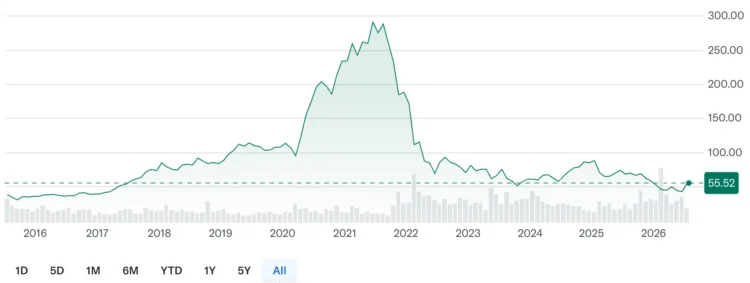
Despite its recent struggles, PayPal’s vast user base, mature payment network, and global brand resonance continue to make it a highly attractive strategic asset. Earlier reports from Bloomberg indicated that numerous banks, financial institutions, and industry rivals had expressed interest in acquiring all or part of PayPal. While acquisition rumors have periodically buoyed PayPal’s stock, capital markets generally maintain a cautious outlook on its independent growth prospects.
Confronted with growth impediments, PayPal has accelerated its internal reform initiatives. Following Enrique Lores’s appointment as CEO in March, the company swiftly implemented a series of adjustments, including reorganizing business units, refreshing the executive team, and sharpening its focus on core offerings like Checkout, Venmo, and crypto payments. Concurrently, PayPal is pursuing cost optimization, workforce reductions, and increased investment in emerging growth vectors such as AI.
However, from the perspective of capital markets, internal reforms typically entail longer realization cycles and higher execution uncertainties. Consequently, a strategic acquisition that facilitates a rapid value re-evaluation is often perceived as a more compelling proposition than patiently awaiting PayPal’s independent transformation.
For Stripe, an ascendant payment giant, PayPal’s true strategic value extends far beyond its traditional payment operations; it lies primarily in its deeply entrenched consumer gateway. Stripe has long excelled in enterprise payments and merchant services but has historically maintained a comparatively smaller footprint in the consumer payment arena. PayPal, in contrast, boasts over 430 million consumer accounts, the popular Venmo social payment network, and a mature digital wallet ecosystem. A successful integration would enable Stripe to bridge its consumer payment gap, forging a comprehensive, end-to-end payment closed-loop encompassing both merchant and user segments.
Crucially, this potential merger could fundamentally redefine both companies’ competitive standing in the rapidly evolving landscape of next-generation payment infrastructure.
In recent years, both Stripe and PayPal have been actively developing stablecoin and broader crypto payment infrastructure. Stripe previously ventured into stablecoin payments through its acquisition of Bridge and recently announced a consortium to promote the new stablecoin OUSD. It is worth noting that some listed partners for OUSD, such as Samsung and Dunamu, later clarified they had not formally committed to the collaboration, sparking market debate.
PayPal, meanwhile, not only offers crypto asset trading services but has also launched its own stablecoin, PYUSD, which has rapidly grown to become the eighth-largest stablecoin globally, with a market capitalization exceeding $2.8 billion.
If Stripe successfully acquires PayPal, it would gain an unparalleled advantage in the stablecoin sector, encompassing issuance capabilities, payment infrastructure, a robust digital wallet ecosystem, and an expansive merchant network. This consolidation would significantly bolster its competitive prowess against established players like Visa and Mastercard, as well as other burgeoning digital payment platforms.
Nevertheless, this proposed transaction remains in its nascent stages, with numerous formidable uncertainties clouding its path to completion.
On one hand, the willingness of PayPal’s board to accept the acquisition remains an open question, and potential disparities in valuation could derail negotiations. On the other hand, a merger of this magnitude faces considerable real-world challenges, including rigorous antitrust scrutiny, the stability of bank financing commitments, and the inherent complexities of integrating two massive and distinct business operations.
Regardless of its ultimate outcome, this potential acquisition underscores a pivotal moment in the evolution of the payment industry. It is a clear signal that global payment competition is entering a dynamic new phase, characterized by strategic consolidation and a relentless pursuit of future growth frontiers.
(The above content is an excerpt and reproduction authorized by our partner PANews. Original link)
Disclaimer: This article is for market information purposes only. All content and views are for reference only and do not constitute investment advice, nor do they represent the views and positions of BlockTempo. Investors should make their own decisions and transactions. The author and BlockTempo shall not be liable for any direct or indirect losses incurred by investors’ transactions.