
Bitcoin ETF’s Rollercoaster: Is History Repeating Gold’s “Boom and Bust” Cycle?
Following the meteoric rise of spot Bitcoin ETFs, investors may need to brace themselves for a potential downturn. Eric Balchunas, a senior ETF analyst at Bloomberg, issues a stark warning: Bitcoin ETFs could be mirroring the historical “boom and bust” trajectory of gold ETFs, where an astonishing surge is often followed by a painful correction and a protracted period of consolidation.
As Balchunas highlighted on social media platform X, “Both are fundamentally ‘non-cash-flow generating’ stores of value. Unlike stocks underpinned by earnings, bonds offering interest, or assets backed by governments, the sole drivers of Bitcoin and gold ETF performance are investor sentiment and demand.”

He further elaborated that both Bitcoin and gold share the characteristic of “limited supply.” This inherent scarcity often catalyzes explosive price surges when market demand intensifies. However, this demand is notoriously fickle; it doesn’t accumulate steadily but rather behaves like a powerful wave, arriving with force and receding just as swiftly.
IBIT’s Fleeting Trillion-Dollar Peak: A Glimpse into Volatility
Balchunas’s cautionary outlook is not without precedent. BlackRock’s IBIT, currently the world’s largest spot Bitcoin ETF, boasts approximately $60 billion in assets under management (AUM). This figure represents a significant contraction from its brief peak of $100 billion, which it touched last October when Bitcoin reached its all-time high.
According to Balchunas, IBIT’s tenure above the $100 billion mark was, in reality, “only a matter of hours.”
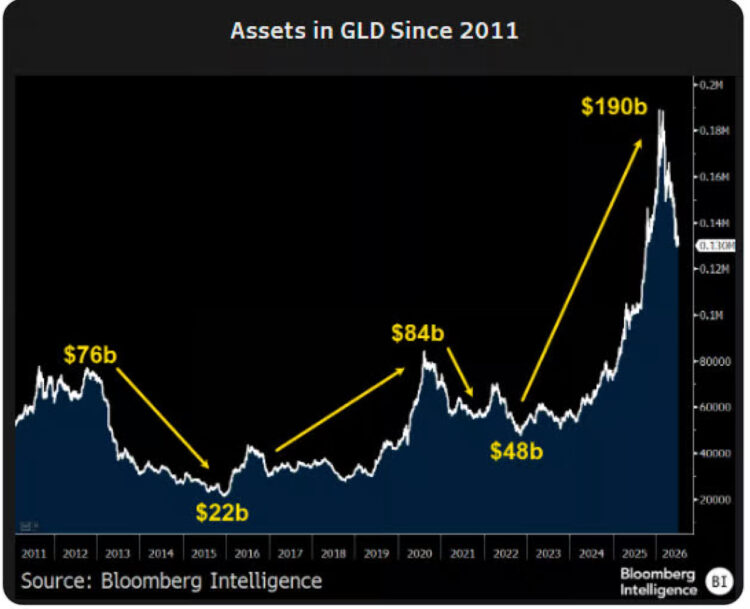
Drawing parallels to over a decade ago, Balchunas likened IBIT’s ephemeral glory to the SPDR Gold ETF (ticker: GLD), launched by State Street in 2011. During its aggressive rally, GLD momentarily eclipsed the S&P 500-tracking SPY to become the world’s largest ETF. He posits that GLD’s trajectory after reaching its zenith then offers a compelling historical parallel for the potential future path of Bitcoin ETFs.
“I believe there’s a staggering historical coincidence between GLD and IBIT,” Balchunas remarked.
He noted that after GLD peaked in 2011, it took nearly eight years to return to comparable levels, during which capital inflows dramatically slowed, and market attention noticeably waned. Crucially, however, he emphasized that after each bull and bear cycle, gold ETFs have consistently achieved higher new highs. This suggests that even after years of consolidation, as long as long-term demand persists, the peak of each subsequent bull market has the potential to continue ascending.
Bitcoin and Gold See Simultaneous Corrections, But Divergent Declines
The recent pullback in Bitcoin’s price has directly impacted IBIT’s asset base. Last Friday, Bitcoin was trading around $63,000, reflecting a year-to-date decline of approximately 30% and a roughly 50% drop from its October all-time high. Gold, on the other hand, also experienced a correction recently, though its decline was more modest. Last Friday, spot gold prices hovered around $4,000 per ounce, down about 7% year-to-date, but still retaining an impressive 19% gain over the past 12 months.
The broader downturn in the cryptocurrency market has also weighed on BlackRock’s digital asset business. Its latest financial report revealed a substantial contraction in digital asset AUM for the second quarter, plummeting from nearly $80 billion to approximately $49 billion, a 40% year-over-year decrease, primarily due to the sharp price drops in Bitcoin and Ethereum.
Weak crypto prices and a conservative market sentiment have undeniably stifled the capital momentum for cryptocurrency ETFs. However, this bearish trend witnessed a potential turning point last week, as both U.S. spot Bitcoin and Ethereum ETFs recorded their first weekly “net inflows” since early May. This development indicates that some investors may be strategically re-entering the market, seeking opportunities at lower valuations.
Disclaimer: This article is provided for market information purposes only. All content and views are for reference only, do not constitute investment advice, and do not represent the views and positions of BlockTempo. Investors should make their own decisions and trades. The author and BlockTempo will not bear any responsibility for direct or indirect losses resulting from investor transactions.