
In the evolving landscape of digital assets, a chilling trend is sweeping through the crypto market: a wave of shutdowns among small and medium-sized centralized exchanges (CEXs). This isn’t merely a consequence of past “black swan” events, but a deeper market correction, signaling a new era of consolidation and strategic recalibration for the industry.

Unlike previous exits driven by hacks, scandals, or abrupt regulatory crackdowns, the current contraction among CEXs is largely a proactive response to fundamental shifts in the industry environment. Exchanges that once thrived on bull market cycles and burgeoning user traffic now face sustained operational pressures, compelling many smaller and mid-tier platforms to voluntarily withdraw from the market.
Veteran Exchanges Retreat: A New Era of CEX Consolidation
Since July, several prominent exchanges, including BitMEX, BitMart, and AscendEx, have announced their cessation of operations.
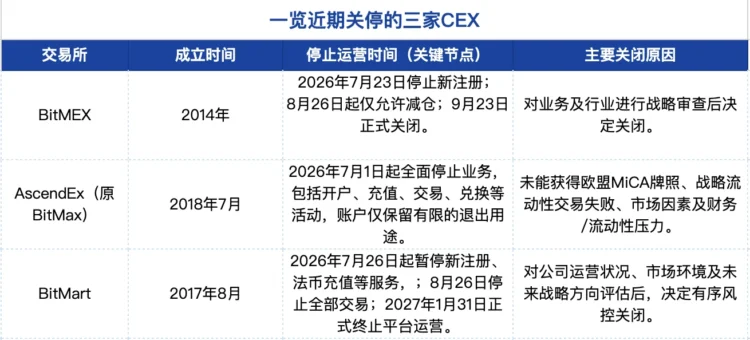
These platforms represent a significant chapter in crypto history. BitMEX, founded in 2014, was a pioneer in perpetual contracts and a dominant force in crypto derivatives for over a decade. AscendEx (formerly BitMax), established in 2017, and BitMart, launched in 2018, both emerged during periods of rapid market expansion. Despite navigating multiple bull and bear cycles, accumulating substantial user bases, and building considerable market influence, these veterans ultimately could not withstand the evolving pressures.
Public statements indicate that a confluence of factors led to these exits: a changing market environment, escalating compliance demands, and rising operational costs. BitMEX and BitMart opted for voluntary contraction after strategic reviews, while AscendEx cited licensing compliance issues, compounded by declining trading activity and liquidity challenges.
Beyond outright shutdowns, the industry is witnessing a surge in mergers and acquisitions (M&A), signaling an accelerating trend of consolidation. Examples include LMAX Group exploring strategic options, South Korea’s Future Asset Group acquiring a majority stake in Korbit, SBI Group’s acquisitions of Coinhako and Bitbank, and WeHub purchasing Flybit.
However, acquiring a CEX is no simple feat. Binance founder CZ recently highlighted the inherent complexities, noting that M&A in this sector involves inheriting historical operations, technical security frameworks, and intricate compliance systems. A post-acquisition hack, for instance, could be difficult to attribute to a legacy backdoor or a new vulnerability, significantly elevating security and compliance risks. CZ emphasized that while CEX acquisitions are still viable, they necessitate far more rigorous due diligence and risk control protocols than other business ventures.
The CEX landscape is undeniably undergoing a profound transformation. For platforms lacking scale, strong branding, and robust compliance capabilities, the road ahead will be increasingly challenging, ensuring that industry reshuffling and resource integration will persist.
Liquidity Centralization and a Persistent Bear Market
The current wave of CEX exits is not a series of isolated incidents but a systemic adjustment as the industry shifts into a mature, competitive phase. The crypto market’s transition to a low-growth environment, characterized by reduced user activity, shrinking trading volumes, heightened competition, and stringent global regulations, is steadily eroding CEX profit margins.
In this new cycle, capital reserves, trading depth, and user fund flows have become critical metrics for assessing an exchange’s resilience and viability. Ample reserves, in particular, are vital for weathering extreme market volatility or concentrated user withdrawals, ensuring asset redemption and operational stability.
DeFiLlama data unequivocally shows a significant concentration of CEX asset reserves among top-tier players. Binance leads the pack with approximately $138.72 billion in reserve assets, commanding an impressive 58.4% of the total surveyed market. This dominance far outstrips its competitors.
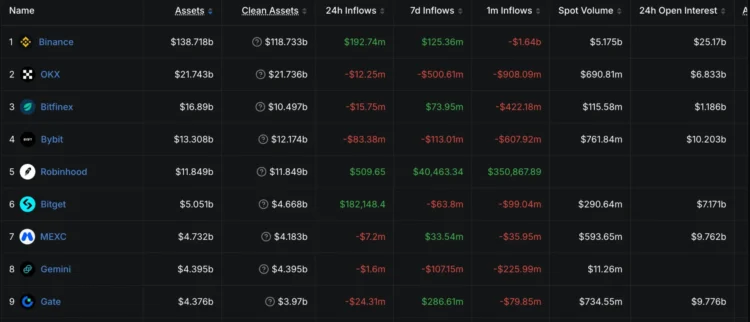
Other major players like OKX, Bitfinex, Bybit, and Robinhood also boast substantial reserves, each in the tens of billions of dollars, underscoring their robust liquidity. While exchanges such as Bitget, MEXC, HTX, Gate, Deribit, and KuCoin hold billions, the disparity with smaller platforms is stark. These smaller entities face considerably greater challenges in liquidity management and risk mitigation during periods of market stress or heavy withdrawals.
Beyond reserves, trading volume serves as a crucial indicator of user engagement and market liquidity. High spot trading volumes signify deeper order books, a more stable trading environment, and greater user participation.
Binance maintains its position as the global leader in spot trading, recording a 24-hour volume of $5.175 billion, representing roughly 34% of the total surveyed platforms. Platforms like Bybit, Gate, KuCoin, MEXC, Upbit, OKX, and Coinbase demonstrate strong activity, with 24-hour spot volumes ranging between $600 million and $1.7 billion. The derivatives market mirrors this concentration, with Binance holding approximately 27.5% of the total open interest at $25.17 billion, followed by Bybit (11.1% with $10.203 billion) and Gate (10.7% with $9.776 billion). Other significant players like MEXC, Bitget, OKX, and Deribit each command 7-10% of the open interest.
This data confirms a clear trend: market liquidity is increasingly consolidating around a handful of dominant exchanges, creating formidable competitive barriers. However, the broader crypto market remains in a low-activity phase, characterized by diminished investor enthusiasm and decelerating capital inflows, posing an overarching growth challenge for all CEXs.
DeFiLlama’s recent data highlights cumulative net outflows of approximately $3.91 billion from the top ten exchanges over the past month. It’s crucial to note that outflows don’t solely indicate user abandonment; they can also reflect asset migration, strategic position adjustments by investors, and capital reallocation driven by market cycles.
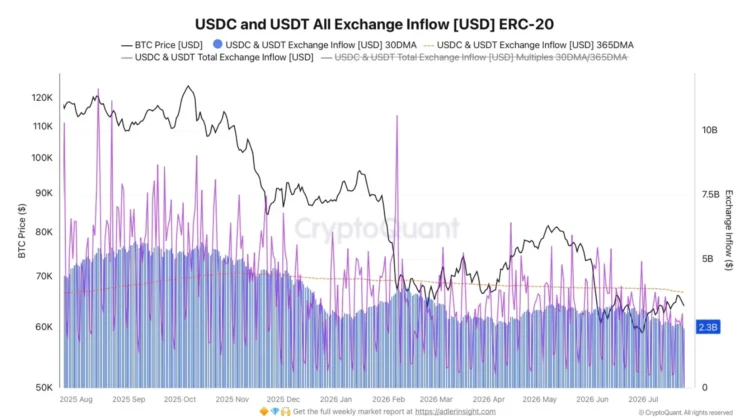
Furthermore, stablecoin inflow data underscores the prevalent market weakness. CryptoQuant analyst Darkfost observed that stablecoin inflows to exchanges have reached their lowest levels in recent years, averaging around $2.3 billion monthly and $3.7 billion annually. This contrasts sharply with Bitcoin’s all-time high periods, which saw monthly inflows of $5.6 billion and annual inflows of $4.3 billion, clearly indicating a decline in investor risk appetite and trading demand.
TradFi: The New Frontier and the Imperative for Differentiation
Historically, small and medium-sized CEXs fueled their growth through listing fees for long-tail tokens, trading commissions, and capitalizing on market trends. However, with the prolonged market downturn and the shift of “Meme coin” frenzies towards on-chain Decentralized Exchanges (DEXs), these traditional growth models are rapidly losing efficacy. Platforms lacking scale, brand recognition, and unique value propositions are now succumbing to sustained operational pressures.
In a significant strategic pivot, Traditional Finance (TradFi) derivatives are emerging as the new battleground for growth among mainstream exchanges, signaling a shift in user capital. TokenInsight’s latest report confirms this trend, revealing that TradFi perpetual contracts became the most substantial growth segment for CEXs in Q2 this year. Monthly trading volumes surged from $52 billion in January to $268 billion in June, primarily driven by equity perpetuals, which soared from $45 billion in May to $141 billion in June.
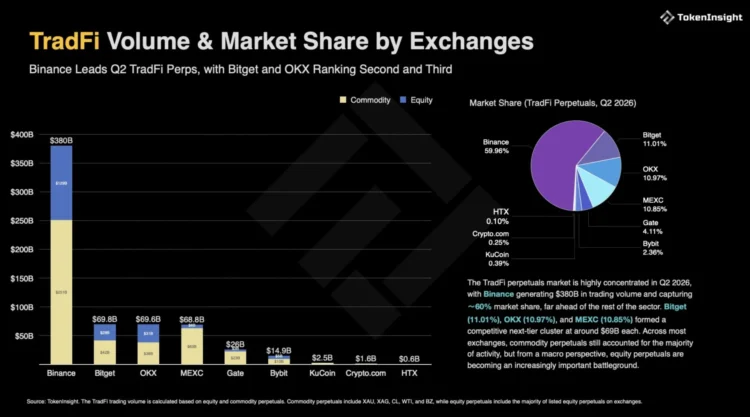
During Q2, TradFi perpetuals significantly increased their share within the derivatives portfolios of major platforms. Binance, Bitget, and MEXC saw TradFi perpetuals account for 8.65%, 8.61%, and 7.22% of their total derivatives trading volumes, respectively. Binance dominated the TradFi perpetual market with $380 billion in Q2 trading volume, capturing an impressive 60% market share, while Bitget, OKX, and MEXC formed the second tier with shares of 11.01%, 10.97%, and 10.85% respectively.
This trend underscores a fundamental shift in user demand, moving beyond purely crypto-native assets towards exposure to traditional financial instruments. CEXs are consequently evolving from mere crypto trading venues into more comprehensive financial gateways.
Crypto researcher Haotian posits that CEXs integrating traditional financial assets like tokenized US stocks, ETFs, and Pre-IPO assets are essentially seeking new avenues for growth. However, this pivot also implies a potential erosion of CEXs’ pricing and settlement power. While perpetuals might offer short-term trading volume and revenue, the long-term consequence of becoming a “channel” rather than a pricing center must be confronted. The more intense the competition in tokenized TradFi assets, the greater the survival pressure on CEXs, with those unable to compete likely facing extinction.
Furthermore, the accelerating trend towards global regulatory compliance is sharpening industry differentiation. Top-tier exchanges, with their robust compliance frameworks, financial might, and established brands, are solidifying their positions in mature financial markets. Conversely, platforms that historically thrived on offshore markets and regulatory arbitrage are seeing their operational space shrink. High-risk regions, such as Iran and Russia, present even greater compliance hurdles, making growth models reliant on sensitive jurisdictions increasingly unsustainable.
Haotian emphasizes that the competition among CEXs in this compliance-driven era is brutal. Licensing, proof of reserves, KYC/AML/KYT, and client asset segregation are no longer optional but essential “entry tickets” for survival. This has drastically reduced the scope for “black swan” failures, effectively dismantling the “zero-sum” logic where one platform’s downfall benefited others. The current wave of shutdowns, therefore, is not a series of catastrophic events but rather a healthy market correction driven by intense competitive pressure.
For small and medium-sized CEXs, future survival hinges not on simply expanding trading volume, but on cultivating differentiated competitive advantages. Haotian suggests two primary paths: either deep specialization in specific regional licenses and localized services, creatively navigating regulatory nuances, or a sharp focus on niche products like TradFi assets, Perps, RWAFi, or even embracing advanced DeFi integrations. Continued homogenization and internal competition will only accelerate elimination. Ultimately, the market clearing out less competitive platforms is a necessary step towards a more resilient and mature industry.
In essence, the CEX industry is transitioning from a phase of rapid scale expansion to one defined by competitive capabilities. Where past growth was fueled by bull markets, trending assets, and user acquisition, future success will be determined by core factors such as capital reserves, liquidity depth, compliance prowess, and the capacity for business innovation.
Should the crypto market enter an extended period of adjustment, small and medium-sized CEXs that fail to carve out a unique niche or explore new growth avenues will likely find their survival space diminishing amidst the ongoing industry reshuffle.
