
EU Unleashes Sweeping Sanctions: 14 Crypto Platforms & 94 Financial Institutions Blacklisted in Russia Crackdown
By Max, CryptoCity
In a significant move to intensify pressure on Russia, the European Union (EU) adopted its 21st package of sanctions on July 23, as reported by Reuters. This comprehensive round of measures primarily targets Russia’s financial, energy, and military-industrial sectors, alongside networks facilitating sanction evasion. Marking one of the EU’s largest single additions in nearly four years, the latest package adds 218 new entries to the sanctions list, comprising 48 individuals and 170 entities.
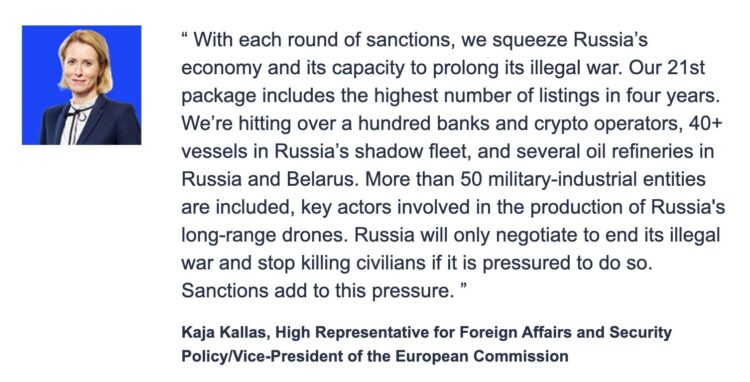
Kaja Kallas, the EU High Representative for Foreign Affairs and Security Policy, confirmed that these sanctions are specifically designed to impact over 100 banks and crypto operators. Concurrently, the EU is also taking aim at Russia’s shadow fleet, refining capabilities, and military-industrial supply chains, demonstrating a multi-faceted approach to disrupting the Russian war economy.
The financial sector forms the bedrock of this new sanctions package. The EU has placed 94 banks and major financial institutions on an asset freeze list, effectively prohibiting EU companies and individuals from providing them with funds or economic resources. Additionally, 33 Russian credit and financial institutions are now subject to a transaction ban, severing their ties with EU markets. Crucially, four non-Russian banks have also been hit with transaction restrictions. One Kyrgyz bank is implicated for its alleged connection to Russia’s SPFS financial information system, while the other three foreign banks stand accused of aiding sanctioned entities in circumventing existing restrictions.
Crypto Crackdown: EU Targets Cross-Border Payment Networks
For the first time, the cryptocurrency industry has been explicitly targeted in this round of EU sanctions, signaling a clear escalation in the bloc’s efforts to curb illicit financial flows. The EU has imposed transaction bans on 14 crypto-asset service platforms, with operators reportedly spanning jurisdictions such as Georgia, Panama, the United Arab Emirates, the Marshall Islands, Kyrgyzstan, and Belarus.
The EU asserts that these platforms have been exploited by Russia-linked funds to bypass established financial restrictions, facilitating crucial cross-border transfers and payments.
Furthermore, this sanctions package introduces expansive new tools, empowering the EU to prohibit transactions with crypto service providers across an entire third country under specific circumstances. Should a nation be found to permit crypto platforms to assist Russia in evading sanctions, the EU can now impose blanket restrictions on all relevant crypto services within that jurisdiction. This marks a significant shift, broadening the scope of sanctions from individual platforms to potentially encompassing entire crypto service networks within specific countries.
In parallel, the EU has designated four entities linked to the A7 cross-border payment network, including those involved in its African operations. This highlights a growing focus on third-country payment channels as critical avenues for sanction evasion.
Striking at Russia’s Lifelines: Shadow Fleet and Energy Revenues Targeted
The energy sector remains a central focus of the 21st sanctions package. The EU has added 41 vessels to Russia’s shadow fleet list, bringing the total number of restricted ships to 673. These vessels are accused of complicity in evading the Russian oil price cap or providing essential refueling, resupply, and other support services. In an unprecedented move, the EU has also blacklisted an agency accused of assisting the shadow fleet in recruiting crew members, alongside imposing restrictions on eight entities and one individual.
Within the oil industry, the EU has added 18 entities and one individual. This list includes three Russian refineries, one major Belarusian refinery, and companies facilitating the sale of Belarusian oil products within Russia. The Kulevi refinery in Georgia will also face a transaction ban after a six-month transition period, accused of involvement in Russian oil trading and processing. Additionally, five oil traders have been hit with transaction restrictions, with the EU alleging their role in undermining restrictions on Russian crude oil and petroleum product purchases.
Tightening the Net: Military-Industrial Supply Chains and Rising Evasion Costs
Regarding military and export controls, the EU has added 56 individuals and entities connected to Russia’s defense industry, with 37 specifically linked to long-range drone production and their supply chains. A further 51 entities are now subject to stricter export controls on dual-use goods and technologies. These entities include companies from China, India, Turkey, Kazakhstan, Kyrgyzstan, and the United Arab Emirates. The restrictions cover a range of critical materials and equipment, including aircraft, drones, missiles, and corrosion-resistant engine coatings.
This latest round of sanctions underscores a strategic pivot by the EU, expanding its focus from internal Russian financial institutions to a broader network of third-country banks, crypto platforms, payment networks, tanker service providers, and military-industrial supply chains.
For the cryptocurrency industry, the blacklisting of 14 platforms and the introduction of tools for country-wide service blockades signal a future of significantly more stringent sanction screening requirements for exchanges, custodians, and payment service providers. Operators who fail to demonstrate compliance regarding fund origins, customer identities, and transaction pathways may find themselves increasingly vulnerable to inclusion on sanction evasion risk lists, highlighting the imperative for robust KYC/AML frameworks.
(The above content is excerpted and reproduced with authorization from our partner “CryptoCity”, original link)
Disclaimer: This article is provided for market information purposes only. All content and views are for reference only, do not constitute investment advice, and do not represent the views and positions of BlockBeats. Investors should make their own decisions and trades. The author and BlockBeats will not bear any responsibility for direct or indirect losses resulting from investor transactions.
