
Bitcoin Under Pressure: Institutional Holdings Face Severe Stress Test Amid Market Downturn
By Ye Zhen
Source: Wallstreetcn.com (via PANews)
Bitcoin is currently navigating an intense period of scrutiny, subjecting its institutional holdings to a severe stress test. As prices breach critical psychological thresholds and approach the cost basis of major institutional players like MicroStrategy, concerns over liquidity for high-leverage holders are rapidly escalating.
Over the weekend, Bitcoin decisively fell below the significant $80,000 mark, hitting its lowest level since April 7, 2025. This latest wave of selling pressure unfolded against a backdrop of conspicuously thin market liquidity, exacerbating Bitcoin’s cumulative decline of over 30% in recent times.
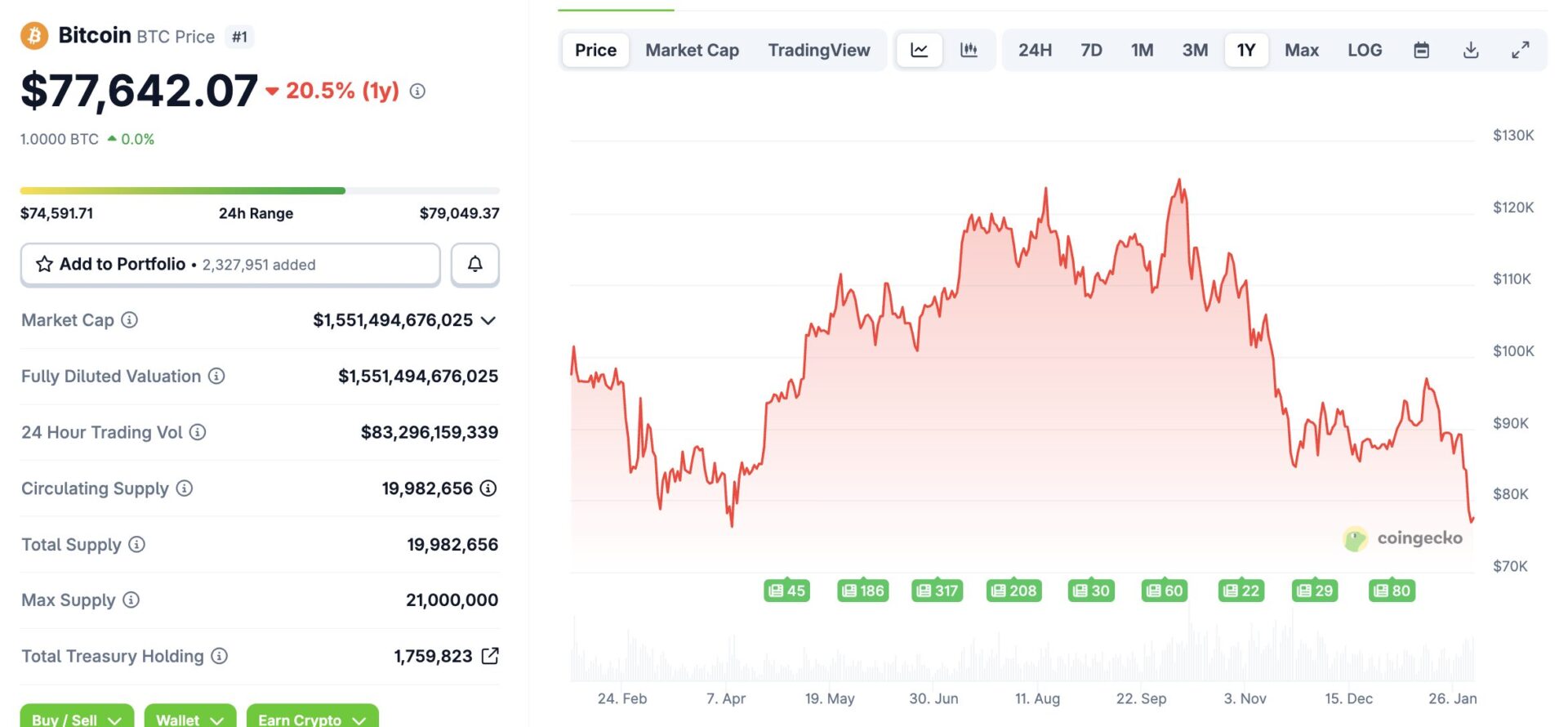
Despite the prevailing bearish sentiment, Michael Saylor, Executive Chairman of MicroStrategy, signaled an unwavering commitment to accumulation. On Sunday, he posted an image with the caption “More Orange” on social media platform X, hinting at continued Bitcoin acquisitions. MicroStrategy has also announced an increase in the dividend yield for its Series A Perpetual Preferred Stock (STRC) by 25 basis points to 11.25%. This move aims to attract capital at a high financing cost to sustain its aggressive Bitcoin buying strategy. However, analysts caution that if Bitcoin’s price stagnates or falls below the company’s cost line, these substantial dividend payouts could trigger a severe cash flow squeeze.

Jim Bianco, Macro Strategist at Bianco Research, suggests that the Bitcoin market is grappling with a crisis of narrative exhaustion. The current market structure is highly institutionalized, with spot ETF investors and MicroStrategy collectively controlling approximately 10% of the circulating supply. Crucially, these major holders are currently sitting on unrealized losses. This indicates that the “institutional adoption” narrative, once a strong market pillar, could now reverse course and become a significant source of selling pressure after these entities bought at elevated prices.
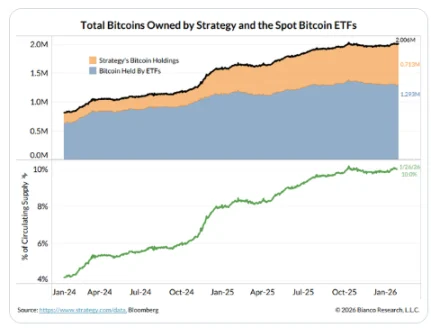
Institutional Holdings Deepen in Red, ETFs Witness Net Outflows
Bianco’s analysis highlights Bitcoin’s increasing “institutional account-ification,” marking the first time the market can clearly observe the cost basis and profit/loss status of large capital. MicroStrategy and the 11 spot Bitcoin ETFs together hold roughly 10% of the total circulating Bitcoin supply. Their combined average acquisition cost stands at approximately $85,360 per coin. At current prices, these institutional holdings are collectively experiencing an unrealized loss of about $8,000 per coin, totaling an estimated $7 billion in unrealized losses.
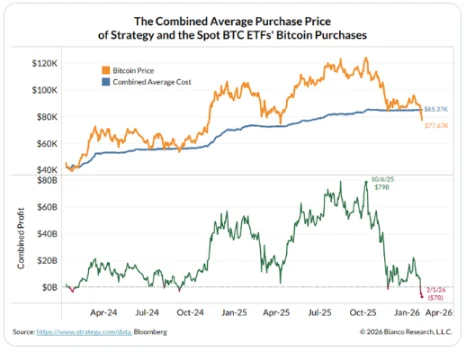
Among these, spot ETFs have emerged as a pivotal force shaping the supply and demand dynamics. Data reveals that the 11 largest spot Bitcoin ETFs collectively hold 1.29 million Bitcoins, representing 6.5% of the total circulating supply, with a market value of approximately $115 billion. However, the average purchase cost for investors in these ETFs is a high $90,200, meaning the current Bitcoin price is now roughly $13,000 below their average entry point.
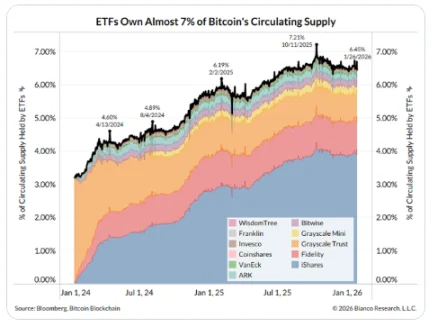
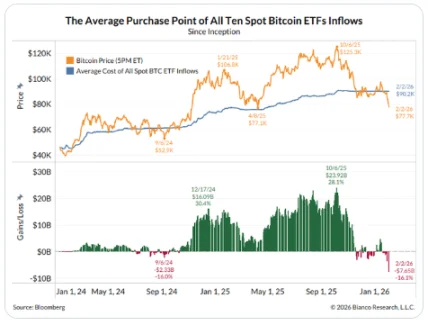
This structure, characterized by buying at elevated levels, has led to a classic pro-cyclical effect. Bianco points out that these ETFs have experienced net outflows for 10 consecutive trading days. Investors are choosing to redeem their holdings after buying at highs, a pattern that is amplifying the market’s downward volatility.
MicroStrategy’s Safety Net Narrows, Aggressive Financing Raises Concerns
As the benchmark for corporate Bitcoin holdings, MicroStrategy’s balance sheet is facing its most rigorous test in months. The company currently holds 712,647 Bitcoins at an average cost of approximately $76,037. With Bitcoin trading prices receding to around the $78,000 mark, the company’s unrealized gains have significantly narrowed to less than 3%.
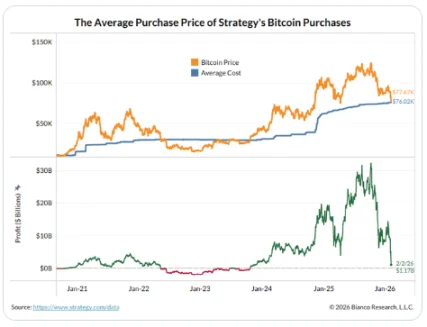
Despite the thinning safety margin, MicroStrategy shows no signs of retreat. To fund its next phase of acquisitions, the company adjusted the yield on its STRC product to 11.25%. This rate offers a substantial premium compared to typical corporate bonds, reflecting MicroStrategy’s intense demand for capital and the inherent volatility risks associated with its Bitcoin-centric business model. Data indicates that sales of the STRC product alone have financed the acquisition of over 27,000 Bitcoins since its debut in November.
Analysts suggest that while MicroStrategy remains in a profitable position, its margin for error has noticeably shrunk. A further decline in price would push the company into an overall unrealized loss. Moreover, maintaining such high-cost dividend payments could strain its cash flow, a risk that would become particularly acute if Bitcoin’s price dips below its critical $76,000 cost “waterline.”
The Old Narrative Fails: Market Awaits New Momentum
From a macro perspective, this recent price collapse has intensified weeks of market disappointment. Jim Bianco posits that Bitcoin’s fundamental challenge lies in the absence of a fresh, compelling narrative. The previously much-anticipated “Boomer Adoption” story, which fueled significant optimism, has been fully priced in and is now, arguably, being disproven.
The current market structure reveals that both spot ETFs and MicroStrategy not only purchased substantial amounts but did so in a concentrated manner, and are now collectively underwater. Bianco asserts that without the emergence of a new, sustainable buying narrative, the trend of capital outflows is likely to persist. In this scenario, highly institutionalized holdings, once viewed as a bullish catalyst, could transform into the market’s primary source of pressure. Bitcoin’s current dilemma isn’t about past buyers, but rather, at current price levels, where the next wave of buyers will originate.
(The above content is an excerpt and reproduction authorized by partner PANews. Original Link | Source: Wallstreetcn.com)
Disclaimer: This article is for market information purposes only. All content and opinions are for reference only, do not constitute investment advice, and do not represent the views and positions of BlockBeats. Investors should make their own decisions and trades. The author and BlockBeats will not bear any responsibility for direct or indirect losses resulting from investor transactions.