
By: Nancy, PANews
Who could have predicted that in just over seven months of 2026, the South Korean stock market would trigger its circuit breaker mechanism an astonishing eight times? This unprecedented frequency marks a rare record of volatility in the nation’s capital market history. Particularly in recent months, the alarm bells of market halts have rung continuously, with successive sharp declines severely eroding investor confidence. This summer is undeniably etching itself into the memories of countless South Korean investors as a period of intense market turmoil.
South Korea’s Market Rollercoaster: From Global Leader to Eight Circuit Breakers
The South Korean stock market has once again faced a circuit breaker.
On July 28, the KOSPI index experienced a dramatic downturn, plummeting over 11% intraday and triggering the market’s circuit breaker. This marked the first time since April 14 that the index dipped below the 6,000-point threshold, representing a cumulative decline of more than 35% from its peak in June.
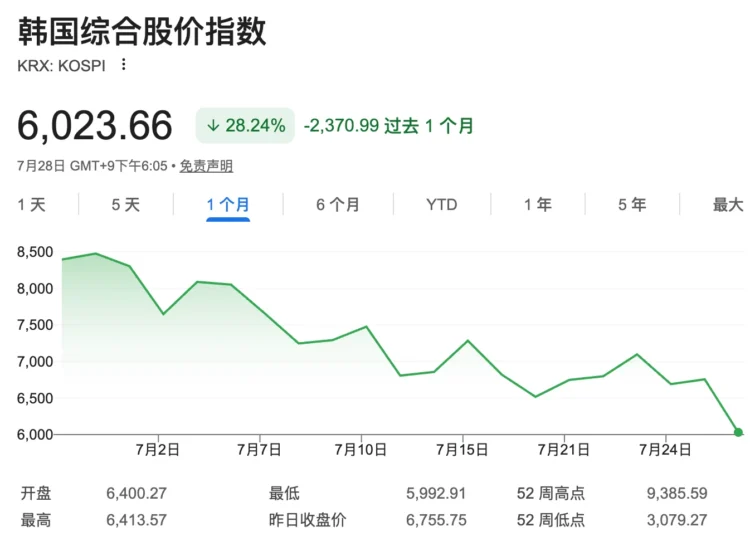
This latest event brings the total number of circuit breaker activations in the South Korean stock market this year to eight.
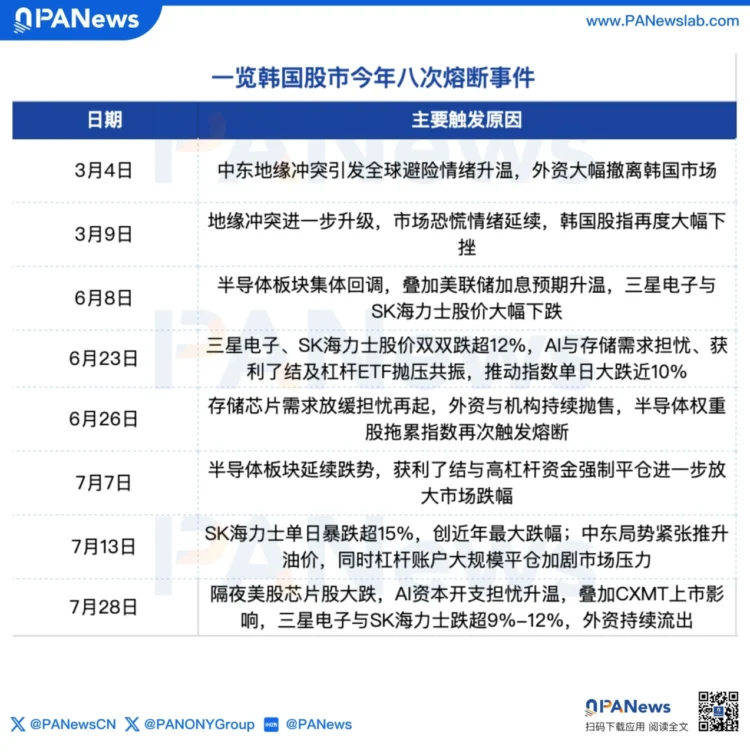
While the two circuit breakers in March were largely attributed to escalating geopolitical tensions in the Middle East and a surge in global risk aversion, the six subsequent halts since June have laid bare the deep-seated structural vulnerabilities within the South Korean equity market. A significant factor in this downturn has been the severe correction in the semiconductor sector, which has been instrumental in shattering investor confidence.
The initial surge in the South Korean stock market was predominantly fueled by the global AI boom. However, the market is now grappling with the adverse effects of a cooling AI narrative. The substantial declines experienced by tech giants Samsung Electronics and SK Hynix have been particularly detrimental, acting as primary drags on overall market performance.
These two semiconductor behemoths collectively commanded over 60% of the KOSPI index, contributing the lion’s share of the market’s earlier gains and propelling South Korea into the ranks of the world’s top-performing markets. Yet, this very reliance on the semiconductor sector has amplified the market’s inherent fragility.
As investors re-evaluate the sustainability of AI capital expenditures, the long-term growth prospects for high-end memory chips, and evolving supply-demand dynamics, Samsung Electronics and SK Hynix have found themselves directly in the crosshairs. Over the past month, Samsung Electronics has seen its stock price fall by approximately 31.2%, while SK Hynix has dropped over 14.8%. Notably, SK Hynix’s American Depositary Receipts (ADRs) even traded below their issue price less than a month after their listing.
In essence, the South Korean stock market is experiencing a profound “semiconductor-driven boom and bust cycle.”
Flash Crash on Hyperliquid: How an $867 Order Triggered an On-Chain Liquidation Storm
Amidst the intense volatility in SK Hynix’s spot market, a peculiar “flash crash” unfolded in the on-chain perpetual contract market.
According to monitoring by HyperInsight, at 7 AM Beijing time today, the price of the SKHX perpetual contract on the Hyperliquid platform abruptly plunged from $1128.2 to $927, a swift 17.9% decline that triggered the liquidation of numerous high-leverage long positions.
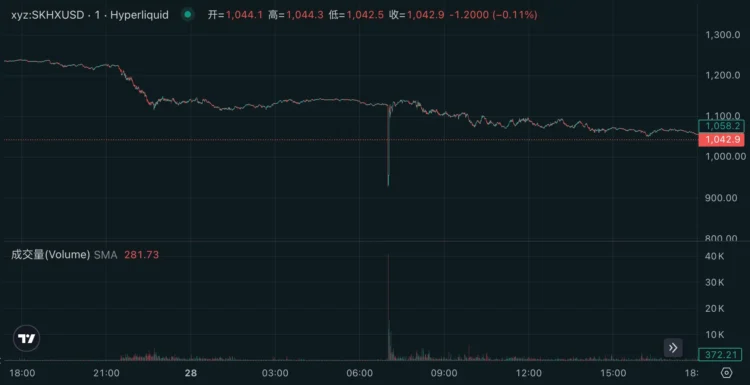
Data indicates that the contract’s notional open interest plummeted from approximately $508 million to $388 million. Within a mere four hours, long liquidations neared $80 million, even surpassing the volume seen on the Binance market during the same period.
The immediate catalyst for this flash crash was an unusual pre-market order on the Korean NXT exchange, valued at a mere $867. Due to the inherent low liquidity in pre-market trading, this seemingly insignificant order, while fully compliant with trading rules, unexpectedly became a crucial source of external price data. It was subsequently adopted by the Trade.XYZ oracle system.
Consequently, the marked price of SK Hynix perpetual contracts on Hyperliquid adjusted in tandem. In the highly leveraged derivatives market, even a momentary discrepancy in the marked price can instigate widespread liquidations. As forced closures of long positions mounted, selling pressure intensified, culminating in a cascading chain reaction.
In contrast, the Binance market experienced a relatively limited impact. Prior to the opening of the main Korean market, Binance primarily relied on its internal pricing mechanisms and did not immediately switch to external quotes, thereby averting a similar cascade of liquidations. However, due to arbitrage opportunities between markets, the price of SK Hynix perpetual contracts was still affected, exhibiting a synchronized decline.
This incident was not a case of market manipulation but rather a “butterfly effect” stemming from a confluence of factors: insufficient liquidity, reliance on external price input mechanisms, and the presence of high leverage.
In a mature spot market, a trade valued under a thousand dollars typically has negligible impact. However, in on-chain derivatives markets, which depend heavily on external price feeds, small transactions can significantly influence marked prices via oracle mechanisms, subsequently impacting large leveraged positions.
In response, Hyperliquid stated that the SKHYNIX perpetual contract was deployed and is operated by the Trade.xyz team. The team is currently investigating the incident and will provide updates upon completion of their analysis.
Regarding the HIP-3 market mechanism, Hyperliquid clarified that the deployer is responsible for pushing the marked price, oracle data, and external price inputs for their specific market. This system allows for a marked price methodology similar to validator-operated perpetual contracts, where the protocol contributes one of three median components, and the remaining two components are supplied by the deployer, influencing the final marked price. For instance, if the on-chain median (derived from last traded price, best bid, best ask) is 100, and the deployer pushes 150 and 151, the final marked price will be 150.
This chain liquidation, triggered by a seemingly minor transaction, serves as a stark reminder. As the on-chain derivatives market continues its expansion, the stability of price sources, the robustness of oracle designs, and the efficacy of liquidation protection mechanisms during extreme market conditions are becoming critical challenges that the on-chain ecosystem must address.
South Korea’s Confidence Crisis: Regulators Step In to Stabilize the Market
South Korea’s “Black July” continues its grip, severely impacting market confidence and prompting an accelerated intervention from regulatory bodies.
A significant amplifier of this market volatility has been the widespread practice of leveraged trading among South Korean retail investors. According to official data, as of July 13, cumulative forced liquidations for the month reached 344.2 billion Korean Won. Over 1.2 million leveraged retail accounts received margin calls, with approximately 320,000 to 360,000 of these accounts forcibly liquidated by brokerages. Disturbingly, some investors have even ended up owing money to their brokers.
In light of these losses, Kim Eun-hye, a legislator from South Korea’s People Power Party, is reportedly discussing the possibility of filing a national compensation lawsuit against the government on behalf of affected investors. Fellow party member Na Kyung-won has also publicly advocated for a comprehensive investigation into national losses and active consideration of state compensation. She has proposed parliamentary and special investigations to clarify the “hasty introduction” process by the Blue House and financial authorities.
Concurrently, in response to escalating risks, the South Korean Financial Services Commission (FSC) has begun to tighten regulations on single-stock leveraged products. Under new rules effective July 31, 2026, the basic margin threshold for general individual investors in these products will be raised from 10 million Korean Won to 30 million Korean Won. Furthermore, margin calculation rules will be refined to mitigate the market impact of retail investors using leverage to chase gains and cut losses. Regulators have also indicated the potential for further increases in investment thresholds and the imposition of individual investment limits in the future.
Beyond leveraged ETFs, the “Fear Of Missing Out” (FOMO) sentiment driving South Korean retail investors to borrow money for stock speculation is also exacerbating market risks. Fueled by rising markets, a significant number of investors pursued equity returns through loans, causing the Bank of Korea’s loan limits to flash red mid-year. Worryingly, some investors with poorer credit histories have turned to illicit private lending, with the number of individuals involved growing from 59,000 last year to 119,000.
To curb financial risks, the Bank of Korea recently tightened its credit loan policies. South Korea’s financial supervisory authorities are also contemplating restrictions on using borrowed funds for high-risk financial products, such as capping the portion of borrowed investment funds allowed for single-stock leveraged products at 20%.
As the South Korean stock market navigates this volatile “roller coaster,” foreign capital is accelerating its exodus. A recent strategy report by JPMorgan Chase highlighted that net foreign capital outflow from the South Korean stock market this year has already surpassed $110 billion, marking the largest outflow record for a single Asian market in history. Approximately 90% of this outflow is concentrated in Samsung Electronics and SK Hynix.
The decline in market confidence is also prompting South Korean investors to redirect their capital towards overseas markets. According to the Seoul Economic Daily, net purchases of U.S. stocks exceeded 5 trillion Korean Won this month. Data from Seibro, the Korea Securities Depository’s information portal, shows that from July 1st to 27th, domestic South Korean investors made net purchases of nearly $3.59 billion in U.S. stocks, approximately 5.5 times the net purchases for the entire month of June, with funds primarily flowing into the semiconductor and technology sectors.
From being a global star market enjoying the dividends of the AI cycle, the South Korean stock market is now undergoing a brutal yet necessary repricing, marked by consecutive circuit breakers, widespread leverage clearance, and a significant foreign capital withdrawal.
(The above content is an authorized excerpt and reproduction from our partner PANews. Original Article Link)
Disclaimer: This article is provided for market information purposes only. All content and views are for reference and do not constitute investment advice, nor do they represent the opinions or positions of Blockcast. Investors are solely responsible for their own decisions and transactions. The author and Blockcast disclaim all responsibility for any direct or indirect losses incurred by investors as a result of their transactions.
